


 Francais
 Deutsch
 Italiano
Refine Your Search
+"Puerto Rico" +1966 stock footage and images
- Showing 7 to 11 of 11 results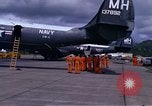
Silver iodide cartridges loaded in bomb racks of planes during operation Storm fury at Roosevelt Roads in Puerto Rico
Project Storm fury at Roosevelt Roads Naval air station in Ceiba, Puerto Rico. Crew members stand near the tail section of EC-121 plane at Roosevelt Roads Naval air station with another EC-121 plane in the background. A ladder leads up to the hatch of EC-121 aircraft. Chief Petty Officer and a civilian engineer opens silver iodide cases next to a RA-3B plane on the line with overcast sky in the background. Cartridges placed in small bomb racks. Men hand over the cartridges to someone in the bomb bay. CPO places a wooden box of silver iodide canisters. He opens the lid and removes canisters. Iodide racks placed in bomb bay. Men use speed wrench to secure the racks on bomb bay. Men off load silver iodide cases from a yellow pick up truck.
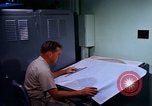
Chief Petty Officer plots the course of hurricane Faith on a weather map
Project Storm fury at Roosevelt Roads Naval air station in Ceiba, Puerto Rico. Chief Petty Officer set as a desk with a weather map spread out in front of him. Photographers mate come and hand over a message to the Chief. Chief looks at the plotting sheet and make markings on the weather map to plot the course of hurricane Faith.
Men on board VW-4 hurricane hunter plane while in flight during Project Storm fury
Project Storm fury, Ceiba in Puerto Rico. The skipper of VW-4 hurricane hunter plane, Commander R.V. Himewick, discusses the flight storm area. Commander in flight gear in a ready room. Two officers of the crew relax during the flight a one of them sleeps while the other one goes through a booklet. Mr. Auston , navigator as he plots a course for aircraft during the flight. The flight engineer, Chief Weekly seated before the control panel during the flight. Dials, buttons switch control of the Pilot and co-pilot at controls in the cockpit of the aircraft.
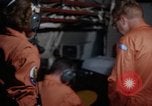
Crew on board VW-4 hurricane hunter plane look at a radar scope during Project Storm fury
Project Storm fury, Ceiba in Puerto Rico. Dr. Simpson, a woman, Dr. Gentry and AX3 Wrant wearing phones at radar scope on board VW-4 hurricane hunter aircraft while in flight during Project Storm fury. They watch the radar scope. Commander Himewick, skipper of VW-4 at controls of the aircraft in flight, instrument panel. EC-121 aircraft and its instrument panel. Dr. Simpson relaxes and drinks milk from a carton with a straw. Cloud formation in sky with water below them. Shadow of clouds on water.
The Smithsonian Astrophysical Observatory facilities and activities in the United States
In the context of Unidentifed Flying Object (UFO) research: Narrator describes the sixteen cameras of the Smithsonian Astrophysical Observatory (SAO) as camera shows one, of atop a multistory building. A map shows several locations in the state of Nebraska. Next, in a closeup, Dr. Richard E. McCrosky, Director of SAO, shows a model of a small building housing aerial mapping cameras. He removes the roof of the model to show how the cameras are installed and turned on by light sensors. He shows a film of a bright object photographed by such a camera installation. Asked about other inputs, Dr. McCrosky mentions the satellite tracking network, and a map shows the 12 stations about the world. McClosky shows a model of a tracking camera contained in those installations. He shows a photograph of the Gemini rendezvous, when the NASA Gemini spacecraft numbers 6 and 7 came close to each other on December 15, 1965. Scene shifts to views of large radar installations and observatories, including equipment inside one. Animated view of Mariner space probe passing the planet Venus. Giant radar antennas rotating. Views of the milky way galaxy and our solar system. Photos of nebulae from the Mount Palomar Telescope. Radio telescope installations, including the one in Arecibo, Puerto Rico.