


 Francais
 Deutsch
 Italiano
Refine Your Search
+"Roetgen Germany" +1944 stock footage and images
- Showing 1 to 3 of 3 results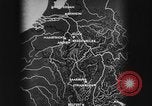
German forces defend as U.S. Army forces probe parts of the Siegfried Line (West Wall) of Germany in World War II
Film opens with a map showing the Ardennes forest with cities Aachen, Maastricht, Eschweiler in the north and Saarburg and Strassburg to the south. (Elements of the American VII Corps have penetrated the Siegfried line (West Wall) in the vicinity of Roetgen, Germany, in September, 1944, when this film depicts German defense responses, from their perspective. Numerous German rockets are seen speeding through the black night sky. In daylight, German gunners fire large artillery pieces as well as more rockets (Nebelwerfer) which also can be heard as the streak past. German gunners firing a 15 cm schwere Feldhaubitze 18 or sFH 18 heavy howitzer. Shells exploding in the distance. Closeup of German soldiers observing the shells exploding. American soldiers being taken as prisoners of war, march past dragons teeth of the Siegfried line. German Panzer tanks rolling along a road as Allied prisoners march the opposite way, under guard, with their hands over their heads. German troops slogging along a muddy road. Some carry panzerfaust anti-tank weapons. One carries an MG-42 machine gun. Bodies of dead U.S. Army soldiers on the ground. Wide field with a distant Panzer V "Panther" tank advancing across the field. German tanks maneuvering and firing their guns. German soldiers in a village engaged in house-to-house combat with American soldiers.
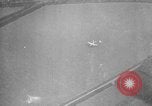
Allied Army paratroopers land at Arnhem Netherlands and advance inwards fighting with enemy during World War II.
United States Army and British Army airlifts paratroopers from England to the border of Holland during World War II. British and American transport airplanes and gliders land near Arnhem Holland (Netherlands). Soldiers, tanks and guns supplies offloaded and soldiers begin fighting with the enemy. Soldiers of Dutch Army aid the Allied forces. Allied soldiers rescue injured soldiers and advance towards enemy lines. Allied soldiers meet with Dutch Resistance or Dutch Underground Army members wearing identifying armbands. Group of German Army prisoners is seen including many young boy soldiers. Allied landing draws attention of German units allowing U.S. Army units to cross border into Germany. American soldiers near a bridge and crossing into Germany. They pass near railroad station at Roetgen Germany. Nazi German prisoners use horse carts and bicycle transport while being led away under Allied guard.
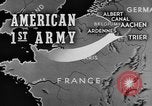
The United States First Army enters Roetgen and supplies are dropped to and retrieved by the Belgian White Army (WW2)
The United States First Army enters Roetgen, Aachen and other German border towns without opposition during World War II. Map showing the capture of the Ardennes, Albert Canal, Aachen, and Trier by the First Army. View of Luxembourg’s Ardennes. A dugout in Wallendorf, in the state of Rhineland-Palatinate. A captured pillbox displays sign in German reads “Der führer besichtigte diese anlage am 15. mai. 1939” (“The Führer visited this facility on May 15, 1939” in English). The town of Wallendorf with heavily damaged buildings from recent Allied shelling. Civilians saving their belongings outside the bombed “Gastwirtschaft von Franz Wenzel” in Wallendorf. Troops on moving M4 Sherman tanks and Jeeps. Soldiers climb the hill and enter Germany. The troops maneuver over fields. Troops occupy the Roetgen, located approximately 16 km (10 mi) south-east of Aachen. 'Roetgen' written on building. White flag on building of 'The Deutsche Reichsbahn'. View of village and huts. Belgian White Army lights fire for supplies by airborne. They gather hay to make bonfires. A White Army soldier with bayonet scans the sky. Another soldier holds a rifle. Soldier watches through binoculars towards plane. A passing bomber drops supplies for the Belgian White Army. Parachutes landing on earth. Supplies and arms are dropped to and retrieved by Belgians. Parachute are rolled and returned to England. Men load supplies into a truck. Horse cart moves away.