


 Francais
 Deutsch
 Italiano
Refine Your Search
+"Romania" +1944 stock footage and images
- Showing 1 to 6 of 28 results more
more Hide
Hide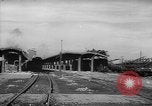
Destruction in Ploesti, and Brasov, Romania, from U.S. Army Air Forces bombing during World War II
Destroyed rail yards in Ploesti (Ploiesti) Romania, from attack by U.S. 15th Air Force bombers, during World War 2. Destroyed rail cars and damaged switch yard. Fires burning in distant background. Passenger trains with slight damage to their cars. One is labeled in Hungarian: "NEMZETKOZI JALOKOCSI ES EUROPAI"(International sleeping cars and Europe).Twisted rails and ties beneath a bridge and all along the rail lines in and out of the marshaling yards. Destroyed stations and steel frameworks of trains. Repair crew pulling a rail car along some useable track. A church in the background (possibly St Pantelimon Church). Bombed-out industrial buildings and railroad sidings. Locomotives steaming as trains sit on some remaining useable track. Work crews looking over the wreckage. Lumber strewn all over an area. At timecode 2:11, Scene shifts to Brasov, Romania, in May, 1944, with a truck driving toward the camera on a street parallel to the Railroad Station Square. The camera pans left, past destroyed buildings to the Station Square where a bus and some passengers are seen. Camera pans right showing more destroyed buildings, and then a locomotive steaming at head of a train on some undamaged rails. Views of bombed out freight cars. At timecode 2:54, Men are seen sitting and standing on useable rails as they look at some destroyed rail cars. The station is seen in distance at the right. View is along the railroad leading in the direction of Bucharest. Remaining views show the damage to building at Station Square, and the bus parked there.

United States Army Air Corps film "The Truth About Ploesti."
Formations of B-24 Liberator bombers are seen in flight, headed for Ploesti, Romania, on August 1, 1943, during World War 2. Next, vertical columns of bombs are seen falling from the planes. Animated map of Europe shows Romania and Ploesti. It show paths of oil from the Ploesti oil fields to Germany. (Narrator states Ploesti provides 30% of Axis oil.) Map show path of 9th Air Force bombers from Libya to the Ploesti oil fields. Scenes shift to captured German films from 1944, showing the fires and destruction resulting from the constant B-24 raids. Huge black clouds rise from the area. Firefighters rush to combat flames. They direct streams of water on the conflagrations. (Commenter states: "Delayed action bombs prevented firefighters from rushing in, until too late.") Nighttime views of large fires and heavy smoke from 6 of Ploesti's 7 refineries ripped wide open. Film advances to August, 1944, showing Ploesti with the fires out, following Rumania's capitulation. Next, with some fires still burning, King Michael I of Romania, tours the site with military officers. They walk amidst the debris. Smoke rising near a rail marshaling yard. Against a background of dense smoke rising, a Slate is displayed showing the cost to the United States of the Ploesti raids, as 300 bombers and 3000 American airmen were lost.
Soviet troops advance and enter Romania on the Eastern Front during World War II.
Allied campaign against the Axis in 1944 during World War II. The Soviet Army advances towards Romania after running over Ukraine. The tanks advance. German soldiers captured by the Soviet Army.
Various cities in Europe being liberated from Nazi occupation (WW2)
Allied campaign against the Axis powers in 1944 during World War II. People gathered outside the Colosseum (Piazza del Colosseo, 1, 00184 Roma RM, Italy) in Rome, Italy celebrate their liberation from occupation by Nazi Germany. Allied soldiers in trucks move past the cheering crowds. Pope Pius XII addresses the people from a balcony. Victory parade in Paris, France at the Arc de Triomphe (Pl. Charles de Gaulle, 75008 Paris, France) on August 26, 1944. French children clapping. People cheer as they carry banners. In Bucharest, Romania soldiers loaded onto trucks drive past crowds cheering after their liberation. On 3rd of September 1944 people cheer on the streets of Brussels, Belgium as Allied troops enter. A woman sits on top of a moving Jeep. In Belgrade, Yugoslavia on October 20, 1944 people celebrate their liberation. In Athens, Greece women carry a Greek flag and a flag being hoisted after their liberation.
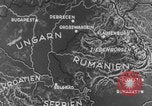
German aircraft attack Soviet tanks on Eastern front, and German forces invade Hungary in World War II
Film begins with a map of the South Eastern part of Europe, including countries of Hungary,Croatia,Serbia, and Romania. Then a German Air Force officer is seen dispatching aircraft to attack Soviet tanks on the Eastern front. Next are views from a cockpit of German Junkers Ju 87 (Stuka dive bombers) in flight. Closeup of a Stuka airplane inflight. It is equipped with a machine guns under its wings. More views from a cockpit of smoke rising from the ground, and then of Ju 87s strafing Soviet tanks. Narrator states that more than 300 Soviet tanks were destroyed. Scene changes to German soldier in a defensive position in Hungary, during the German invasion of that country in March, 1944 (Operation Margarethe). View of explosions in the distance. Brief closeup of a German soldier. German infantry leaving their defensive positions and advancing along a hill crest where they are silhouetted against the light sky. Artillery firing from hidden position near trees. Several scenes of burning buildings. German gun crew holding their ears as they fire a heavy artillery piece. A burning tank.
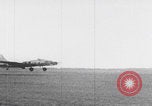
Prisoners of war arrive in Italy after evacuation from Romania (Operation Gunn, WWII)
15th Air Force Operation Reunion (Operation Gunn) to rescue Allied prisoners of war in Romania during World War II. B-17 takes off from Romania. An injured prisoner of war (with head covered in bandages) takes a seat inside plane. A POW smiles while holding a newspaper. Another POW waving goodbye from a window. Groups of bombers in flight. A Boeing B-17 Flying Fortress bomber lands in San Giovanni Airfield. Allied prisoners of war disembark from the bomber after landing. United States troops greet their comrades after their evacuation from Romania. A happy reunion for prisoners of war and their comrades in Italy. Former prisoners of war smiling outside the bombers. Chief of Staff Colonel Taylor speaks to the former prisoners of war after their arrival in Italy. Officer gathered, including Colonel Taylor, General Nathan F. Twining, General Bourne.