


 Francais
 Deutsch
 Italiano
Refine Your Search
+"Russia" +1914 stock footage and images
- Showing 7 to 12 of 21 results more
more Hide
Hide
European Heads of State review their respective forces mobilizing for World War I. Glimpses of trench warfare.
German Kaiser Wilhelm II walks among German troops assembled for inspection in Berlin, Germany at outbreak of World War 1. The Kaiser and senior commanders review the troops on parade. The last contingent in the parade comprises civilian officials in top hats. French Prime Minister, Alexandre Ribot, is saluted by a military honor guard as he exits a building. He doffs his hat and turns in deference, as Raymond Poincaré, President of France exits behind him. They both enter a waiting car, followed by the French Minister of War, Jean Brun., who joins them. As they are being made comfortable in the car, French General Ferdinand Foch, exits the building (wearing a great coat) and is escorted by another General. In Russia, Emperor, Tsar nicholas ll, leads military commanders as they review a contingent of Russian guards in formation on the platform of a train station in Moscow. Camera pans across crowds filling the Palace Square, St. Petersburg, upon the declaration of war on 20, July, 1914. Base of the Alexander Column visible in center of crowd. Russian troops file into well established trenches. Huge explosions raise tons of earth amongst the trenches. Troops flee for safety. Many take cover in large shell craters. Several fall to machine gun fire, near barbed wire. A book is opened to a page entitled: "Military Program Proletarian Revolution" (in Russian). German troops are seen from above and behind sheltered in a trench with a desolate battlefield in front of them. Closeup of the troops. Next, Russian troops who died are seen in a water-filled trench. One is holding an M1891/Mosin–Nagant firle. Closeup of another soldier, covered in mud leaning against sandbags. Bodies of two soldiers at a pond of water in their trench. One is immersed, with face up, in the pond and the other is reaching down into it. What appear to be the bodies of soldiers entangled in barbed wire at edge of trench..
European immigrants go through health examination at Ellis Island circa 1900.
Describes European immigration to America from 1880 to 1914. Elderly European immigrants recall their experiences to interviewers in 1975. Still photo montage scenes circa 1900: Immigration officer with a woman. Large number of immigrants wait for immigration check at Ellis Island. Children lined up. Immigrants at port and going through health examinations. During physical examination, immigrants with disease of Trachoma marked and segregated. In 1975 an old lady describes her experience of being misdiagnosed with Trachoma and almost sent back to Russia. She was reexamined and allowed to remain in America.
Maps of different countries show their relative oil production as compared to that of the United States.
Relative oil production of the United States and other countries for the year 1914 is depicted. A political map of the United States shows some states with dots and some with crosses and some states with dots and crosses both. A box on the top left corner of the map shows the state of Alaska. A map of the continent of South America with oil production of some of its countries. A box on the top right side of the map shows oil production in Trinidad. A map of Russia shows its neighboring countries such as Germany, Galicia, Roumania and others. Relative oil production in these countries is depicted using crosses and dots. Boxes on the top right corner of the map show relative oil production in Japan and Formosa. Another map shows India, Tibet and neighboring countries. Relative oil production in these countries is depicted. A box in the lower middle of the map shows relative oil production in Dutch East Indies.
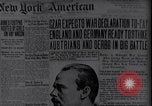
Headlines of prominent newspapers show rising tensions in Europe, assassination of Archduke and Russia's entry in World War I
Headlines of prominent newspapers show rising tensions prior to World War 1. Headline of New York American 'Czar expects war declaration today, England and Germany ready to strike, Austrians and Serbs in big battle'. Montage of headlines from various newspapers regarding looming war. Berliner Tageblatt New York Times headlines say 'Austria and Serbia ready for war, Russia gives warning to Germany, London still sees hope for peace'. New York Times and Freier Press headlines about the assassination of Archduke Ferdinand of Austria. Serbian police dragging the assassin. Blood stained tunic of Archduke. Burial ceremony of Archduke Ferdinand with coffin covered with Austrian flag. Czar Nicholas II of Russia reviews troops. Various Cossack regiments being reviewed. Russian Revolution scenes and mass demonstrations and riot in streets of Moscow as Bolsheviks seize power in 1917. Russian civilians and Bolshevik loyal soldiers armed with rifles marching in mass funeral processions and demonstrations in Russia against the Czar led government. Leon Trotsky speaking to a crowd and saluting Red forces as Bolshevik troops parade. Food distribution to Russian children and people eating on snow covered streets of Moscow around time of revolution. Headlines showing Russian entry in World War I. Snow covered Kremlin. Vladimir Lenin at a desk talking. More views of newspaper headlines regarding outbreak of World War 1.
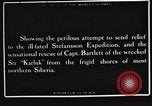
Captain Bartlett comes aboard Whaler "Herman" after escaping from the Karluk in Siberia, Russia during an expedition.
Whaler "Herman" in Siberia, Russia during arctic cruise. Natives on sleds as they bring in news of Captain Robert Bartlett to a ship in Emma Harbor in Siberia. The Eskimo natives travel across a snow covered field on sleds pulled by dogs. Captain Robert Bartlett comes aboard SS Herman (with news of the fate of the ship Karluk and its survivors marooned on Wrangel Island). Captain Christian Pedersen welcomes Bartlett aboard. Ice being cleared for the ship to get underway at sea. Ice floats on the surface of the sea. Captain Bartlett and Captain Pedersen aboard SS Herman, a trading and whaling vessel.
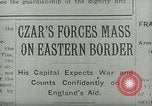
Russia, Germany and Romania mobilize for World War I.
Tsar Nicholas II of Russia mobilizes ten million men on the Eastern border during the early stages of World War 1. The Tsar inspects Russian troops and consults with his uncle the Grand Duke Nicholas. Russian troops and the military band march. German Kaiser Wilhelm II, and the king of Wurttenberg step from a car in Germany. Officers and civilians gathered around. The Kaiser reviews soldiers in Germany. The Crown Prince Wilhelm of Germany readies to command an army. Field Marshall August Von Mackensen, readies to fight the Romanian Army.