


 Francais
 Deutsch
 Italiano
Refine Your Search
+"Russia" +1917 stock footage and images
- Showing 25 to 30 of 79 results more
more Hide
Hide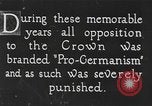
Russians mistreated by government prior to abdication of Tsar Nicholas II. Latvian soldiers executed by German firing squad
Shows government suppression of Bolsheviks around time of Russian Revolution, and before the 1917 abdication of Tsar Nicholas II, in Russia, and by German forces in post-war Latvia, in 1919. Imperial Russian troops intrude on a gathering of persons ostensibly opposed to Tsarist policies. Slate states such persons are accused of "Pro-Germanism." View of a damaged prison building and high guard tower. View of women and children in a large common cell of the prison. View of prison wall from outside, with barred windows evident. Women walking about inside the prison, as an Imperial Russian guard walks past the cell. View through a barred window. The final short sequence was filmed near Riga, on May 26, 1919, by American Army cameraman, Lieutenant Johnson, who was in Latvia as part of a U.S. post-war relief effort. It shows three Latvian Bolshevik soldiers facing a German firing squad. Boots of the condemned (which were valuable) have been removed. The firing squad executes the Latvian soldiers. Next, the bodies of the victims are seen in a ditch where they had fallen. (Note: This entire film includes a mix of staged theatrical and documentary scenes from various sources, times, and places.)
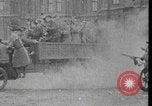
Bolshevik Red Guards lead takeover of Government buildings in Petrograd during Russian revolution, in World War I
Scenes of October revolution in Petrograd, Russia, during World War 1. Bolshevik Red Guards forces, waving red flags, charge across a square in military vehicles, followed by numerous others running to take over government buildings. on 24 October 1917.
Nations in various stages of mobilization before and during World War I
Nations mobilizing for World War 1 (The Great War).from 1914 through 1917-18. Civilians in a Slavic country react to information fastened on a large circular post. Closeup of British Mark II tanks moving near the camera, followed by view of British Whippet tank in front of army trucks. Uniformed, armed, German troops assembling in a town square. German General Paul von Hindenburg leading members of his staff and a diplomat, on inspection of troops. A Russian officer on horseback with troops assembled in a city park. Unusual grouping of Military officers from Germany (wearing Picklehaube helmets); France; and Russia (including a Cossack), gathered in front of a Russian Orthodox Church (presumably somewhere in Russia) prior to World War 1. Anachronistic view of middle-aged Winston Churchill giving an address, before numerous microphones. U.S. Marines hurrying along a waterfront pier, past a variety of boats docked in a city marina. American soldiers looking at a U.S. Connecticut-class battleship docked at a pier, displaying a large American flag, during World War 1. Camera pans across the pier. Crew members seen on Japanese battleship, Settsu. Japanese troops disembarking from a transport ship covered with ice.
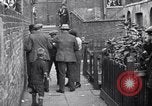
Events that initiated World War I and animated map showing involvement of nations from 1914 through 1918
Opening scene shows a man being roughed up by a group of men in an alleyway with pushing and shoving as they fight. A slate comments (in French) that when nations are bellicose, an assassination can cause a world war. Next, a slate shows picture of the world and states (in English) "One murder may start a world war." Another slate (in French) states that In 1914, while Europe's armies and fleets were more powerful than they had ever been, the nephew of the Emperor of Austria (Archduke Ferdinand) was assassinated. A front page is shown of newspaper, "Journal De Geneve" carrying the story. Next scene is a view of the city of Sarajevo. The ancient Emperor's Mosque dominates the scene. A slate appears asking Where is Sarajevo? It is followed by a map of Europe in 1914, which zooms in on Austria and Serbia and identifies and labels Sarajevo,in Austria, close to the Serbian border. Slates (in French) says Austria accused Serbia of War and other nations enter the melee. Animated World map shows the nations getting involved, starting with the German Empire in 1914, including its African colonies, and then successively showing Russia, France, Belgium,Great Britain, Japan, and the Ottoman Empire. Map advances to 1915, showing the Italian empire, Bulgaria,and Central Arabia. In 1916 it adds Portugal, Roumania. Next, the U.S.A. is added in, 1917, along with Central and South America, Greece, Siam, and China. Finally, the slate shows the war ending in 1918. Slate shows Armistice Day, the 11th hour of the 11th day of the 11th Month (November), with time shown on hands of Big Ben in London.
Images pertaining to advance of communism during 20th century, especially in East Germany
Statue of Karl Marx on his grave stone in Highgate Cemetery, London. A picture of Karl Marx. Scenes in Russia around the time of the Russian Revolution circa 1917 and creation of the Soviet Union. Soviet soldiers walking slowly in loose formation. Bolsheviks standing with a large banner. Images spanning many years thereafter: Damaged shops on a street. "One way" street signs in several languages. Large gathering of people carrying signs reading: "Frieden" (Peace, in German). A sign reading: "HALT, Landesgrenze" marking a German provincial boundary. A sign in German, designating the customs border at Furth im Wald, Bavaria ("Zollgrenz-Bezirk, Furth i.Wald"). East German border guards setting obstacles and sentry paths at barbed wire barriers (constituting the Berlin Wall, early on). Picture of Günter Litfin, a twenty-four-year-old tailor, who swam across the Spree Canal to West Germany on 24 August 1961. View of him being fatally shot from across the border, by East German guards, as he is being pulled into West Germany (the first such fatality at the East West German border). Animated map of the world with label references to Berlin,1961; Havana, 1959; Budapest, 1956; Coyoacan, 1940; and Kronstadt, 1921.
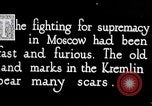
Damage in Moscow as result of conflict during 1917 Russian Revolution
Damage in Moscow from revolution conflict including: Severely damaged Kremlin gates; damage to the Spasskaya Tower and clock on Red Square; and damage to several other grand buildings., including a cathedral. (World War I; World War 1; WWI; WW1)