


 Francais
 Deutsch
 Italiano

Refine Your Search
+"Russia" +1945 stock footage and images
- Showing 7 to 12 of 71 results more
 Hide
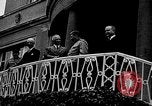
Allied National Leaders hold numerous conferences to plan and coordinate their efforts during World War II
First scene shows President Harry Truman shaking hands with Joseph Stalin on a porch of the Cecilienhof ( home of Crown Prince Wilhelm) in Potsdam, Germany. The two leaders are accompanied by their respective foreign ministers, James F. Byrnes, U.S. Secretary of State, and Soviet Minister of Foreign Affairs, Vyacheslav Molotov. Stalin descends steps from the building followed by Truman. View of the back lawn at Cecilienhof. View of its front entrance. Various views of the house and grounds. American, Soviet, and British flags flying from the building. Cars carrying the leaders on road to the Cecilienhof. President Truman and James Byrnes entering outside gate, followed by other attendees. Then Stalin is seen entering followed by Soviet officers and officials. U.S. General Dwight D. Eisenhower, Supreme Commander Allied Expeditionary Force (SCAEF) in Europea and U.S. Army Chief of Staff. George Marshall are seen walking together in a wooded glade on the meeting grounds. British Field Marshal Bernard Law Montgomery, entering the grounds for the meeting. British Prime Minister Winston Churchill, President Harry Truman, and Joseph Stalin stand on a step before an entrance to Cecilienhof. Truman places their hands together in a mutual handshake, at which Churchill and Stalin laugh. Views of the Kremlin and St. Basil's Cathedral, in Red Square, Moscow, Russia where foreign minsters of the United States, Britain, and the Soviet Union are seen meeting meeting in conference at the Spiridonovka Palace in October, 1943. Closeup of Soviet Prime Minister Vyacheslav Molotov, British Prime Minister, Anthony Eden, and U.S. Secretary of State, Warren Hull, successively signing a document. Scene shifts, to a C-47 transport aircraft flying over great pyramid of Giza in Cairo, Egypt. Next, the front of the Soviet Embassy in Teheran, Iran, is shown. The "Big Three" (Stalin, Roosevelt, and Churchill) sit on the porch of the building. Military officers from their countries stand behind them. Narrator (Franklin D. Roosevelt) says they agreed to launch a gigantic attack on Germany. Scene shifts to Germany, where German military is paraded on public display, showing artillery, Panzer I tanks carried aboard army trucks, Heinkel He 111 bombers in formation overhead, and marching troops giving Nazi salute silhouetted against bright pavement. View shifts to the Livadia Palace, in Yalta, Crimea, Russia. Brief view of the "Big Three" and their staffs sitting around a conference table. Change of location to San Francisco, California, where flags of many nations are displayed along with a United Nations Logo. Representatives of the many nations sign the Charter of the United Nations, founding the U.N. organization on 26 June 1945. Film shifts to Germany where victorious American, British and Soviet troops shake hands and celebrate victory. They share drinks and toast victory.
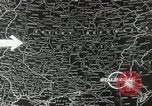
Post-World War II scenes in Communist occupied areas of Europe and Asia
Animated map shows thrust of German forces during invasion of Soviet Russia in World War 2. Stalingrad is highlighted as a turning point. Another animated map shows Soviet territorial gains at the end of the war, as narrator discusses the disposition of those places and their respective populations, as in Latvia, Lithuania, and Estonia. He also discusses Soviet zones of occupation. Animated map shows "Iron Curtain." Soviet troops on parade. Soviet ZSU-57-2 self-propelled anti-aircraft guns (SPAAG) on display during a parade in 1945. A stadium filled with people in Soviet-occupied East Germany, in 1949. Friedrich Wilhelm Reinhold Pieck, the first President of the German Democratic Republic, is seen in the stands. Young East German women parade in traditional costumes, clapping their hands, in the stadium. Waterfront scenes show Soviet trade activities with post-war occupied entities. Scenes of conflict as Chinese communist forces expel Chiang Kai-shek's Nationalist Chinese forces (ROC) from mainland China to Formosa (Taiwan), in 1949. A litter-borne casualty and a refugee mother and small girl are seen as they evacuate.
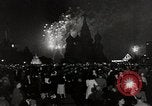
Fireworks in Red Square. Tehran, Iran, conference in 1943. Potsdam conference, 1945.
A crowd enjoys fireworks in Red Square, Moscow, Soviet Union, at night. Past events show Soviet Premier Joseph Stalin, U.S. President Franklin D. Roosevelt and Prime Minister Winston Churchill of the United Kingdom in Tehran, Iran for the Tehran Conference of 1943. U.S. President Harry S. Truman in Germany during the Potsdam Conference of 1945. The Grand Kremlin Palace in Moscow, Soviet Union. Soviet people along a street in Moscow. Foreign Minister of the Soviet Union, Vyacheslav Molotov with others applauding at the Bolshoi theater, in Moscow. Anti-soviet disorders. Street cars being overturned. (Hungary?).

Russian soldiers drive German forces back from Russia.
Soviet Union soldiers fight German troops in Stalingrad, Russia. Italian Prime Minister Benito Mussolini and Fuhrer Adolf Hitler in an open top car in a European city. Their motorcade passes through crowded streets. People give Nazi salute to Hitler. Wreckage of tanks and ruins in Stalingrad Russia. Billows of smoke rise from explosions. Russian soldiers drive the enemy (Germans) back to Germany. Tanks and soldiers advance on the battlefield. (World War II period).

Marshal Joseph Stalin review Russian soldiers in a parade and standing at attention in Moscow, Russia (WW2)
Russian soldiers in Moscow, Russia. Russian soldiers parade and stand at attention as Russia's activities since declaring war on Japan later in World War II. Marshal Joseph Stalin with another official at balcony of a building. The Kremlin in the background.

Signed German surrender document, destruction in Berlin, and victory parade in Moscow, Russia
Views of the signature page on the German surrender document, ending World War II in Europe. Scenes of devastation in Berlin with many buildings and bridges reduced to rubble, including the Reichstag building. A victory parade in Moscow, Russia after signing of Nazi surrender. Victory parade by military troops in Moscow. Troops march with rifles, salute Josef Stalin and others on review stand. Huge crowd gathered singing victory hymns. Soviet citizens cheer and present bouquets to Russian soldiers and lift them. Women laugh. Fireworks at night in Moscow to celebrate the victory.