


 Francais
 Deutsch
 Italiano
Refine Your Search
+"Saipan Mariana Islands" +1944 stock footage and images
- Showing 1 to 6 of 196 results more
more Hide
Hide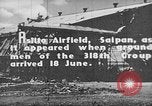
Aslito Airfield as it appeared when ground men of the 318th Fighter Squadron arrived on 18th June, 1944, Saipan Island.
The Pacific Campaign of World War II on the Island of Saipan, Mariana Islands. Aslito Airfield as it appeared when ground crews of the 318th Group arrived on 18th June, 1944. A U.S. Marine as he walks around inspecting the dead bodies of Japanese soldiers. Japanese mess kit showing spilled rice. Several dead Japanese soldiers lying around in the area. Destroyed Japanese aircraft with "NTP-1" written on tail. Demolished hangars and buildings. Fuel drop tanks lying around in the area. Surrounding installations showing the buildings that have been bombed or completely demolished. 804th Aviation Engineers at work clearing the area for camp site using heavy duty equipment such as bulldozers, graders, cranes, and half tracks. Damaged Japanese hangar.
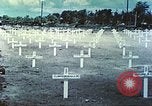
A U.S. Marine walks past 2nd Marine Division Cemetery in Saipan, Mariana Islands.
A U.S. Marine cemetery in Saipan, Mariana Islands during World War II. Crosses over graves. A marine armed with a carbine walks past a sign: '2nd Marine Division Cemetery'. Names of the marines who died on 15th June, 1944 engraved on the crosses.
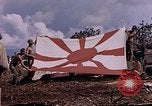
Aftermath of Japanese Banzai charge on Saipan, Mariana Islands during WWII
Americans display (holding it upside down) a huge Japanese rising sun Vice Admiral rank flag , captured after a desperate "banzai" attack by Japanese forces on Saipan, during World War 2. A photograpner takes a picture. Ammunition left on the ground from the battle. Two knocked-out Japanese Type 95 Ha-Go tanks. Destroyed defensive positions and buildings. Americans examine remains of buildings and defensive positions. Several local civilians walk into the center of the scene of death and destruction. Dead Japanese soldiers are seen everywhere, throughout the sequence. (Note: Aftermath of the "Tanapag Plain banzai attack" on July 6th and 7th, 1944. Americans engaged included units of the 105th Infantry; 165th Infantry; 23rd Marines; 24th Marines; 25th Marines; 20th Marines; and 10th Marines.)
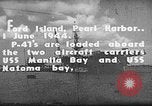
Loading of P-47s on aircraft carriers and 19th Fighter Squadron men embarking on ships at Ford Island, Pearl Harbor.
The Pacific campaign on the Island of Saipan, Mariana Islands during World War II. P-47 Thunderbolt planes loaded aboard carriers in Ford Island, Pearl Harbor. P-47s of the 318th Fighter Group, 19th Fighter Squadron , are loaded aboard the two aircraft carriers, USS Manila Bay and USS Natoma Bay, at Ford Island, Pearl Harbor. Among the aircraft seen are: P-47 named "Big Baduzi;" P-47 number 42-75783 named "Little Rock-ette;" one named "The Wicked Wench;" and one with serial number 43-2530. Various views of aircraft being loaded on carriers from dock area. Crane in operation. Plane being swung over onto the deck where it is pushed on the elevator and moved down into the hold of the ship. Air Force mechanics working with Navy personnel moving planes and placing them below deck. Navy personnel pushing the aircraft around into position above and below the deck of carrier. Sailors cut loose the mooring lines. Several officers and sailors standing on deck of a carrier as they move out of the harbor. View across Pearl Harbor at Diamond Head mountain in background. Remaining ground crews, support personnel, and others of the 318th Fighter Group assembled on the pier, ready to embark on a troop ship, June 6, 1944. They commence boarding via a gangplank, being checked off as they board.(This third convoy, departs on June 7th.) Various sections of ship with views looking out across at land and ships parked in the harbor.
U.S. convoy of freighters, aircraft carriers, and LSTs, reaching Saipan Island, Mariana Islands in World War II
The Pacific Campaign on the Island of Saipan, Mariana Islands during World War 2. Map titled 'Mariana Islands' showing the location of U.S. carrier convoy. Map showing the location of LSTs (Landing Ship, Tank). Map with heading '804th Aviation Engineers in Saipan'. Map and sea route marked from Hawaii past Johnson Island showing location of transport convoy, June 17, 1944. Convoy at sea showing men aboard the ships looking down at the water. Convoy showing the various types of vessels in the convoy, mostly freighters. Continuation of maps with sea markings of the route of the convoy showing the location of Kwajalein Islands and location of Eniwetok. Carriers underway showing planes aboard the carriers. Personnel on look out, aircraft spotters and others. Huge geyser of water erupting near a freighter. Convoy off the coast of Saipan showing a huge geyser of water going up. LSTs and freighters at anchor off the coast of Saipan. Personnel aboard LST as they move in towards the shore. Gun flashes can be seen ashore. Unloading operation showing the LST pulling into shore, the door falls down into the water and a half track pulls out and moves into the shore loaded with men and equipment. Trucks, jeeps and all types of equipment moving across the water in toward shore. Men walking ashore.
The battle of Saipan during World War II in the Pacific.
U.S. forces battle against the enemy on Saipan, Mariana Islands during World War II. The 4th Marine Division advances on the eastern side of Saipan. Marines fire rifles. The 2nd Marine Division fires at enemy snipers. The 8th Marine Regiment advances amidst heavy firing. A Marine M3 Stuart (M3A1) light tank equipped with flamethrower (Satan flame tank) is seen in action. Marines moving slowly behind a tank. Two marines running, under fire, carrying a wounded on a stretcher. Others run for cover before a huge explosion. The 8th Marines capturing Mount Tapochau. The 4th Division moving M16 rocket launchers into position for deployment. barrages of rockets striking distant targets in the Bluff Point area. Closeup of rockets being fired from launcher on back of a truck. Map showing Saipan and the disposition of the various Marine units as of 24 June, 1944. American P-47 aircraft parked at Aslito airfield. One has the name "Rosemary" painted across its engine cowling. P-47s taking off on 26 June, to strike at Tinian. A Grumman TBF Avenger is seen taking off at the same time. Another status map shows improved U.S. positions.