


 Francais
 Deutsch
 Italiano
Refine Your Search
+"Saipan Northern Mariana Islands" +1944 stock footage and images
- Showing 115 to 120 of 228 results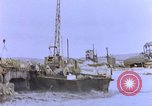
Glimpse of U.S. Navy Seabees at Saipan port, after the U.S. defeat of Japanese forces there in World War II
Glimpse of Amercan Navy Seabees, in a boat backing away from a dock at waterfront, in Saipan, after defeat of Japanese on the island during World War 2. A mobile derrick stands behind the boat. The area contains damaged and destroyed facilities.
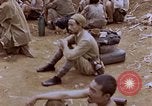
U.S. forces plan airbase construction after the battle of Saipan during World War II
America forces begin preparing Saipan as an advance base in the Pacific campaign against Japan in World War 2. Japanese military prisoners as well as civilian women and children are seated on the ground, shaded by a tree on a coastal plain in Saipan. American officers review a map laid out on the hood of a jeep. They converse in a group as they stand near a rudimentary small gauge railroad track in the sand. Sheer cliffs are close behind them and the ocean is nearby. A jeep is seen parked and another moves along a bumpy path. Officers and soldiers stand on and near the small gauge rail line. Several jeeps are parked. Camera pans over sheer cliffs behind. (Some contain openings that housed Japanese fortifications.) Camera pans over wide flat area where the Japanese were building an airfield near Marpi Point on the northern end of the island of Saipan. Construction materials cover the area and several jeeps travel through it. Final scene shows more Japanese civilians in a group where several American soldiers are attending to their needs.
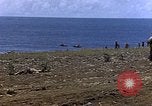
American forces dealing with prisoners and bodies of dead Japanese after the battle of Saipan during World War II
Camera pans past body of fallen Japanese soldier to U.S. Marines spread out along a shoreline as landing craft maneuver nearby and an American aircraft flies low overhead. Japanese prisoners along with women and children walk in a line. Glimpse of body of a dead Japanese soldier. Another group of Japanese prisoners and civilians. Several stand near American soldiers looking out at the small craft maneuvering offshore. A man (interpreter) speaks into a microphone, giving instructions to the Japanese persons on the shore. Body of dead Japanese woman. Bodies of numerous dead Japanese soldiers along the shore. Japanese prisoners with shovels begin recovering the bodies, placing them on makeshift litters and carrying them away.
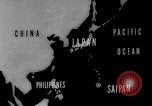
Living conditions of the United States soldiers in Saipan during World War II.
United States soldiers in Saipan during World War II. Map of Pacific Ocean with China, Japan, Saipan. Island of Saipan. Living conditions of the soldiers. Pup tents, dugouts in the area. Runway with ocean in the background. Piles of equipment stacked up. Soldiers lift a crate on to a truck. Man pushes gas drum along rails. Jeep pulls two barrels in a trailer. Piled equipment and tents in the background. Soldiers ride a horse-drawn cart. Row of tents. Soldiers walk along the area. Tents in the foreground.
U.S. Brigadier General Emmett O'Donnell, Vice-Admiral John Hoover and Brigadier General Haywood Hansell arrive on Saipan
Us Army Air Forces B-29 Super Fortress of the 73rd Bomb Wing (Tail Code: "V Square 29") comes in for landing. Plane parks on the ramp. U.S. Brigadier General Emmett O'Donnell, Vice-Admiral John Hoover and Brigadier General Haywood Hansell study a map, leaning it against one of the plane's propellers. General O'Donnell walks over to converse with Major Robert Morgan, who is well-known as the pilot of the B-17 "Memphis Belle" that flew 25 missions over Germany in the European theater. He now flies B-29s with the 73rd Wing in the Pacific theater. (World War II period).

Japanese planes attack B-29 base in Saipan, Pacific Theater.
Location of Saipan on an animated map. Japanese planes attack B-29 base in Saipan, Pacific Theater. Many United States B-29 bomber aircraft destroyed. Fire and heavy black smoke rises up. Troops try to extinguish fire by throwing water through buckets and hose. Japanese planes attack second time. Jeeps pass on the airfield. Wrecked and burnt planes on base. (World War II period).