


 Francais
 Deutsch
 Italiano
Refine Your Search
+"Salerno Italy" +1943 stock footage and images
- Showing 1 to 6 of 77 results more
more Hide
Hide
U.S. operations during the battle at Salerno, Italy, beginning September 6, 1943.
Convoy of ships at the harbor in Salerno, Italy. Aerial view of ships moving in the sea, aircraft bombing on ships and infantry reinforcement heading in landing crafts. Wounded soldiers in basket litter hoisted to aboard landing craft. Men help in pulling the litter on the landing craft. An army truck coming out from the landing craft while infantrymen getting down along with the wounded ones at the sea shore. A downed U.S. fighter plane at the shore in background is visible while soldiers and infantrymen move in army vehicles in front of it. (World War II period).
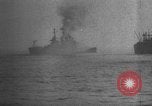
Allied Naval Task Force operations supporting Amphibian assault on Salerno, Italy, in World War II
Opening scene shows the USS Savannah (CL 42), on 11 September, 1943, after being struck by a German remotely controlled glider bomb released from a high flying German aircraft, She was supporting Allied amphibious operations at Salerno, Italy, in World War 2. Next, after fires were put out and smoke cleared, The disabled Savannah is seen sitting low in the water, making way slowly, among other Naval Task force ships in the background. (She made way to Malta under her own steam for emergency repairs.) Views of the Savannah passing as she heads for Malta. A Fletcher class destroyer fires her naval guns at the shore. Attack transports and other support ships are seen nearby. More views of support ships, including the USS Samuel Chase (APA-26). A barrage balloon seen above the convoy in some scenes. Sailors manning a Bofors 40mm anti-aircraft gun aboard a U.S. warship. A British Escort Carrier with number 337 on her bow. Sailors with a Oerlikon 20 mm cannon aboard a warship. The British Escort Carrier seen earlier, (with number 337 on her bow) passes the camera ship. Aircraft are seen on her flight deck. A Navy warship firing 40mm Bofors and 5-inch guns as it lays down a smoke screen.
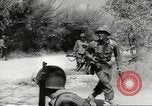
Amphibious operations in Italy, during Operations Husky and Avalanche. General hazards of wartime amphibious assaults including those in the Pacific Theater in World War II.
American soldiers in Italy, during Allied Operation Husky, and Operation Avalanche in World War 2. In landings during invasion of Salerno, Italy, soldiers pause their movements while two use a detector to search for possible buried mines. They detect one and are seen carefully digging it up from the sandy soil. Soldiers unroll steel matting across an area of beach. Close-up of heavy trucks moving across the matting. A bulldozer uses a cable to pull a section of temporary docking out of an LST (Landing ship tank). Troops move across several sections of such docking as they make their way onto the shore. A sherman tank making its way toward the shore . More heavy equipment coming ashore from LSTs, including a US M1 155mm “Long Tom” Gun. The gun being towed on shore, as trucks and jeeps maneuver through shallow water nearby. A long line of jeeps and trucks moving inland. Military vehicles being offloaded from the British Landing Ship Tank (HM LST-200). U.S. troops moving on a beachhead, along with artillery pieces, and vehicles. Soldiers carrying boxes of supplies and ammunition and struggling with large wooden crates of such, in shallow surf, and using a roller conveyor to offload some heavy items from a ship. A landing craft suspended from a cable operated A-Frame on wheels (in the water). At this point the thrust of the film shifts to illustrate the hazards of amphibious operations, in general. Swamped vehicles and a landing craft in the surf. The beach littered with damaged and swamped landing craft and equipment, including, among others, a landing craft from the USS Samuel Chase (APA-26). A huge explosion in the water. Glimpse of a German Junkers Ju 87 (Stuka) dive bomber attacking while being shot down by a U.S. sailor firing an anti-aircraft gun . View from above of sailors firing twin bofors 40mm antiaircraft cannons from an emplacement on a ship. Several German Junkers Ju 87 planes maneuvering as they attack. Quad bofors antiaircraft guns firing from a ship. More attacking Ju-87 dive bombers on the attack. A dramatic explosion and smoke from the Liberty ship SS Robin Rowan after being hit by a German bomb off the coast of Gela, Sicily on July 11, 1943. A landing ship burning from German bombing, off Gela, Sicily, with its deck full of halftrack and personnel carrier vehicles. The film continues the theme of losses encountered in wartime amphibious assaults, by shifting to the Pacific theater of operation, where a Landing Ship Tank (LST) is seen ablaze, off Guadalcanal, after being hit by Japanese shelling. View from beach with barbed wire, ashore, of the burning LST. Sherman tanks lost in a conflagration aboard an LST. Sailors carry a casualty on a litter, and place it next to other fallen crew members, on deck.
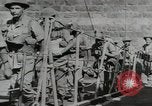
British 8th Army and U.S. 5th Army land in Italy and advance after gaining a beachhead during World War II.
The Allied Campaign in Italy during World War II. The campaign begins on September 23,1943. British 8th Army troops get onto ships . British 8th Army Commander General Bernard Montgomery. British soldiers land in Calabria, Italy. 8th Army troops advance. Supreme Allied Commander General Dwight D. Eisenhower aboard a ship. The Italian fleet surrenders. U.S. 5th Army soldiers loaded in a ship under the command of U.S. Army General Mark Clark as they head for Salerno, Italy. Allied aircraft provide a cover to the convoy underway at sea. German soldiers and equipment in Salerno. Allied troops land at a beach as the Germans open a heavy fire. Explosions occur at the beach. Allied naval guns are fired at German positions. Nazi aircraft attack to disrupt Allied landings. Royal Air Force and B-17s of the U.S. 9th Air Force aircraft in flight. Aerial view of bombs exploding on German positions. Dead soldiers at the beach. 8th Army soldiers advance inland. Artillery being fired. General Mark Clark with the soldiers after gaining the beachhead. 8th and 5th Army soldiers advance into Italy. A map depicts the position of Foggia, an Allied stronghold.
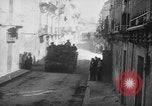
Allies, including U.S. Fifth Army, encounter heavy enemy resistance in amphibious assault at Salerno, Italy, in World War 2
Allied invasion at Salerno, Italy, during 2nd World War. Scenes of U.S. Sherman tanks, military vehicles and troops, moving easily through Sicily. Animated map depicts allied invasion routes from Bizerte, North Africa, to two points on opposite sides of Italy mainland. Convoys emerge from smoke screens in bay of Salerno, Italy. Allied warship creating heavy black smoke screen. Decks of LSTs crammed with trooops and vehicles. Allied warships bombard Salerno coastline. Commandos, Rangers and Seabees, in first assault wave are targets of German guns and dive bombers. Pontoon boat dropped from LST, with 35 Seabees aboard, strikes a mine, and is destroyed, setting off conflagration on the LST. Other LSTs (Landing Ship Tank) discharging vehicles to the beach over floating causeways, under enemy fire. Destroyed U.S. Sherman tanks, vehicles and a U.S. P-40 aircraft , litter the beach. A Seabee uses semaphore flags to direct an LST to beach area. Seabees build shelters for war materiel and dressing stations where allied wounded are treated. Seabees continue to unload supplies to beachhead. Brief view of Lieutenant General Mark Clark, 5th Army commander, on the beachhead. Allied casualties being tended. Stretcher bearers carry wounded. Allied troops advancing on roads in Italy. Admiral Moreell, chief of the U.S. Navy's Bureau of Yards and Docks, concludes narration of the Seabee documentary, from his office in Washington, DC
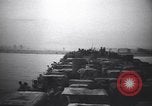
British LST reaches Salerno Beach in Salerno, Italy. Winston Churchill's son, Randolph Churchill, aboard ship (WW2)
Salerno Beach in Salerno, Italy during World War II. Views of trucks and British troops on a Landing Ship Tank (LST), men looking from the deck sides. Ship reaches the beach at Salerno. Enemy tracer bullets visible at night. British Supermarine Spitfire aircraft flying overhead. View of the LST2 captain, John P. Horgan, together with Randolph Churchill (Major Randolph Frederick Edward Spencer Churchill), son of Winston Churchill. Randolph Churchill observes the action through binoculars while smoking a cigarette and talking to the LST captain. On deck of a ship view of a German Prisoner of War and an American soldier playing chess and several other soldiers, some American and some British, standing by watching. U.S. military guards with German POWs on the beaches at Salerno.