


 Francais
 Deutsch
 Italiano
Refine Your Search
+"San Jose Island Panama" +1944 stock footage and images
- Showing 13 to 16 of 16 results
Gas bombs tested on ship's during U.S. chemical warfare tests on San Jose Island.
Tests of non-persistent gas munitions during U.S. chemical warfare tests on San Jose Island, Panama during World War II. Tests of non-persistent gas on ship targets are carried out. A Japanese fleet underway at sea in the Pacific Theater of World War II. Exposed Japanese personnel aboard a ship and Japanese fleet maneuvers at sea help determine the losses of bomb attacks. Expansion of concentrated gas bomb exploding during testing on San Jose Island. A U.S. 6th Air Force bomber aircraft drops bombs on water to determine results. B-24 Liberator bombers in flight. Tests are carried out by dropping bombs over a stationary raft and a barge in water.
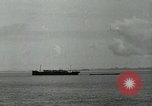
Tests of non-persistent gas on ship targets are carried out by U.S. Army at San Jose Island during World War II.
Tests of non-persistent gas munitions during U.S. chemical warfare tests near San Jose Island, Panama during World War II. Tests of non-persistent gas on ship targets are carried out. A stationary ship in water on which tests are to be carried out. Goats are loaded aboard the ship to represent Japanese personnel. Testing stations are set up at the bow, the stern and on varying heights by U.S. Army personnel. A man works with a gas concentration sampling instrument at a testing station aboard the ship. Goats wearing gas masks fitted with Japanese canisters are placed on the testing station. Bombs are loaded on U.S. 6th Air Force B-24 Liberator bombers at an airfield for carrying out the tests. The bombs are dropped from the B-24s near the test ship. Gas clouds cover the target completely after bursts on water. A man examines protected and unprotected goats killed by gas concentration. Attack on various vessels.
U.S. Marines using flame throwers against Japanese, Chinese troops during Sino-Japanese War, aftermath mass suicide of Japanese
A film titled 'The San Jose Project' gives an introduction of chemical warfare tests carried out by U.S. Army on San Jose Island, Panama during World War II. Film opens with scenes of U.S. troops battling Japanese on Pacific islands during World War II. Tank mounted flamethrower being used to burn Japanese from caves. Backpack style handheld flamethrower being used by U.S. Marine at mouth of a cave. A Japanese soldier emerges from a cave and is shot by American soldiers. Scene changes to China, where Chinese troops march near fields during the Sino-Japanese War before World War II. A wounded soldier carried by Chinese troops. Scene changes again to Mariana Islands during World War 2. Piles of bodies of Japanese civilians and soldiers at base of a cliff from which they jumped to commit suicide rather than be captured or killed by American forces. A Japanese civilian jumping off of a cliff. Japanese civilians at waters edge jumping into water.
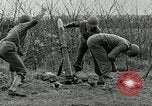
U.S. Chief of Chemical Warfare General William N. Porter directs the establishment of tropical chemical warfare tests.
An introduction of chemical warfare tests to be carried out by the U.S. Army on San Jose Island, Panama during World War II . U.S. troops test chemical warfare in a jungle. Rocket artillery is fired. Rockets explode. U.S. Chief of Chemical Warfare General William N. Porter during an initial conference with two other U.S. officers in the United States. General Porter directs the establishment of tropical chemical warfare tests on San Jose Island. British, Canadian, U.S. Marine and U.S. Navy officers attend various conferences. U.S. NDRC (National Defense Research Committee) scientists and technicians in front of charts and various instruments. The technicians carry out chemical tests. A scientist during a laboratory testing. The technicians at various instruments in a jungle during a testing phase.