


 Francais
 Deutsch
 Italiano
Refine Your Search
+"Sicily" +1943 stock footage and images
- Showing 181 to 186 of 215 results more
more Hide
Hide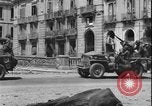
US General George S. Patton arrival in Messina, British soldiers cook on the street after Allied Invasion of Sicily during WW2
British and United States soldiers clear up rubble in ruins of Messina after the Allied Invasion of Sicily in World War 2. Commandos of the British Army cook with military stove and drink with mugs on a devastated street in Messina. A military vehicle drives through ruined part of Messina (probably 157th Infantry, 45th Division ). View of a partly sunken ship by the waterfront. General George S. Patton and General Lucian K. Truscott arrive in Messina’s waterfront. Generals George S. Patton and Lucian K. Truscott speak with British officer at city hall after surrender at present day Piazza Unita d'Italia (building seen behind them is Via Giuseppe Garibaldi, 134, 98121 Messina)
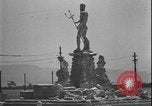
Damage of statues, buildings in Messina after the Allied Invasion of Sicily during WW2
The fountain of Neptune (Fontana del Nettuno) in Messina (Via G. Garibaldi, 98122 Messina ME, Italy) shows damage after the Allied Invasion of Sicily during World War 2. Messina’s waterfront, the Via Vittorio Emanuele II, with damaged structures and rubble strewn all over. The Comune di Messina-Palazzo Zanco at Via S. Camillo, 110, 98122 Messina ME with the word “Vincere” (“win” in Italian) on the side of the building, with the war memorial Monumento ai Caduti (Via Consolato del Mare, 25, 98122 Messina ME, Italy) seen on the left. View from the intersection of Via Antonio Laudamo and Via G. Garibaldi shows Via Antonio Laudamo strewn with rubble, with The Church of Christ the King (Viale Principe Umberto, 93, 98122 Messina ME, Italy ) in the background with a sign “DUCE” (title of Italian Prime Minister Benito Mussolini). Closer view of The Church of Christ the King and the sign “DUCE”. A street in Messina with wrecked vehicles. View of the Strait of Messina, with smoke in the horizon.
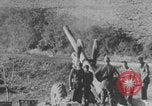
Allied soldiers firing artillery during Invasion of Sicily (WW2)
Allied soldiers firing with a field gun (likely BL 5.5-inch medium gun) during the Invasion of Sicily in World War II. Close up of gun barrel during recoil. Explosion with flying debris in a field. United States soldiers firing a field gun under a camouflage net. Explosion in a field.
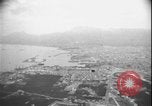
Aerial view of Palermo, Sicily harbor covered by mechanized smoke screen of US Army during Invasion of Sicily in WW2
Mechanized smoke screen surrounds the harbor of Palermo, Italy during World War 2. Thick smoke screen, provided by the 69th and 78th Chemical Smoke Generator Companies of the United States Army, covers the view of Palermo old town, the Gulf of Mondello, and the nearby Palermo mountain range.
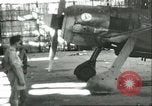
Allied soldiers examine wrecked German aircraft in a hangar during Allied invasion of Sicily, Italy in World War II.
Film opens with Allied soldiers looking at an Fw 190A-5 of SchlG 2. (Schlachtgeschwader 2) Immelmann, a Luftwaffe Dive bomber-wing.The Gruppe insignia, of Mickey Mouse riding a bomb and brandishing an axe, is displayed on both sides of the plane, near the engine cowling. Inside a hangar, a Ju-88 bomber is seen with left wing elevator missing as well as other parts. Camera shifts to another Ju-88 sitting nearby. Scene shifts to two soldiers, in shorts and knee socks (British?) standing partially under a wrecked German plane. Some bombs sit on the ground under the plane. They watch as an American soldier digs on the side of a bomb, with a large knife, apparently trying to test the composition of the bomb, or possible remove something. Next, a soldier in shorts is seen descending from the Ju-88, onto a maintenance stand underneath it. He walks toward the camera holding his hand up (almost as if to ask the cameraman not to photograph him). Scene shifts to beneath a Junkers Ju-52 transport plane, with "Kaltstart,"stenciled on its fuselage. The American soldier, with the big knife, digs at a darkened area on the bottom of the plane, cutting away a patch that reveals a bullet hole that had been patched.
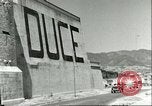
Allied forces advancing through Messina, Sicily, Italy in World War II.
Allied soldiers in a jeep and a British personnel carrier, drive past huge letters, spelling "DUCE," painted on the side of a massive concrete wall in Messina, during World War 2. Change of scene shows American soldier examining an Italian Pavesi military tractor. He is very intested in its unusual wheels. Change of scene shows the soldier climbing into the seat of another Pavesi tractor and checking out its controls. A large building across the street displays a British flag. An American technical sergeant offers an Italian civil policeman a cigarette. A closeup of the policeman as he smokes. The sergeant points to "Heil Rommel" written on a door, and other graffiti in chalk on a wall. He pauses to examine some wrecked Italian vehicles. Closeup of the wreckage.