


 Francais
 Deutsch
 Italiano
Refine Your Search
+"Solomon Islands" +1942 stock footage and images
- Showing 37 to 42 of 44 results more
more Hide
Hide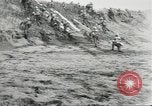
Japanese forces landing on Kiska, Aleutian Islands, during World War II
Japanese No. 3 Special Landing Party of 500 Imperial Marines are seen landing and proceeding inland on Kiska, Aleutian Islands. They carry the rising sun flag. They are seen searching two captured Americans from the U.S. Naval Weather Detachment. The rising sun flag is seen in right foreground. The Japanese troops continue walking across the island. Buildings of the weather detachment seen in background.The Japanese troops assemble in formations near the weather detachment buildings as their commander addresses them. A Japanese Type 97, 4EFB (Mavis) flying boat seen taxiing into the bay and being tended by Small boats. (Reportedly, the Tail code "O" identifies the seaplane's unit as Taiwan-based Toko-tai, also active in Solomon islands.)
Amphibious forces carried by U.S. Coast Guard, at Guadalcanal and in North Africa during World War II
United States Coast Guard operations in World War 2. Underwater views of ship's anchors being weighed, Convoy of U.S. ships in Pacific Theater, in July, 1942. The Attack Transport, USS Hunter Liggett underway, with crews doing amphibious training. Members of the 1st Marine Division aboard USS Hunter Liggett with Coast Guardsmen. Officers confer aboard vessel. Marines read books on ship. August 7, 1942, U.S. Marines begin amphibious assault against Japanese on Guadalcanal. Naval guns bombard Guadalcanal Island. Marines descend from the USS Hunter Liggett, on nets and enter LCVPs (Higgins boats) operated by Coast Guardsmen, to assault the island. Marines hit the beach from the boats. Marines firing small howitzers and advancing on the island. November 7, 1942, convoy of eight hundred ships en route to North Africa. Warships bombard the shore. An officer observes through binoculars. British and American troops descend on nets into LCVPs from Attack transports: USS Joseph T. Dickman (APA-13);USS Leonard Wood (APA-12); and USS Samuel Chase (APA-26). Troops hit the beaches of North Africa, under fire.
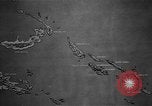
The USS Enterprise (CV-6) in Battle of the Eastern Solomons, with 75 Seabees aboard, making emergency repairs
Animation shows shadows of U.S. B-17 bombers flying from Henderson Field, Guadalcanal, to attack Japanese targets. F4F and Douglas SBD Dauntless aircraft take off from the USS Enterprise (CV-6) which had been sent into battle with 75 Seabees, from Company B, 3rd Construction Battalion, still on board making emergency repairs. Scenes of the battle between U.S. and Japanese fleets in the Eastern Solomons. U.S. warships fire antiaircraft weapons at attacking Japanese aircraft, and fire heavy guns at Japanese warships. View of damage to flight deck of USS Enterprise. A U.S. warship on fire billowing black smoke. Black puffs fill sky from U.S. antiaircraft flak, as Japanese aircraft attack. Fire burning at edge of flight deck on USS Enterprise, as crewmen stretch long hoses to fight the blaze. Views of heavy damage sustained by the USS Enterprise during the battle. (World War II ; World War 2; WW II; WW 2).
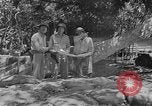
Three U.S. generals converse and pose for pictures on Guadalcanal in World War II
As film opens, Brigadier General William H. Rupertus, Assistant Commander of the First Marine Division (on the left) and Major General Alexander McCarrell "Sandy" Patch (in the center) Commander of the U.S. Army 23rd Infantry Division (the Americal Division) and his Assistant Commander, U.S. Army Brigadier General Edmund Sebree, are seen looking at a map on Guadalcanal, during World War 2. Rupertus converses with Patch and shakes his hand. He then shakes hands with Sebree, as both of them laugh at some comment made. General Sebree salutes General Rupertus, who returns his salute, and the three of them walk away. Close up of General Patch, posing for the camera. He fastens the chin strap on his steel helmet and then releases it. Closeup of General Rupertus, posing for the camera.
American Marines land and advance inland in Guadalcanal.
American Marines and the Japanese forces in Guadalcanal during World War 2. Animation depicts the Allied forces plan against the Japanese forces on islands in the Pacific Ocean. A convoy of U.S. ships. The United States Marines land on Guadalcanal. Marines running out of landing craft while under fire. The Marines move inland. Combat scenes show soldier in prone position firing rifle. A U.S. Marine firing a machine gun at enemy Japanese in jungle area inland of beach during battle. Face of Marine in fox hole. (World War II period).
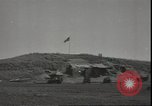
USMC (United States Marine Corps) officers confer at Henderson Field on Guadalcanal during World War II.
American flag flying from a tall flagpole over a hill near Henderson Field on Guadalcanal during World War 2. U.S. Marine officers are seated at a table in a local headquarters tent dug in and sandbagged at the base of the hill, which sits on the edge of the captured Japanese airfield (Henderson Field). One of the officers is looking through binoculars. Nearby, behind them a C-45 transport plane (Beechcraft Model 18) is approached by a fuel truck. Many other aircraft parked aircraft are seen in the distance. Two Marines standing in front of a mound of sandbags discuss something on a clipboard. Several Marines relax in front of a wooden building. Another Marine officer wearing a sidearm joins them with a large map, which they discuss. One of the Marine officers is a Colonel (O-6). Scene shifts to a B-17, tail number 41-2403, taxiing. Next, several B-17s are seen through palm trees, flying overhead. One has its landing gear extended and descends, beyond some trees, to land. Camera moves to a site where pipelines are being repaired by Seabees. A Seabee welder is at work on one. Seabees move new pipe into position on cross ties. (Note: The B-17 Number 41-2403 ditched January 27, 1943, on the way from Guadalcanal to Espiritu Santo, with Brigadier General Nathan Farragut Twining, Commander, 13th Air Force, on board. On 1 February 1943, the U.S. Navy rescued him and 14 others from their life rafts, near New Hebrides Islands.)