


 Francais
 Deutsch
 Italiano
Refine Your Search
+"South Pacific" +1945 stock footage and images
- Showing 1 to 6 of 15 results more
more Hide
Hide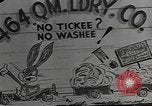
The U.S. Army Quartermaster Corps provides numerous support services to troops in the South Pacific in World War II
The U.S. Army Quartermaster Corps delivers laundry and myriad other services in the South Pacific during World War 2. Opening scene show a cartoon sign by the 464th Quartermaster Laundry Company featuring Bugs Bunny in a jeep pulling mobile laundry equipment in wagons. Next, U.S. troops are seen in jungles subject to rain and mud of the South Pacific. A soldier crouches in a riverbed and washes his clothes. A mobile laundry installed near a river. Soldiers using washers and dryers in the facility. Views of larger fixed installation Quartermaster laundry, such as in New Caledonia; Fiji; and the New Hebrides. Quartermaster salvage and repair workers operating sewing machines as they repair military clothing. A sign identifies "Island Quartermaster C&E Repair Shops" (Clothing and Equipage Repair Shops). Here workers sort, repair, and remark sizes on salvaged clothing. Two workers sit in a mound of garments that they cut into rags and toss into a heap behind them. Two workers repair broken shoes. Soldiers' feet seen walking through mud. A stack of army shoes needing repair. A team of army workers using modern machines to repair them. View of finished shoes, as good as if repaired in the U.S.A. Sign identifies Orthopedic Department where a man works on specially designed and fitted shoes prescribed for an injured soldier by a medical officer. A nurse and a doctor place the special shoe on a patient. A nurse assists the patient to walk. Typewriters needing repairs line shelves. Technicians are seen at work stations, repairing typewriters. The final sequence begins with a sign reading: "Tent Repair, Drive in here. All tents must be clean, dry, and folded properly." Quartermaster workers raise a tent inside a shelter and then identify and repair a hole in it by applying fabric glue and a patch.
Unwounded men and ammunition is found as U.S. Navy 7th Fleet officers capture a Japanese mercy ship in the South Pacific Ocean.
A Japanese mercy ship is captured in the South Pacific Ocean during World War II.. A Japanese mercy ship underway at sea. U.S. Navy 7th Fleet officers capture the Japanese mercy ship. Unwounded men come off the ship. Cases of 75mm ammunition are uncovered. Labels 'Medical Supply' on the ammunition. Prisoners are taken in custody.
Interview of Capt. William S. Parsons, U.S. Navy, crew member on Enola Gay, after the Hiroshima atomic bombing mission
Setting: North Field, Tinian Island in Mariana Islands, South Pacific, almost a week after the atomic bomb was dropped on Hiroshima Japan, August 8, 1945, during World War II. Public Relations Officer, Major John F. Moynahan (not seen) is interviewing members of the Crew of the B-29, Enola Gay, from which the bomb was dropped. Here he interviews Captain William Sterling "Deke" Parsons of the U.S. Navy who was weaponeer aboard the Enola Gay, during the mission. and who now serves as Scientific Head of the Atomic Bomb Project in the Pacific Theater. Captain Parsons describes the events of the mission from their early morning departure through the actual bombing. He notes that the actual bombing went smoother than earlier practice missions.
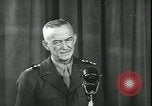
General Courtney H. Hodges informs about the new assignment of the 1st Army in the south Pacific during World War II.
United States General Courtney Hughes speaks during a radio talk in United States. General Courtney H. Hodges speaks into a microphone as he talks to radio audiences soon after the end of World War II in Europe. He says that he is happy to be home and will soon visit his home town in Georgia. He says that after that he will visit Washington and then leave for the South Pacific where the United States 1st Army has been ordered to go. He poses with other officers.
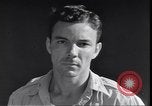
U.S. Army Air Forces B-29 bomber crew member on a South Pacific island gives his view on surrender of Japan.
Crew member of USAAF B-29 Superfortress bomber at a South Pacific island, gives his view on surrender of Japan soon after returning from a flight to Japan. The crew member speaks about B-29s bombing Japan in the final days of World War II and talks about his first peacetime landings.
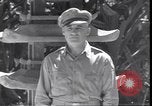
U.S. Army Air Forces officer on a South Pacific island gives his view on B-29 bombers and surrender of Japan.
Crew member of USAAF B-29 Superfortress bomber at a South Pacific island, gives his view on surrender of Japan in World War II soon after returning from a flight to Japan. A U.S. Air Force officer pays tribute to the production line of B-29 bombers, ground and air crews. The officer says it was only because of B-29s United States was able to defeat Japan in the final days of war.