


 Francais
 Deutsch
 Italiano

Refine Your Search
+"Soviet Union" +1942 stock footage and images
- Showing 7 to 12 of 60 results more
 Hide
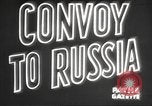
Arctic convoy of British ships underway in the North Sea carrying weapons to Russia during World War 2.
A British ship convoy underway in the North Sea as part of the Arctic Convoys supplying ships, weapons, and materials to the Soviet Union at Arkhangelsk and Murmansk during World War II. A map showing the North Sea route. The British ships underway. The ships carry weapons and other equipment to Russia as an aid for the fight against Nazi Germany. A man aboard a ship watches the area through binoculars. Crew dressed for Freezing cold temperatures. Enemy aircraft in flight over the area. The German aircraft drop bombs on the convoy. Guns fired from the ships. Smoke rise from firing and bombardment in the area. Circa 1942.
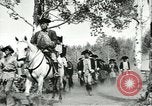
American forces prepare for war; ASF Lieutenant General Brehon B. Somervell addresses officials (WW2)
Continental Army cavalry riding horses and soldiers marching in an American Revolutionary War reenactment. Continental Army soldiers carrying the wounded on their backs under heavy rain. United States Army soldiers marching in New York City during World War II. Views of enormous numbers of U.S. Army soldiers marching in formation. Large columns of U.S. Army soldiers seen approaching camera position and from above. A soldier with an Army Service Forces (ASF) patch marching. Close up of the Army Service Forces (ASF) patch. Commanding General of the ASF Lieutenant General Brehon B. Somervell smiling. A notice detailing the War Department Reorganization effective March 9, 1942. Army Ground Forces commander Lieutenant General Lesley J. McNair. Army Air Forces Commander General Henry H. Arnold. General Somervell and Army Chief of Staff George C. Marshall. Soldiers advance towards a battlefront. Wounded are evacuated from the area. The soldiers stand in formation. Officials seated at a desk. General Somervell addresses them and speaks on the value of war material. A dead German soldier in tank. Dead bodies of Japanese soldiers scattered on the beach in the Pacific. Tires and scraps for use by the army. A newspaper advertisement reads “Your scrap will save some brave boy’s life!”. Ceiling prices listed in grocery store during wartime. Japanese planes bombing Malaya and Singapore. Burned houses after Japanese bombardment in Asia. A burning house in China. An oil tanker explodes and burns after being bombed at sea. Tanks advance towards the front. Generalissimo Chiang Kai-Shek and wife Soong Mei-Ling (Madame Chiang). An airplane in flight, bombarding a target area. Prisoners of war standing. Dead bodies lying on the ground. Destroyed area after an enemy attack. The soldiers and the tanks advance towards the battlefront. Barrage balloons in flight overhead. Allied flags on display such as the Soviet Union and England.

Allied Leaders confer and plan during World War II
Opening slate reads: "Cairo and Teheran." A view of the world turning, accompanied by voice of President Franklin Roosevelt broadcasting a Christmas messeage to the Armed Forces in 1943, during World War 2. Glimpses of families and people abroad listening to the President on radio. Views of Moscow and the Kremlin in the Soviet Union. British, American, and Soviet flags on a desktop at the Moscow conference in October, 1942. Camera shows Foreign Ministers Vyacheslav Molotov, Anthony Eden and Cordell Hull signing documents and then shaking hands. View of great pyramid of Cheops and the Sphinx. Closeup of Prime Minister Winston Churchill, President Franklin D. Roosevelt, and Generalissimo Chiang Kai-Shek at the Cairo Conference. Wider view of them with their respective military Commanders standing behind them. A view showing Madam Chian Kai-Shek seated near and conversing with Winston Churchill. Animated map of China. Illustration of a book entitled: "The Tanaka Memorial." Warships firing their guns. U.S. Marines in Landing Vehicles Tracked on amphibious assault of a Pacific island. Marines ashore in combat. More views of U.S. Navy ships bombarding Japanese-held islands and of U.S. forces in amphious assaults. Glimpses of fighting in jungles. A U.S. Navy Consolidated PB4Y-2S Privateer aircraft in flight. Bombs dropping from aircraft. Australian and New Zealand forces firing artillery in jungles. Dutch soldiers in a landing ship. British soldiers in a landing craft. Australian soldiers moving onto an island. At TC:03:38, a flight of three Flying Tiger P-40 airplanes are seen flying in fornation. Geralissimo Chiang Kai-Shek walks among Chinese soldiers. American Flying Tiger pilots walk toward their P-40 airplanes parked in line on a ramp. One taxiis out for takeoff. A B-17 bomber taking off from a foreign airfield. Closeup of General George Marshall with General Douglas MacArthur. Admiral Nimitz conversing with U.S. officers on a captured Japanese Island.
Scenes from the Battle of Stalingrad during World War 2.
Siege of Stalingrad, from 1942 through 1943. Germans and Soviets battle for Stalingrad in the Union of Soviet Socialist Republic (USSR) during World War II. German Stuka dive bombers in a line for a take off. A formation of German Stukas JU-87s. Soviet troops march across a field. German Pz.III tanks go across dry land. German heavy artillery lay down a barrage on the city of Stalingrad. Explosions in the city. German troops advance across a scrubby terrain throwing hand grenades. German troops use flame throwers against Soviet troop positions. Shell bursts in the city. Smoke rises. Buildings in Stalingrad on fire. German soldiers advance into outskirts of Stalingrad which shows completely demolished buildings. Smoke rises in the city. Winter scenes show Soviet artillery firing at German troop positions following successful Soviet encirclement of German forces in Operation Uranus. A Soviet officer with his beard covered with frost. Soviet troops counterattack across snow covered fields. Aerial views of Soviet aircraft including Tupolev Tu-2. Dead German soldiers lying in a field. Soviet troops advance. Street to street fighting. Soviet machine guns fired.

A new rolling mill begins operation at the first Metallurgical Plant in Uzbekistan, USSR
Title slate reads,"the First Metallurgical Plant in Soviet Central Asia." Narrator says construction started 4-years ago during the Battle of Stalingrad in World War 2 (1942-43). Interior of the plant is shown from a vantage point high above the factory floor. Strips of hot steel are seen being extruded from a rolling mill. Closeup of the rolling mill in action and workers standing beside it. Closeup of the mill's rollers and hot steel blank passing through them. Workers handle the hot steel with long tools, as they move it back and forth to different sets of rollers. Narrator says the rolling mill has a capacity of 50 thousand tons per year. Closeup of two steel workers. Change of scene with view from above and then from below, as a furnace is tapped and molten steel flows into a crucible, emiting smoke and flames. Closeup of Uzbek steel workers employed at the steel plant. Next, workers are gathered in a ceremony marking the opening of the new rolling mill. A plant supervisor speaks before the gathering. A huge picture of Joseph stalin forms a backdrop. (Note: This is the The Uzbek Metallurgical Plant, aka V. I. Lenin Uzbek Metallurgical Plant, located in Bekabad, Tashkent Oblast,Uzbekistan. The 300-millimeter light rolling mill, seen here, began operating in October, 1946.)
General Sikorsky and Vyacheslav Mikhailovich Molotov meet in the Soviet Union.
Poland aids the Soviet Union during German-Russian Combat in the Union of Soviet Socialist Republics (USSR) during World War II. General Sikorsky of Poland is greeted by Vyacheslav Mikhailovich Molotov, Chairman of the Council of the People's Commissars of the Soviet Union at Stalingrad. General Sikorsky and the General Secretary of the Communist Party of the Soviet Union Joseph Stalin plan an agreement for mutual defense. Two flags flying from flag poles. Polish troops stand at attention. Soviet or Polish troops march. Soviet troops at battle stations in a field. Soviet tank corps men run out and jump into their tanks. A tank goes out through a city near Moscow. Battle action during winter shows Soviet troops advancing to meet on coming Germans. A large gun mounted on a railroad (RR) car. A Soviet officer gives a signal to fire guns. All types of Soviet artillery mounted on railroad train cars, armored trains, tanks field artillery, large artillery guns fire. Several buildings being demolished by shell blasts. Russian tanks advance during battle with German forces. The Soviets advance across snow covered terrain. Soviet civilians gather up German equipment and pile it around in the area. Dead German soldiers on the ground. Destroyed German mechanized equipment. Observation towers and lookout posts commanded by the Soviets.