


 Francais
 Deutsch
 Italiano
Refine Your Search
+"Soviet Union" +1970 stock footage and images
- Showing 1 to 6 of 29 results more
more Hide
Hide
Visual saga of the American Soldier from 1945 to 1970: WWII; Korea; Berlin Crisis;Cuban Missile Crisis; Red China
Review of conflicts involving U.S. from World War 2 to 1970. A U.S. soldier with rifle and binoculars, on guard. German Chancellor Adolf Hitler speaks in Germany to mass audience. German mobilization and blitzkrieg. U.S. troops firing small arms on island in Pacific, battling Japanese. U.S. soldiers on half-track firing artillery. Explosive destruction of Nazi swastika and Eagle symbol on top of building in Zeppelin Field, Nuremberg, Germany. General Douglas MacArthur stands as Japanese General signs surrender documents aboard USS Missouri, ending World War II. Times Square in New York City on Victory over Japan Day (VJ Day) marking end of World War 2. American troops firing artillery and small arms in Korean War. Soviet leader Nikita Khrushchev speaking at the United Nations. Newspaper headlines about postwar Berlin Crisis. Soviet missiles on display in military parade in Red Square in Moscow, Russia, Soviet Union. Soviet General Georgy Zhukov and Nikita Khrushchev, at Kremlin, reviewing the parade. Cuban President Fidel Castro giving a speech. A newspaper headline reading: "Khrushchev orders removal of missiles" ending the Cuban Missile Crisis. Soviet cargo ship with covered missiles on its deck. Red flag with image of Lenin and message: 'Partido Communista Dominicano' and a crowd chanting support for the Communist party in the Dominican Republic. Communist Chinese people marching with massed flags in the People’s Republic of China. Chairman Mao Zedong waving to a crowd of young supporters and Red Guards in China as they chant. A United States soldier in South Vietnam during Vietnam War looks through binoculars and then walks carrying his M-16 rifle. A map of Vietnam.
John Kennedy and Nixon debate over the prestige of America prior to the presidential elections in the United States.
Presidential election debate held between Democratic nominee Senator John F. Kennedy and Republican nominee U.S. Vice President Richard Nixon in the United States. New York Herald Tribune newspaper correspondent Roscoe Drummond asks Senator Kennedy that how can American prestige be measured abroad. Senator Kennedy responds stating that America is identified with the cause of freedom and if other countries have to choose between America and a Communist country, they would choose America. He further speaks that there are many indications that prestige of the United States is not as high as it once was. Kennedy summarizes some of these indications and relates to it by mentioning the example of Sputnik space program by the Soviet Union in 1957 (during the Space Race). Kennedy speaks about the economic development of the Soviet Union. He says the Soviet Union will be ahead of any other country scientifically and militarily by 1970. He mentions votes by different countries in the United Nations dealing with Red China. He says that Guinea and Ghana, two independent countries now are supporting Soviet foreign policy at the UN. NBC correspondent Bill Shadel asks Richard Nixon to speak on the topic. Vice President Nixon responds by speaking about the economic development of the Soviet Union. He speaks that the Soviet Union is a very primitive economy and that the United States is well ahead economically. He says that if the United States is going to maintain its strength and its prestige, they must not only be strong militarily and economically but must be firm diplomatically also. Bill Shadel says that an entire hour was devoted to answering questions from the reporters. He says that each candidate was questioned in turn and each had the opportunity to comment on the answer of his opponent. Shadel says that the reporters were free to ask any question on any subject, neither candidate was given any advance information on any question that would be asked. He says that the fourth debate is scheduled for Friday, October twenty-first.
A Soyuz rocket launch; rocket lift-off from a launch pad in the Soviet Union
A spotlighted Soyuz rocket on launch pad before launching in the Soviet Union. Thick cloud of smoke from Russian rocket ignition. Flames of the burning rocket engine. View from ground of the climbing rocket as it lifts off towards space. Night view showing the lift-off. Satellite dish and tracking antennas used to track the Soyuz rocket at sunset.
Railroad cars and antennas at a railroad yard in the Soviet Union
Railroad train cars moving at a railroad yard in the Soviet Union. Antenna towers are seen in the background.
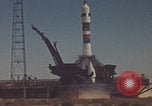
Soyuz rocket lifts off from launchpad in the Soviet Union; Soviet mission control staff
A Soyuz rocket on launch pad before liftoff in Soviet Union. The Russian rocket ignites and lifts off from launchpad. Rocket climbing upward as seen from the ground. A television screen showing screen with the rocket ascent underway, and a reel to reel tape recorder operating beside the television monitor. A tracking antenna tracks the Soyuz spacecraft. Animation depicts Soyuz aircraft in space. Tracking antennae at a control center. Soyuz docking with another spacecraft. Soviet cosmonauts inside spacecraft. Soviet scientists end engineers track the Soyuz at a mission control center.
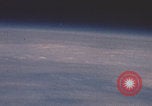
Soyuz tracking antennas and mission control center in the Soviet Union
A scientist at a mission control center in the Soviet Union. View of the earth’s surface from outer space. Animation of Soviet spacecraft during a undocking or separation maneuver. Tracking antennae at sunset on earth. Footage showing aerial view of earth’s surface. Russian scientists in a mission control center working on a Soyuz spacecraft mission. Soyuz spacecraft in flight. A large Soviet tracking antenna array moving.