


 Francais
 Deutsch
 Italiano
Refine Your Search
+"Spain" +1964 stock footage and images
- Showing 1 to 6 of 9 results more
more Hide
Hide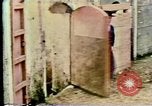
CIA and other U.S. sponsored experiments dealing with control of animals and people using various techniques during the 1960s and 70s.
In 1964, Professor Jose M.R. Delgado, of Yale University's School of Medicine, invented a device he called a stimoceiver. It was a chip that could alter the brain’s electrical impulses via radio signal. In tests sponsored by the U.S. Office of Naval Research, he implanted the device in the brain of a bull. This film opens shows that experiment and its results. A man in Cordova, Spain, opens a bull ring door to allow a fighting bull to enter. It charges a man holding a cape. Another man fires a dart to sedate the bull. Several men plant electrodes for a stimoceiver in the bull's brain. Next, the bull charges a man holding a cape, but pulls up short before hurting him. The bull chases the cape but never attacks the man as the man uses remote control to influence the animal's behavior. The bull charges around in a circle. Scene shifts to Dolley Madison Parkway (Route 123 in Mclean, Virginia, where sign points toward the CIA headquarters at Langley, Virginia. Narrator lists various techniques examined in the 60s and 70s, including brain surgery; psychosurgery; creation of amnesia; parapsychology; and manipulation of genes. Glimpse of some facilities at CIA headquarters. Change of scene to hearing of the Senate Subcommittee on Health and Scientific Research on September 20, 1977. Chaired by Senator Edward M. Kennedy, the Committee sought information about these activities by the CIA. Narrator says witnesses had agreed to limit information they would provide the Subcommittee. Former narcotics officer Charles Siragusa is seen on camera admitting that the man he reported to at the CIA wanted him not to say anything. Former CIA chemist Robert V. Lashbrook is seen testifying that he has no knowledge about the CIA running safe houses. (Narrator states he ran one of them and that a "surprise LSD experiment" was conducted there.) Scene shifts to a California tennis court, where Dr. Sidney Gottlieb is playing doubles tennis, Narrator says he oversaw those activities at the CIA but destroyed all his records when he retired in 1973. View of a letter he wrote at that time, in which he states he and his colleagues had been able to maintain contact with the leading edge of chemical and biological developments in the field of biological and chemical control of human behavior. View of Dr. Gottlieb entering an ante room where he testified before the Senate Subcommittee on Health and Scientific Research without being filmed because of what his lawyer claimed were health and cardiac problems. View of him on the tennis courts as Narrator states he declined ABC News requests for an interview. Change of scene to George White who retired from the CIA and lives in Stinson Beach, California. View of Stinson Beach from high overlooking vantage point. People jogging on the beach. Narrator states that White wrote to Dr. Gottlieb summing up his career saying, "it was fun fun fun, and where else could a red-blooded American boy lie, kill, and cheat, steal, deceive, rape, and pillage, with the sanction and blessing of the All Highest." Narrator strolls on lawn near the U.S. Capitol building and says it appears doubtful that mind control has been achieved. But work, that we don't know very much about, is continuing in this field. He asks how deeply are the Russians and other dictatorships into this. He notes that the CIA is reluctant to give information about it (such as Project MKUltra) and he questions where such a program fits in a democracy. He notes that one person working on these projects told him there are capable, conscientious, and very capable scientists working for our country, and "their work speaks for itself."
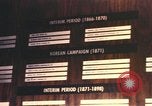
Hall of Heroes at the Pentagon showing hero names from Korean Campaign to the Vietnam War
View of the Hall of Heroes at the Pentagon, in the United States, during the Vietnam War. Names of the war heroes in the hall. Nameplates of the war heroes of each historical conflict on the wall. Names of the soldiers and officers who served the best in the wars. Names under the nameplates reading: 'Interim Period (1866-1870)', 'Korean Campaign (1871)', 'Interim Period (1871-1898)'. Other nameplates read: 'War with Spain (1898)', 'Philippine insurrection (1899-1913)', 'China Relief Expedition-Boxer Rebellion (1900)'. Several other conflicts mentioned in the hall. Other nameplates read: 'World War I (1917-1918)', 'Haitian Campaign (1919-1920), 'Second Nicaraguan Campaign (1925)', 'Word War II (1941-1945) and 'Vietnam (1964-Present).
USAFE and Spanish musicians perform John F. Kennedy March in San Sebastian, Spain
United States Air Forces in Europe (USAFE) band and a Spanish concert band joining for the first public performance of the "John F. Kennedy March" at San Sebastian, Spain. A USAFE soldier and a Spanish concert band member both play an oboe. The bands jointly play in front of the City Council of San Sebastian, also known as the Donostiako Udala (Ijentea Kalea, 1, 20003 Donostia, Gipuzkoa, Spain). The march’s composer, Jose Maria Bastida, leads the performance as a conductor. The conductor raises his baton. Jose Maria Bastida embraces the United States Consul General to Spain. American and Spanish officials clapping. An official speaks though an Altavoces Eguia microphone. USAFE and Spanish musicians play saxophones. A USAFE conductor with baton. Spanish musician plays a wind instrument. USAFE soldiers play with a Tuba and cymbals. Spanish musician hits a drum. Spectators clapping at the performance. Spectators crowd the plaza in front of the City Council of San Sebastian. Children hang on to railings in front of the City Council building to watch the orchestra concert performance. Spanish soldiers and children standing in the plaza. Faces of children attending the orchestra performance.
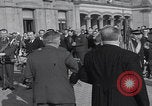
First public performance of John F. Kennedy March in San Sebastian, Spain
United States Air Forces in Europe (USAFE) band and a Spanish concert band joining for the first public performance of the "John F. Kennedy March" at San Sebastian, Spain. The bands jointly play in front of the City Council of San Sebastian, also known as the Donostiako Udala (Ijentea Kalea, 1, 20003 Donostia, Gipuzkoa, Spain). The USAFE conductor speaks to an official. Spanish officials clapping. Three USAFE band members playing flute. A USAFE musician plays clarinet with Spanish concert band members. USAFE conductor conducting with baton. Spanish musicians with clarinet. Musicians stand up after the performance. Jose Maria Bastida, the march’s composer, shakes hands with the USAFE conductor. USAFE conductor blows kisses to the crowd and gestures to Jose Maria Bastida and the joint orchestra. Crowds of Spaniards attend the public performance.
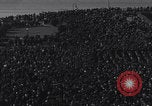
USAFE and Spanish concert band musicians perform music together in front of the City Council of San Sebastian, Spain
United States Air Forces in Europe (USAFE) band and a Spanish concert band joining for the first public performance of the "John F. Kennedy March" at San Sebastian, Spain. The bands jointly play in front of the City Council of San Sebastian, also known as the Donostiako Udala (Ijentea Kalea, 1, 20003 Donostia, Gipuzkoa, Spain). Spectators crowd the plaza in front of the City Council of San Sebastian. View of the City Council of San Sebastian building and the Concha Bay. USAFE and Spanish concert bands playing together in front of the City Council of San Sebastian building. Musicians playing brass instruments. Spectators clapping. The Lord Mayor of San Sebastian place a medal on a banner “USAFE BAND WIESBADEN”. Different flags adorn the USAFE banner. Jose Maria Bastida leads the concert band.
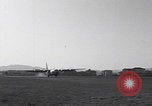
A United States Air Force aircraft taxiing on airport in San Sebastian, Spain
A United States Air Force aircraft (likely a Douglas C-118 Liftmaster) taxiing on an airfield in San Sebastian, Spain. The aircraft is taxiing on the airfield. Sign at the San Sebastian Airport (Gabarrari Kalea, 22, 20280 Hondarribia, Gipuzkoa, Spain) reads “Aeropuerto de San Sebastian Fuenterrabia”. A man stands on the balcony of the San Sebastian Airport control tower. View of the airfield as seen from an aircraft taking off.