


 Francais
 Deutsch
 Italiano
Refine Your Search
+"Tarawa Gilbert Islands" +1943 stock footage and images
- Showing 1 to 6 of 36 results
2nd Marine Division aboard transport ships headed to Tarawa, Gilbert Islands, during World War II
U.S. Marines boarding troop transport ships in World War 2. A line of the transport ships underway in the Pacific, en route to Tarawa, Gilbert Islands. The Destroyer, USS Frazier (DD-607) seen close to port, astern, with a line extending to the transport ship. A sealed packet of orders for the transport and the Marines is delivered over the line. Scene shifts to an officer briefing marines with help of a large relief map of Betio in the Tarawa atoll. The map is complete, in every detail, down to models of structures there. Marines are seen belting machine gun ammunition and test firing their weapons. Marines on deck exercise doing calisthenics. Officer briefing Coast Guard and Navy coxswains who will be operating landing craft during the amphibious assault. Religious service being conducted on deck by a military Chaplains, on evening of November 19, 1943. Catholic chaplain, Father Francis W. Kelly, Chaplain, U.S.N.R. saying Mass, for marines. (Narrator comments that many of these Marines were killed the next morning.)
U.S. Marines launch amphibious assault against Japanese forces at Betio, Tarawa Atoll, in the Pacific during World War II
Scene is dawn viewed from deck of a troop transport ship off the coast of Tarawa, Gilbert Islands, on D-day (November 20, 1943) for the amphibious assault by U.S. marines against the Japanese- held atoll, in World War 2. Marines loaded into a Higgins boat at the side of the transport ship. Several such landing craft maneuvering off the ship's bow. Benson-class destroyer bombarding the coast. Closer view of the destroyer with landing craft nearby. Glimpse of Japanese Aichi D3A (Val) dive bomber above. Two bombs exploding in water near the camera ship. U.S. Navy F4F aircraft flying low bombing and strafing. Glimpse of Navy warships bombarding after Navy planes depart. Then many landing craft are seen, some from the USS Sheridan (APA-51). Mixture of quick views showing naval gunfire, Marines in landing craft (including closeup of two marines looking out from inside one). U.S. Naval aircraft bombing inland, close to the shoreline. A derelict Japanese ship, displaying battle damage is seen in the surf. (Narrator notes that Japanese machine guns were set up and fired at landing craft from this hulk.) Closeup of radio operator on deck of invasion vessel. Views of amphibious landing vehicles tracked (LVT) moving toward shore. All American Higgins boats and LVTs subject to heavy Japanese machine gun and mortar fire, as well as bombing by Japanese Aichi D3A dive bombers. Burning landing craft in the surf. Landing craft arriving at the beach under heavy fire. One is marked, "KA 20-11" indicating it is from the USS Virgo (AKA-20). Long shot of Marines strung out on section of beach. Closeup of marines wading ashore from wrecked LVT. Several marines move along a concrete pier. Many marines are hunkered down behind it. Various views of marines pinned down on the beach. Some sheltered behind an LVT.

U.S. forces capture Tarawa, Gilbert Islands, from Japanese forces. Sea Bees repair captured airfield. during World War II.
The Battle of Tarawa between U.S. and Japanese forces during World War 2. U.S. Task Force ships head for Tarawa in the Gilbert Islands. U.S. officers confer aboard a ship. A stick points out the location of Tarawa on a map of the Pacific Ocean. U.S. soldiers bow their heads in prayers aboard the ship. U.S. naval guns are fired at coastal targets. U.S. Marines in landing crafts head for Tarawa. Smoke rises from artillery shell attacks on the island. The Marines use hand grenades to destroy Japanese pillboxes and machine gun nests. Reinforcements arrive and U.S. Marines advance inland after heavy fighting. Abandoned coastal artillery guns and dead Japanese soldiers on the island. The island after the battle. Forced Korean laborers on the island. A U.S. medic giving first aid to a Korean laborer. U.S. Navy CBs (Construction Battalion) make repairs and construct an airstrip on Tarawa.
Operation of United States Coast Guard in Tarawa, Pacific Theater during World War II
Overseas activities of United States Coast Guard in World War II. November 20, 1943, U.S. Marine Corps invade Tarawa Atoll. Naval warships bombard Tarawa. Transport ship USS Arthur Middleton underway. Only 1 out of 5 U.S. troops reach the beach in first wave of attack. Firing and explosion. U.S. troops wade. Many U.S. Marines injured during the landing on Tarawa. The U.S. Coast Guard brings back the wounded to the transport ship. Wounded soldiers lifted on stretchers.
United States destroyers, heavy cruiser, and light cruiser bombard Tarawa Island in Pacific Theater
U.S. Navy World War II battleship, destroyers, heavy cruiser and light cruiser bombard the Island of Tarawa in Pacific Theater, in November 1943. Smoke rises from the beach. A 16" gun on board USS Maryland (BB-46) bombards Tarawa. Shells burst in air and island obscured by smoke. Depth charges explode in water as light cruiser continues to bombard the island. Ship at timecode 2:34 and 3:10 is a heavy cruiser of the Portland or Northhampton class, based on catapults with sea planes located at mid ship. Based on ship assignments and locations at that time, this would make it either the USS Chester (CA-27), the USS Portland (CA-33), or the USS Indianapolis (CA-35).
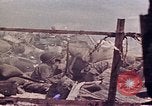
U.S. marines mopping up after battle for Tarawa, in Pacific. Generals Holland and Julian Smith. Admiral Harry Hill. Marine dead.
U.S. Marine Corps during Battle of Tarawa of World War II in November 1943. United States 2nd Marine Division Corps fire artillery. On the beach,Chaplains Assistants remove one dog tag from each of many dead marines. General of the United States Marine Corps Generals Holland McTyerie Smith and Julian Constable Smith U.S. Navy admiral Harry Wilbur Hill, commander of the task force. Bulldozers dig the ground in search of Japanese in bunkers as deep as 20 feet. They destroy the Japanese bunkers. Japanese prisoners are marched by the Marines.