


 Francais
 Deutsch
 Italiano
Refine Your Search
+"Tehran Iran" +1943 stock footage and images
- Showing 25 to 30 of 30 results more
more Hide
Hide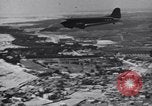
Leaders of U.S., Britain, and the Soviet Union meet in Teheran, Iran, to plan actions against Nazi Germany during World War II
Film begins showing a U.S. Army Air Forces C-47 transport plane in flight over the city of Cairo and Pyramids, in Egypt during World War 2. U.S. President Franklin D. Roosevelt's voice is heard speaking in his 1943 Christmas report to the Armed Forces. He states that following the Cairo Conference, he and Prime Minister Winston Churchill flew to Teheran, Iran. View of city of Teheran from an airplane overhead. View of front of the Soviet Embassy building there. Wider view showing conference principals on the porch with reporters and photographers below the steps. Next, a closer look with Soviet Marshal Stalin, President Roosevelt, and Prime Minister Churchill, seated on chairs, conversing. Closeup of the Big Three with their military commanders standing behind them. Views of ongoing Soviet operations on the Eastern Front. Russian troops firing field artillery from a snowy field. (A transport airplane is in the far background.) Shells bursting on snowy hillside. Soviet soldiers training in white arctic clothing rush through toward tanks and lie down in the snow. Three Soviet aircraft buzz a snow covered field. A huge explosion is seen and then Soviet cavalry charge across snow. View shifts to U.S. Army troops operating in Italy. A jeep filled with soldiers tows an artillery field piece across a shallow river. U.S. soldiers ride across a stream in a truck. Rear view of artillery piece being towed toward an italian town. Glimpses of aerial combat between Allied and German aircraft. General Dwight D. Eisenhower and General Mark Clark are seen riding in a jeep across a bridge in Italy. Glimpse of Italian people trying to clean up destroyed section of a town. Portrait of Benito Mussolini in the debris. General Eisenhower walking with a local British commanding officer and General Mark Clark, in Italy. Eisenhower and Clark at an outdoor briefing by British officers. Eisenhower pinning the Legion of Merit medal on U.S. Army Air Forces Lieutenant General Carl Spaatz, deputy commander of the Mediterranean Allied Air Forces who President Roosevelt says has been selected to be commander of Strategic Air Forces in Europe. Glimpse of B-24 Liberator bombers dropping bombs in Europe. Film shifts back to Teheran and the Big Three Leaders sitting in chairs. Closeups of them. Then their foreign secretaries step being them (Molotov, Hull, and Eden.) Nazi swastika flag. German armed forces marching on parade. German boys playing on artillery pieces under watchful eyes of German soldiers. Children at a playground. European farmers harvesting grain by hand. German troops in black parading. Glimpse of Adolf Hitler giving impassioned speech. Several views of Teheran conferees. President Roosevelt holding a ceremonial sword. Scenes of good will with hand shakes among conferees. Glimpses of British, Soviet, and Chinese troops attacking. Massed flags of the Allies.
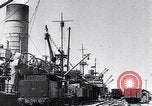
Roosevelt, Stalin and Churchill meet at Tehran conference in Iran
Cargo being unloaded from ships. Military trucks move over a bridge. Joseph Stalin, the Soviet Premier, President Franklin D. Roosevelt of United States and Prime Minister Winston Churchill of Britain at Tehran Conference in Iran.
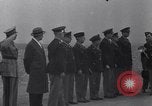
Shah of Iran Mohammad Reza Pahlavi and his wife inspect United States military installations in Tehran during World War II
Shah of Iran Mohammad Reza Pahlavi and his wife, Queen Fawzia, and an entourage of Iranian officers, inspect United States military installations in Tehran. United States Military officials greet the royal couple. Major General Donald H. Connolly (wearing glasses), Commander of the U.S. Army Persian Gulf Command steps forward to greet the Royal couple. Shoulder patch of the Persian Gulf Command (a scimitar and 7-pointed star) is seen on his uniform. General Connally salutes and removes his cap, as he takes the hand of Queen Fawzia. He introduces a Brigadier General to the Royal couple and then all proceed down a path. Large radio antennas are seen dimly in the background. The Shah and Empress emerge from the broadcast facilities of the American Expeditionary Station Tehran, and General Connolly helps Queen Fawzia into a U.S. jeep. An American soldier driver gets into the jeep. The Shah, Queen, and party are escorted by the American officers along a path to the "Service Club", as American soldiers stand to the side. They are seen later, coming out of the Service Club. The party poses for photographs.
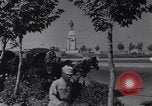
Views of Tehran, when Iran was the "Persian Corridor" for American Lend-Lease aid to the Soviet Union in World War II
Opening scene is of ordinary day in teheran, Iran, during World War 2. A horse and wagon sits quietly in shade at edge of a traffic circle centered on monument topped with a statue of Reza Shah Pahlavi . A U.S. Army truck, displaying a white star, and a jeep, drive by on the nearby roadway. A horse-drawn wagon passes at edge of toad. A military truck drives around the road closest to the statue of Reza Shah Pahlavi . Closeups of the statue. Change of scene shows an official-looking modern building, with a guard at its open gate. A sculpture above the gate depicts a crown flanked by two lions. Several pedestrians pass by casually on the road and sidewalk. The pedestrian women include some in Western dress and ant least one with head modestly covered. View through the open gate shows a circular drive around a garden and a large building behind it. Two military officers walk out the gate. One wears a steel helmet. They pass the guard standing by his booth. Street scenes showing a modern building and light traffic, including another American jeep, a horse-drawn wagon, a car and a bus. Several multistory apartment buildings. View looking down on a horse-drawn cart moving along a tree-lined city street.
Franklin Roosevelt travels in a jeep during Tehran Conference in Iran.
A jeep procession on the road during Tehran Conference in Iran. U.S. President Franklin Roosevelt's jeep leads the procession. Snow covered mountains in the background. Buildings of Camp Irmimad in view. Soldiers in attention as the jeeps pass. The convoy stops. Band plays National Anthem. Officers salute. (World War II period).
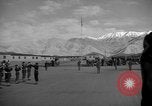
United States President Franklin Roosevelt travels in a jeep procession during Tehran Conference in Iran.
A jeep procession on the road during Tehran Conference in Iran. U.S. President Franklin Roosevelt sits in a jeep. Snow covered mountains in the background. The convoy stops. Band plays National Anthem. Officers salute. The jeeps restart and the convoy continues. The jeeps pass the soldiers standing in attention. U.S. President Franklin Roosevelt's jeep leads the procession. (World War II period).