


 Francais
 Deutsch
 Italiano

Refine Your Search
+"Tunisia" +1943 stock footage and images
- Showing 73 to 78 of 92 results more
 Hide
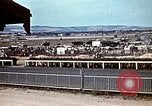
Allied controlled camp for German prisoners of war in North Africa.
Allied held POW camp in Tunisia during the North African campaign, around time of capture of Tunis and Axis surrender in North Africa in World War 2. German prisoners of war move about the compound filled with many small tents and tarps for shelter. German prisoners stand beside military trucks. A German soldier wearing a Afrika Korps M41 Cap smokes a cigarette. A group of German soldiers in a loose line in the background.

Scuttled ships and factory ruins at the Tunis Port.
Scuttled ships at the Tunis Port in Tunisia during World War 2. Charred deck of a bombed ship. Ruins of charred buildings and factories at the port. Hull of a sunken ship. Naval officers in a speed boat. Sailor walks past the rubble of damaged factory. Sign of the Tunis Port Depot. Wrecked ships and cranes in the background. U.S. Navy sailor stands before an iron gate.
Allied Forces invade Sicily during World War II
Allied Operation Husky in World War 2. Opening scene shows Allied ships in task force bound for the invasion of Sicily, Italy. Barrage balloons are seen in sky overhead. At first most of the ships seen are troop transports. Then a British Escort Cruiser is seen, followed by other British warships. The British Naval Ensign flying from the masthead of a warship. More views of battleships and destroyers. Aircraft carriers in line. View from ship in the task force as it passes island off Tunisia, and then passing Cape Bon, Sicily. A British destroyer pulls to the port side of the camera ship and transfers a person by bosun's chair. (Narrator calls him a "military expert.") Glimpses of life aboard the ships of the task force. Sailors swimming in a pool aboard deck. Others repairing shoes; washing items in small buckets; and reading "soldiers Guide to Sicily." Sailors use signal lamp to communicate with other ships. Sailors man and maneuver a multi barrel bofors anti-aircraft gun, on deck. Suddenly winds pick up and the seas become very rough. Next, the seas are seen very calm. Scene shifts to North African mainland, where several trucks full of British and American paratroopers move across the sand toward C-47 aircraft that will take them behind enemy lines in Sicily. C-47s are seen parked all over the area. Paratroopers don their chutes and battle gear as they prepare to board their aircraft. Closeup of a crew chief pulling propeller through on number one engine of a parked C-47 aircraft. British paratroopers assist one another with their gear. Officer makes final check of paratroopers under his command. Closeup of British paratroopers boarding their C-47 transport aircraft, and the plane taxiing in sand and taking off. Numerous C-47s taking off as daylight wanes. Allied warships bombarding the Sicilian shore in the nighttime. Troops engaged in amphibious assault on beaches of Sicily. Battle scenes showing black flak clouds in the sky and explosions near the assault and landing craft during the amphibious operations. Black smoke rising from Allied ships struck by bombs or shelling. A landing craft, filled with Canadian soldiers, leaves a transport ship headed for the beach. Other assault boats headed for the beach. Views from the Allied beachhead on Sicilian shore. British, Canadian and American troops making their way from landing craft to the shore, guided by ropes. The march along the shore. A British scout car arrives on the beach, followed by a truck. Then tanks come ashore from large landing craft. Some troops come ashore on a DUKW amphibian vehicle. Allied troops wade ashore and smile for the camera.
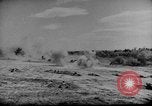
U.S. Army Quartermaster Corps prepare mortars, fire anti aircraft guns, and provide supplies during World War II.
Clip opens with brief World War I scene, circa 1917, of new American army recruits receiving army uniforms being issued by a U.S. Army Quartermaster. Clip then covers U.S. Army Quartermaster Corps' combat operations in various Theaters of Operations during World War II. Quartermaster Corps soldiers with rifles under the cover of a military truck during battle. Troops in trucks. An aircraft in low flight over a field. A U.S. Army truck. A Quartermaster fires an anti aircraft gun. Explosions occur and smoke rises. A British tank in a field. Soldiers beside a truck. Cans and barrels stacked on the ground. An enemy German tank in a field. Soldiers take cover. Quartermasters with guns in a trench. They come up the trench in prone positions. Dramatized battle scene with several Quartermaster corps casualties beside a wire fence. Soldiers prepare a mortar gun. An anti aircraft gun on an army truck. A soldier takes aim and fires a rifle during training. The Quartermaster flag hoisted on a pole. Actual footage shows aerial view of Bataan, and then ground views of groups of remaining U.S. Army soldiers around time of surrender of Bataan in April 1942. American soldier seen with their hands up and under guard of Japanese soldiers during Bataan surrender. Landing crafts arrive at a beach in North Africa. Supplies being offloaded at various battle fronts of World War 2. Soldiers and supplies off-loaded on the beach. Quartermasters seated on supplies boxes. Landing crafts arrive at a beach in the South West Pacific. Troops move across the beach. Troops disembark from landing crafts and move across a beach in Sicily, Italy. The Quartermasters unload boxes of supplies during various beach landings. They unload supplies and fire artillery on a beach head in Italy. Troops in trucks. A convoy of trucks loaded with supplies. Ammunition, ration and personnel in trucks move from Algeria to the front in Tunisia. Explosions occur and smoke rises. Trucks advance through smoke at night and in difficult conditions. Quartermaster General Major General E. B. Gregory speaks about the Quartermaster Corps. He says that the Quartermasters distribute goods to the army during training and combat. The movement of the Corps should be so regulated so as to deliver the goods at the right time in the right quantity.

Italian troops advance with tanks and fire artillery at Tunisian Front.
Italian troops battle on the Tunisian Front. Soldier speaks on phone inside a bunker. Italian troops advance with artillery. Axis soldiers fire artillery. Explosions on hillside. Prisoners get onto army truck. (World War II period).

Remains of wrecked German 6 motored transport at El Aouina airfield in Tunis.
Completely wrecked German Messerschmitt Me 323 Gigant at the El Aouina airfield in Tunis. Heavy tubular skeletal framework of the main body and dense framework of the wings is seen. All covering is gone, except for a few tattered remnants on the body and wings. The empennage appears to be partially intact.