


 Francais
 Deutsch
 Italiano
Refine Your Search
+"United Kingdom" +1915 stock footage and images
- Showing 13 to 17 of 17 results more
more Hide
Hide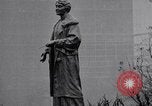
Brief montage of moving images from early 20th Century Women's suffrage and equal rights movement in Great Britain.
Scene opens showing the statue of British Women's suffrage movement leader, Emmeline Pankhurst, located in Victoria Tower Gardens next to the Houses of Parliament, Westminster. (This was erected in her memory, in 1930, two years after her death.) A World War 1 parade of women in clothing of religious orders; nurses; some military; and academics. One group carries a banner reading "Demonstrate-Trained Nurses." It also depicts What appears to be an Angel of Mercy and an appeal to buy war bonds. They are followed by women carrying a large British Union Jack, and by others, in academic garb, carrying banners of academic institutions. (This march was probably organized by the "Women's Party," the 1917 group founded by the Panghursts' to replace their "Women's Social and Political Union." The new party emphasized support for the British war effort.) Scene shifts to suffragist Emmeline Pankhurst (sometimes called a suffragette) viewed from camera behind her right shoulder as she addresses a large crowd. She is standing on a roofed platform in a park-like setting. The audience is mostly civilian, but a soldier is seen here or there. Several London Bobbies are in the audience, close to the speaker's stand. The next scene shows pedestrians gathered near Buckingham Palace, in London. A number of Bobbies (London policemen) are present, some on foot and some on horseback. The Queen Victoria monument is visible in the background. A horse-drawn carriage passes in front of the camera. Next, a woman is seen being arrested by two Bobbies, as passersby watch. An automobile passes and then the woman and police are seen approaching the camera as more officers become involved, keeping spectators away. In the final scene, in the 1920s, a man standing in front of a large group of women, congratulates one (probably Christabel Pankhurst). Closeup shows, from left to right, the man; a somewhat tired-looking Emmeline Pankhurst; and her daughter, Christabel.
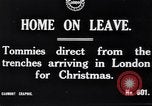
British soldiers arriving in London on Christmas leave during World War I
British troops arriving at Kings Cross railroad station, in London, on Christmas leave during World War I. Soldiers amongst civilian shoppers at a poultry market. One of the soldiers holds up a dressed bird. (World War i; World War 1; WWI; WW1)
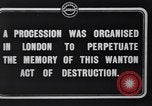
The procession by the British Empire Union in London, protesting the sinking of the Lusitania in World War I
Procession by the British Empire Union with boards and banners in London. Houses and buildings in the background. The procession is protesting the World War 1 sinking of the ship Lusitania. Signs include "Out with all Germans, naturalised or not." A model of the Lusitania is carried by the protestors, encased in a long box with glass sides. (WWI; WW1)
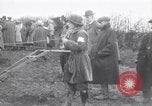
British women handle plows and work fields during World War I.
Women working in Britain to aid the war effort, during World War 1. British women from the Surrey, England area use manual plows pulled by horses. Civilian men look on and provide advice, as the women practice plowing.
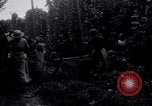
Hoppers harvest hops in Kent England during World War I
Men, women, and children gathered at a hops farm in World War 1. The happy workers, possibly from Kent, or migrant "hoppers" from London on a "hopping holiday" work together to harvest hops. The row is filled with busy hoppers of all ages. Bin men with long poles pluck hop-laden vines from the high-growing plants. Children and women separate hop cone flowers from plants, gathered over bushel baskets. A woman pulls a hand cart between rows of hop plants.