


 Francais
 Deutsch
 Italiano
Refine Your Search
+"United Kingdom" +1919 stock footage and images
- Showing 1 to 6 of 15 results more
more Hide
Hide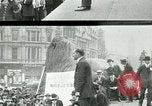
British World War I veterans speak and crowd listens at Trafalgar Square at a demonstration in London, England.
Discharged veteran British soldiers and heroes of the Battle of Mons demonstrate at Trafalgar Square in London, England soon after World War 1. A veteran with crutches speaks from the platform. Men in the crowd raise hands. A man speaks from a platform while another sits and stands near the bronze lion. Soldiers stand near the crowd in Trafalgar Square (Trafalgar Sq, London WC2N 5DN, United Kingdom).
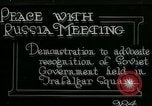
British Communists campaign at Trafalgar Square for recognition of Soviet Russia
Slate reads; "Peace with Russia Meeting. Demonstration to advocate recognition of Soviet Government held in Trafalgar Square." A large crowd is gathered at the Square. Several speakers address them from the base of Nelson's Column (A400 Trafalgar Square, London, United Kingdom), next to the lion statues. One banner seen reads: "prepare to lay down tools," pointed at working men. A call for "copper donations" results in an outpouring of pennies, which men pick up from the ground and carry to the front where one of the only women seen, is consolidating the contributions. Two men converse. One wears a fez.
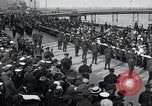
Body of Edith Louisa Cavell being brought to England from Brussels.
Procession of the body of Edith Louisa Cavell in England. A huge procession seen walking and crowds gathered to see the procession. A carriage carrying the body of Edith Louisa Cavell, a British nurse during World War I, after it was brought back by the destroyer HMS Rowena from Ostend, Flanders to Admiralty Pier in Dover. A fleet of soldiers, nurses with flower bouquets and army band seen walking with the carriage carrying the coffin. The coffin is covered with the English flag. Soldiers bow as the coffin is brought at the Norwich Cathedral (65 The Close, Norwich NR1 4DH, United Kingdom) where it was reburied.
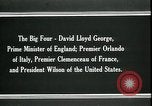
David Lloyd George, Vittorio Emanuele Orlando, Georges Clemenceau, Woodrow Wilson meet for the Versailles Peace Treaty.
Events during the Paris Peace Conference after World War I. The Big Four- Prime Minister of United Kingdom David Lloyd George, Prime Minister of Italy Vittorio Emanuele Orlando, President of United States Woodrow Wilson, and Prime Minister of France Georges Benjamin Clemenceau are seen. They were the dominant diplomatic figures in the Paris Peace Conference and played a major role in designing The Treaty of Versailles.
Final days of WW I, and aftermath. Riots in Russia. Treaty of Versailles. League of Nations. Harding elected President
Final throes of World War I and postwar situation. German submarines sinking allied ships. American workers work in war plants. U.S. Army General John Joseph Pershing visits France. American soldiers disembark from a ship in France. Germans defeat Russians on Eastern front and divert troops to the Western front. German soldiers on horse drawn wagons and others walk carrying guns as they move. Riots in Russia after it collapses in war. American soldiers fire field artillery. U.S. President Woodrow Wilson writes letters to countries at war like Germany. Papers with the 14 points to maintain peace. The soldiers of Germany and America on battle field. Dead soldiers on ground. Soldiers carry another injured soldier on a stretcher. The people protest during a rebellion in Germany. Soldiers of America cheer signing of Armistice. Cemetery. .Americans on streets in the U.S. after the war. President Woodrow Wilson goes on a tour of Europe. He sails to different places. Prime Minister David Lloyd George of the United Kingdom, Prime Minister Vittorio Emanuele Orlando of Italy, Prime Minister Georges Clemenceau of France, and President Woodrow Wilson of the United States in France during the signing of the Treaty of Versailles. Map shows the different nations formed after the war. The president returns after his visit. Henry Cabot Lodge, a U.S. senator. President visits different places to explain the peace treaty. Sketches show the President suffering a paralytic stroke and his wife takes his important decisions. Sketch depict the opponents of the peace treaty and the defeat of the league of nations. Warren Gamaliel Harding elected as the new President Harbinger of the future: views of Adolf Hitler on the rise in postwar Germany.

Delegates arriving at the quarters of the German delegation in Versailles, France
Delegates arriving at quarters of the German delegation in Trianon Palace Hotel (1 Bd de la Reine, 78000 Versailles, France) in Versailles, France. French Marshal Ferdinand Foch, French Premier Georges Clemenceau, President Raymond Poincare, Colonel Edward M. House, United States Ambassador to France Henry White, United States President Woodrow Wilson, United States Secretary of State Robert Lansing, Greek Premier Eleftherios Venizelos, Lord Balfour, United Kingdom Prime Minister Lloyd George, and Polish Prime Minister Ignacy Jan Paderewski arriving.