


 Francais
 Deutsch
 Italiano
Refine Your Search
+"United Kingdom" +1941 stock footage and images
- Showing 7 to 12 of 76 results more
more Hide
Hide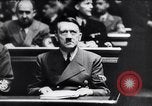
Hitler addresses Reichstag in Berlin, Nazi army advances in Soviet Union, and signing of Atlantic Charter during World War II.
Adolf Hitler addresses the Reichstag in Berlin on December 11, 1941 declaring war operations against the United Kingdom, Soviet Union, and United States. Marshall Hermann Goering, Sharp and other Nazi leaders listen to him. A map shows eastern front with Nazi German Armies advance in Soviet Union. Battle scenes between German and Soviet armies. German soldiers capture a Soviet prisoner of war. German soldiers fire artillery during a battle. View of German tanks advancing and firing on a battlefield. Ruins of a wrecked, smoking Soviet tank. Scene shifts to United States President Franklin Roosevelt and British Prime Minister Sir Winston Churchill at Atlantic Conference aboard ship "Prince of Wales" for signing of Atlantic Charter. The Allied leaders are seen singing "Onward Christian Soldiers" during a service.
American Curtiss P-40 fighter planes are being readied for shipment to United Kingdom
Shows P-40C’s in production at Curtiss plant in Buffalo, NY (2303 Kenmore Avenue), getting readied for shipment to United Kingdom as a part of Lend-Lease program. Aircraft workers working in Curtiss plant, assembling aircraft. A worker moves a stack of aicraft tires. P-40 fighter plane taxiing and planes in flight line at Curtiss facilities at the Buffalo Airport.
The discovery and production of penicillin and its first import to the United States
Scottish scientist Sir Alexander Fleming isolates antibiotic substance penicillin from the fungus at St Mary's Hospital in London, United Kingdom. A petri dish with penicillin. Articles on bacteriology, immunology and chemotherapy are published. Pharmacologist Howard Walter Florey extracts penicillin at Oxford University. In June 1941, tiny flask of penicillin brought to the United States. Chemists work and develop penicillin in refined form. Penicillin Production Factory. Penicillin is built in many forms. Penicillin is made in huge fermentation tanks and passed through many machines for purifying and refining. Quantities of penicillin reduced in gallons to recover it. It is concentrated in the laboratory. Water contained penicillin, evaporated at laboratory. Penicillin transferred to sterilized vials and packed in boxes. Penicillin prepared for use.
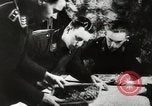
Germans prepare for a direct invasion of England, and British sailors drop naval mines in the English Channel for coastal protection.
Germany's preparations for invasion of the United Kingdom in World War 2. German soldiers study papers at a desk and prepare for direct invasion over England. The soldiers observe back lighted reconnaissance photos with a magnifying glass and observe forms of ships. A German pilot inside an aircraft in flight low near the coast of Dover, Portsmouth, and Plymouth. A German torpedo boat, or Schnellboots aka S-boot or S-boat, at sea running at high speed. German sailors and officers on the deck of a Schnellboots torpedo boat. German Army paratroopers in training for jumps. German paratroopers jump from simulated aircraft at low height, and hanging from wires, as they practice landing and rolling. German paratroopers at the open door of an aircraft and jumping in a line from the aircraft in flight. A number of parachutes in the air. A sketch shows the layers of British defensive positions from the coast inward. British flying boat over water. Gun turret of flying boat in action. Allied signal man soldier using portable signal lamp. Sailor on ship using large signal lamp. A British ship in the rough North Sea during a squall storm. British sailors in mine laying operation drop large round naval contact mines with protruding Hertz horns visible, into the sea. Booms with steel submarine nets in front of a British harbor to catch submarines and surface craft.
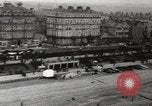
British soldiers with guns at beaches and soldiers check identity of people in England during World War II.
Aerial view of buildings and beaches on coast of England, United Kingdom, during World War 2. Narrator describes preparations by British soldiers for an invasion of England by German forces. British soldiers train for defensive operations. They run holding rifles and take up positions along the coast. Artillery gun barrel as the gun is fired. A group of soldiers run carrying guns. Two soldiers walk. A church and a field. A soldier checks the identity of a woman and a man. Another one stops a vehicle and checks the identity of a civilian driver. Soldiers board vehicles. British aircraft overhead in flight, on patrol against German attack. British troops hold guns and march. New recruits are processed: Man in civilian suit stands in queue to receive military uniform and equipment as he enters the British armed forces. A ship carrying troops from Canada departs its home port bound for the war front. Families of the troops wave from dock and wish them good bye.
King George and Queen Elizabeth visit a shipyard in England; Exiled King Peter II of Yugoslavia arrives in London (WW2)
King George VI and Queen Elizabeth Bowes-Lyon visit a shipyard in England. The King and Queen of the United Kingdom are cheerfully greeted by workers. King George VI watches a worker welding. The royal couple congratulate Ms. Jacqueline Cochran, thanking the American female pilot for her service to the British Air Transport Auxiliary (ATA) as a flight captain and a recruiter of qualified woman pilots delivering American built planes to Britain for the "Wings for Britain" effort in World War II. King Peter II of Yugoslavia, young monarch in exile and Godson of the King and Queen of England, arriving safely in London after a dramatic escape from Yugoslavia.