


 Francais
 Deutsch
 Italiano
Refine Your Search
+"United Kingdom" +1942 stock footage and images
- Showing 1 to 6 of 70 results more
more Hide
Hide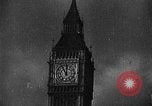
Axis forces of Rommel's Afrika Corps in full retreat after facing heavy Allied attacks in El Alamein, Egypt.
Second battle of El Alamein in Egypt, North Africa, between Allied Forces and German Forces in October, 1942, during World War 2. View of Big Ben clock tower in London, England, United Kingdom. In a UK war material production facility, British women war production workers stop work to listen to BBC announcement over public address speaker that Axis forces of the Afrika Corps (Africa Corps) under German commander Rommel are in full retreat in El Alamein, Egypt. Scenes in North African of British tanks advancing past many pieces of destroyed German armor, tanks, and artillery. Views of captured German planes, artillery, tanks and prisoners. Some artillery and tanks destroyed or still smoldering from recent attack on the retreating German forces, including smoldering Panzer tanks (Pz IV). Destroyed and bombed out German Luftwaffe aircraft parked on the ground. Five divisions of Italian soldiers in the South, abandoned by Rommel are swept up by Allied forces as prisoners of war. Italian prisoners kneel at a ditch and drink water from it. German prisoners march under British guard. German General Wilhelm Ritter von Thoma, captured near the hill of Tel el Mampsra, marches on sand under British guard. Aerial views of British Royal Air Force planes bombing retreating German positions on ground. Bombs away views from aircraft, and explosions and clack smoke arises from ground. View of British RAF pilot in cockpit flying De Havilland DH 98 Mosquito aircraft and strafing German trucks and armor as they retreat across open desert. Low level views of British Mosquito aircraft as it strafes German positions, as seen from cockpit of Mosquito aircraft.

British RAF bombers of No 2 Group bomb the Philips Electrical works at German-occupied Eindhoven, Holland, during World War II.
Film starts wirh slate reading: "R.A.F. Blasts Holland." At an Royal Air Force (RAF) base in England, United Kingdom, ground crewmen work on a British Supermarine Spitfire aircraft. Closeup of RAF pilot in cockpit of an airplane. Closeups showing fires burning and severe destruction of the Philips Electrical works at Endoven, the Netherlands, in aerial photographs taken during a bombing attack by RAF 2 Group, on December 6, 1942. Animated map illustrates the flight path of the attacking bombers from England, across the North Sea and the German occupied Holland, to Endoven. View of a de Havilland Mosquito bomber with propellers turning and then one of a Mosquito bomber in flight overhead. View from a warship of several RAF 2 Group aircraft flying low over the North sea. Glimpse of a Mosquito bomber flying low enough to affect the ocean surface. View from another aircraft in the formation, of a Mosquito bomber underway low over the water. View of a pilot in a cockpit, wearing learher helmet with earphones and an oxygen mask. View from aircraft approaching the coast of Holland, with two others already low above the mainland. More views of the bombers flying extremely low over Holland. View from a bomber showing agricultural land and the Philips Electrical works at Endoven, dead ahead. German flak guns fire and the bombers return fire by strafing the target building. The camera aircraft pulls up climb above the building and maneuvers over a river and city. Scene shifts to views from a high altitude group of RAF 2 Group, over the target. Views of their bombs bursting on target complex, causing fires and heavy smoke. Scene shifts, again to the bomber aircraft recovering at their home base in England. (Narrator states that 12 aircraft did not make it back.) View of a mosquito bomber crash landed. A severely damaged Lockheed PV-1 Ventura bomber. A crash landed Douglas A-20 Havoc bomber. Air crews conversing after arriving back from the mission. (Note: Losses to 2 Group were heavy, with 14 aircraft brought down by flak and enemy fighters, a 20% loss rate. Three more aircraft crash-landed on returning to England. Fifty-seven aircraft had been damaged and needed repairs.)
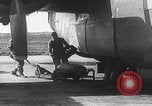
USAAF B-24 Liberator bombers leave the United Kingdom for assignment in North Africa (WW2)
United States Army Air Force (USAAF) B-24 Liberator bombers taxiing and taking off from the United Kingdom during World War 2. Men attach bomb on a B-24 Liberator (Second Bombardment Wing). Nose art of B-24 Liberator “Peep Show” (42-7535) depicting a naked cartoon blond woman seen from a keyhole. B-24 Liberator “Peep Show” engine begins to move. B-24 Liberator aircraft leave the United Kingdom for an assignment North Africa. Another USAAF B-24 Liberator begins to taxi on the airfield. B-24 Liberators taxiing and taking off from an airfield. A group of USAAF B-24 Liberator bombers in flight, flying past branches of trees. A machine gun barrel peering out in front of a group of flying bombers. A bomber in flight.
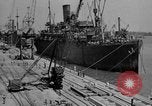
Military supplies to China from United States and the United Kingdom transit from Calcutta, India to China during WW2
Workers load supplies in Calcutta port in India during World War 2. A crane lowers stacks of boxes. Indian laborers roll artillery shells. A row of United States army trucks. Various materiel and military supplies, including rolls of chain link fencing and rolls of barbed wire. United States soldiers prepare a row of tanks for shipment. A transport boat on the Hooghly River in Calcutta, India (present day Kolkata, India). Sign on boat reads, "Rambari." Transport boat sets sail for the Brahmaputra River. A train begins to depart on the Bengal-Assam Railway. Indian worker transfers boxes to another train during a stop. Laborers repair train tracks damaged by monsoon rains. United States Army Douglas C-54 Skymaster planes in flight.
U.S. Army Air Forces repair and re-fly a battle-damaged B-17 after an emergency forced landing in World War II
Film opens showing a large formation of U.S. Army Air Forces B-17 bombers flying high overhead as they return to bases in the United Kingdom, during World War 2. Closeup of one plane shows Triangle tail code of the 97th Bombardment Group, and tail number 42-23383. View looking past tail tunner turret towards numerous aircraft in a formation. Scene shifts to view from a B-17 of black flak clouds from German anti-aircraft guns. A B-17 in flight with flak damage to a wing, and another with a destroyed left tail stabilizer and elevator. Closeup of feathered right inboard engine on a B-17 in flight. More views from behind the formation, and looking straight up at passing B -17s overhead. View looking down at a B-17 approaching for landing. Closeup of both right engines feathered on a B-17 in flight. (Narrator states an aircraft named "Stella" had three engines inoperative and was unable to reach the field to land.) Army Air Forces controllers communicating by radio with crews of aircraft. View from ground of the B-17 ("Stella") coming in for a crash landing in an oat field, with landing gear not extended. Closeup from cockpit, of number 3 engine running and number4 feathered. View from inside the aircraft as it crash lands. View of it in the field. It displays tail number 42-5910 and a "G" tail code in a white triangle, identifying it as belonging to the 40th Bombardment Wing, 305th Bomb Group at RAF Grafton Underwood Trucks are seen carrying mechanics and technicians to the crash landing site. Next, the B-17 is seen surrounded by repair crews. It is sitting in a cleared area and its landing gear is intact. Closeup of the aircraft's flak torn fuselage. A severely damaged gun turret on the ground next to the aircraft. Section of cockpit sitting on the ground. Views of mechanics working in their portable shops as they make repairs to the B-17 aircraft. Machinist running a lathe in one of the portable shops.View from ground of the mechanics at work on the aircraft's engines, as engineers employ earth-moving equipment in the background to create a temporary runway to facilitate takeoff. Closeups of the earth-moving equipment at work. More closeups of mechanics working to restore the aircraft. Some work on an engine suspended from an A-Frame. Closeup of two mechanics, one of whom displays images of a Lockheed P-38 lightning fighter aircraft and a B-26 Marauder aircraft on his jacket. More views of eath-moving operations. Closeup of a mechanic being moved by crane as he guides a propeller into place on the B-17. Closeups of mechanics affixing propellers on the plane. View of engineers employing surveying instruments as they ready the emergency strip for the B-17's takeoff. Closeup of the aircraft ("Stella") surrounded by seated mechanics, as she is about ready to fly again. View from behind spectators, including local English people, as the aircraft engines start. The repaired B-17 taxis onto the improvised air strip, and raising lots of dust as she takes off. Glimpse of local people waving as the aircraft becomes airborne.
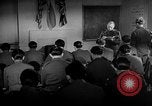
Polish soldiers stand and sing in chorus in a classroom at a secret school in London, England, during World War II.
World War 2 Project Eagle by the United States Office of Strategic Services. A Secret School to train Polish soldiers, in London, England. Students stand and sing in chorus in a classroom. An officer sings along with them. The flags of the United States and the United Kingdom on a flag pole. A crucifix placed on a wall.