


 Francais
 Deutsch
 Italiano
Refine Your Search
+"United Kingdom" +1944 stock footage and images
- Showing 319 to 324 of 376 results more
more Hide
Hide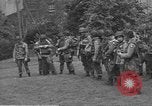
Paratroopers of U.S. 507th Regiment, 82nd Airborne Division are inspected by an officer in England.
Paratroopers of U.S. 507th Parachute Infantry Regiment, 82nd Airborne Division in England during World War II. The paratroops are inspected by an officer. A paratrooper tests his pistol and shows a knife. The paratroopers march across a field.
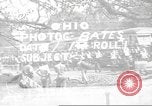
Paratroopers of U.S. 507th Regiment, 82nd Airborne Division leave Camp Tollerton for an airport in England.
Paratroopers of U.S. 507th Parachute Infantry Regiment, 82nd Airborne Division leave Camp Tollerton in England during World War II. The paratroopers board buses. The paratroopers in a bus. The buses leave Camp Tellerton for an airport.
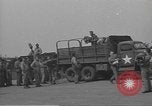
U.S. 507th Regiment, 82nd Division paratroopers receive parachutes and sham attack in Camp Tollerton, England.
Paratroopers of U.S. 507th Parachute Infantry Regiment, 82nd Airborne Division in England during World War II. The paratroopers pass a truck to receive two parachutes. A man inspects a reserve parachute. The paratroopers march on a road. They race across a field and sham attack to see how the equipment rests while running. After the tryout the men return to the camp.
Loading of a U.S. LST (Landing Ship, Tank) with army vehicles at Falmouth, England during World War II.
Loading of a U.S. LST (Landing Ship, Tank) at Falmouth, England during World War II. An M3 half track pulls a trailer aboard the LST at the dock. An M-8 Light Armored Car moves up the ramp of the LST. U.S. jeeps move along a road.
The USS Chase County (LST 532) on the Helford River, heading for Polgwidden, near Falmouth, England, during World War II
Landing Ship, Tank No. 532, The USS Chase County, at Polgwidden (AKA Trebah) on the Helford River, near Falmouth, Cornwall, England during World War 2. The LST moves up the river at Trebah. The USS Chase County is seen docked and ready for troops and equipment to embark. (Note: Later this same day, Allied troops and equipment did embark on the USS Chase County for the D-Day invasion of Normandy. However, they spent the next 5 very uncomfortable days afloat in bad weather that actually delayed the operation.)
U.S. soldiers in England, install wire cutters on U.S. jeeps before shipping them to France, during World War II.
U.S. soldiers of the 87th Chemical Battalion (mortar) make field modifications by installing wire cutters on army jeeps, at the D-Day Marshalling Area Camp in Shiphay, Torquay, (Devon) England during World War 2. U.S. soldier paints an angle iron vertical post (wire cutter) fastened on bumper of a jeep. He pastes U.S. flag on the windshield and writes OK in chalk on the front bumper. Line of modified jeeps travel along road after completing check ups. Soldiers use hack saws to cut pieces of metal and hand drills to put holes in bumpers where angle iron wire cutters will be fastened. They use files to take sharp edges off the angle irons. A soldier slips washers and bolts on an angle iron and tightens them with an adjustable wrench. (Note: These angle iron vertical rods, mounted on a vehicle front bumper, were meant to protect jeep occupants by catching and cutting wires that might be strung across roads to injure or kill unprotected drivers of open vehicles, such as Jeeps.)