


 Francais
 Deutsch
 Italiano
Refine Your Search
+"United States USA" +1898 stock footage and images
- Showing 7 to 12 of 20 results
Beginnings of successful powered heavier-than-air flight. Wright Brothers flights in U.S. and Europe. General Hap Arnold
History of aviation. A balloon in flight. Historic glider such as that which interested U.S. War Department as early as 1898. In 1903, a crew of men moving a Wright Flyer into position. Two men turn over propellers on a Wright Flyer, and the engine starts. View of the Wright-designed water-cooled engine. View of Orville Wright. The famous first powered flight, at Kitty Hawk, North Carolina, with Orville Wright at controls. Animation shows that 120 foot flight juxtaposed against a B-36 wing. Wilbur Wright in Europe, in 1908, gesturing as he converses with interested parties. A gallery of spectators including the President of France, King of England, King of Spain, and King of Italy. Wilbur Wright places a wheel under the right wing of a Wright Flyer and lashes it to the strut. A team of horses pulls the plane across the field. Men maneuver the plane onto a monorail on the ground. Men pull on a heavy rope to raise a weight in a tower, for a catapult. Two men spin the propellers and the Wright Brothers airplane motor starts. Wilbur Wright and his passenger, a French journalist, board the plane. The catapult weight drops, launching the aircraft which flies low over the field. U.S. President Theodore Roosevelt speaking (He is seen on a podium campaigning for the Bull Moose Party nomination at the Kansas State Fair in Hutchinson, Kansas on September 22, 1912.) War department issues specifications for a heavier-than-air craft. Reenactment of a Wright brother signing a bid contract. A Wright Flyer airborne at Fort Myer, Virginia, as the Wrights meet the Army specifications and sell, U.S. Army airplane number 1, to the War Department, in 1908. Gold Aviator wings being pinned on the uniform of a U.S. Army pilot. Photograph of Army Air Forces Chief, General Henry (Hap) Arnold, wearing his original aviator wings on his service uniform. A Glenn Curtis training airplane starting up and taking off. View of a DH-4 airplane and a Wright Flyer taking off together.
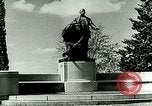
Contributions of African Americans in various fields in the United States.
(See also clip 65675078146 from different film transfer). Famous African American men and women citizens in the United States. Clip opens with of Booker T. Washington at Tuskegee University. Scene in a laboratory with African American scientist and inventor George Washington Carver, as an elderly man, working with another scientist in the laboratory. African American judge of New York city court. African American explorer Matthew Henson is seen looking at a globe (he was with Admiral Peary planting the American flag at the North Pole in 1909), and an unnamed African American surgeon at work in an operating room in New York. Next scene shows famous "father of the blues" musician and composer W.C. Handy (William Christoper Handy) smiling. Next is seen the financier and publisher of the Amsterdam News, Dr. C.B. Powell (Clilan Powell) greeting three uniformed African American women during a World War 2 war bond drive, and handing them a check (close up is shown) for 25,000 dollars, dated January 4, 1942, for the war bond drive. It is from the account of the Victory Mutual Life Insurance Company which Dr. Powell also owned. The check is signed by C.B Powell and Philip M.H. Savory (Dr. Savory was co-owner of the New York Amsterdam News). The next scene shows Elise Johnson McDougald, better known as Gertrude Elise Ayer, who was the first black full-time public school principal after the consolidation of New York City schools in 1898. She was also a noted woman writer during the Harlem Renaissance. She is seated in her office at her desk, likely in P.S. 119 in Harlem, since this is approximately year 1945 and she was at P.S 119 at that time. Her name plaque is visible on the front center of the desk. Principal Ayer smiles as a woman delivers a document to her. Next is seen the African American historian, author, and professor, Lawrence D. Reddick, serving in his role as the curator of the Schomburg Collection of African American Literature. In an art studio is seen the famous African American sculptor and painter Charles Alston, at work on a sculpture. Next scene shows the famous African American contralto singer, Marian Anderson, receiving a bouquet of flowers and smiling after a performance. This transitions to a view of African American orchestra conductor Dean Dixon leading an orchestra in a performance of Beethoven's 9th Symphony. Several views of different sections of the orchestra performing under Dixon's direction. Clip closes with brief shots of campuses of several historically black colleges and universities in the United States like Howard University, Hampton, Tuskegee, Fisk, Prairie View. An American college football game underway at the stadium of one of the colleges.
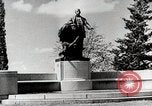
Achievements of African Americans in art, literature, music science, and medicine in the United States, in the late 1930s and 1940s.
A film about achievements of various African American men and women citizens in the United States. A statue of Booker T. Washington, founder of Tuskegee University in Alabama. View of African American scientist and inventor George Washington Carver, as an elderly man, working with another scientist in a laboratory. African American judge of New York city court. African American explorer Matthew Henson is seen looking at a globe (he was with Admiral Peary planting the American flag at the North Pole in 1909), and an unnamed African American surgeon at work in an operating room in New York. Next scene shows famous "father of the blues" musician and composer W.C. Handy (William Christoper Handy) smiling. Next is seen the financier and publisher of the Amsterdam News, Dr. C.B. Powell (Clilan Powell) greeting three uniformed African American women during a World War 2 war bond drive, and handing them a check (close up is shown) for 25,000 dollars, dated January 4, 1942, for the war bond drive. It is from the account of the Victory Mutual Life Insurance Company which Dr. Powell also owned. The check is signed by C.B Powell and Philip M.H. Savory (Dr. Savory was co-owner of the New York Amsterdam News). The next scene shows Elise Johnson McDougald, better known as Gertrude Elise Ayer, who was the first black full-time public school principal after the consolidation of New York City schools in 1898. She was also a noted woman writer during the Harlem Renaissance. She is seated in her office at her desk, likely in P.S. 119 in Harlem, since this is approximately year 1945 and she was at P.S 119 at that time. Her name plaque is visible on the front center of the desk. Principal Ayer smiles as a woman delivers a document to her. Next is seen the African American historian, author, and professor, Lawrence D. Reddick, serving in his role as the curator of the Schomburg Collection of African American Literature. In an art studio is seen the famous "Harlem Renaissance" African American sculptor and painter Charles Alston, at work on a sculpture. Next scene shows the famous African American contralto singer, Marian Anderson, receiving a bouquet of flowers and smiling after a performance. This transitions to a view of African American orchestra conductor Dean Dixon leading an orchestra in a performance of Beethoven's 9th Symphony. Several views of different sections of the orchestra performing under Dixon's direction. Clip closes with brief shots of campuses of several historically black colleges and universities in the United States like Howard University, Hampton, Tuskegee, Fisk, Prairie View. A football game underway in one of the colleges, and view on the field as quarterback throws a pass.
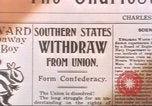
Reenactments of American military in action during the Civil War and Indian Campaigns
John Charles Daly, standing in the Hall of Heroes at the Pentagon in Arlington, Virginia, speaks about recipients of the Medal of Honor during the Civil War and Indian Campaigns. Excerpts from films about those events are then shown. A newspaper headline reads 'Southern States withdraw from Union'. Dramatized scenes: Men fire artillery during the American Civil War in 1861. Soldiers mounted on horseback advance on a battlefield. A montage of current day scenes show battlefield at Gettysburg and various memorial statues commemorating Union soldiers of the Civil War. . Mr. Daly points at names of Civil War Union heroes (1861-1865) and heroes of Native American Indian Campaigns (1861-1898) in the Hall of Heroes at the Pentagon in Virginia.
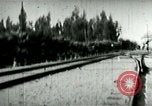
Thomas Edison film of an Atchison, Topeka, and Santa Fe railroad train speeding past the camera.
Opening scene shows view from a siding, of an empty railroad track in the countryside. Suddenly a steam locomotive of the Atchison, Topeka, and Santa Fe railroad appears on the main track, heading toward the camera. It is pulling a number of passenger cars, and passes the camera, at high speed.
Crowds gather to watch the arrival of a Sunset Limited train
Early historic moving images show crowds gathered to watch the arrival of a Southern Pacific Railroad Co. Sunset Limited train in Southern United States. They wave as the railroad train moves past them. Another train passes in the opposite direction.