


 Francais
 Deutsch
 Italiano
Refine Your Search
+"United States USA" +1913 stock footage and images
- Showing 1 to 6 of 9 results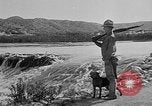
Scenes during Mexican revolution, in 1913, along the U.S. Mexican border
U.S. soldier with shouldered rifle stands guard beside the Rio Grande river, separating the United States from Mexico, in 1913. A dog stands next to him. The river is rushing in the background. View of extensive stakes and barbed wire lining the U.S.Mexico border. U.S. soldiers perform changing of the guard at a checkpoint on the U.S. side of the border between the U.S. and Mexico. Two new American sentries replace those being relieved. Signs on the fence identify the respective country boundaries. Mexican refugees (mostly women and children) flee the revolutionary combat taking place in Mexico. U.S. soldiers monitor as they cross into the United States, and direct some passing inside a trench manned by American soldiers along the border. Scene shifts to an official looking building guarded by U.S. soldiers. Several Mexican men, including Pancho Villa leave the building, accompanied by two or more Americans. (One American, wearing glasses , and carrying a cane. is dressed in a white suit, and wears a bow tie and Edwardian style summer straw hat. Next, Pancho Villa is seen with a number of his soldiers. A group of Mexican men relaxing at a shaded table near rustic structures. Large cacti frame the foreground, where a girl is walking toward them. Closeup of the men gathered around the table.
Garment workers demonstrating, for improved working conditions, encounter resistance in Eastern U.S. cities
Clothing workers in a factory in the United States. Street scene in garment district of Midtown Manhattan, New York City, in 1912. Garment workers, and supporters of their labor rights quest for better pay and shorter hours, pose for a photograph. Workers display many signs expressing their needs, in English, Italian, Russian, Hebrew and other languages. Garment workers, of various specialties, gather in demonstration for better treatment. Employees of the Alfred Benjamins Company refute management's claim that they are satisfied with working conditions. They display a large sign on the sidewalk. Four-sided box signs are also seen (written in Italian and Hebrew). Mounted police move along a street as a foot patrolman arrests a protester. Photograph of lawyer, Fiorello LaGuardia. Garment workers at work in a sweat shop. A large group of young women garment workers marching in a labor rally or demonstration during a strike. Two signs are seen, one reading: "Why are we prohibited from picketing?" and the other, partly hidden, explains why they are striking. A contingent of uniformed policemen with night sticks, stand in front of a building in Baltimore. Smiling women stand carrying signs. One reads: "Our employers are powerful (because) they are organized.We shall be more powerful." Another reads,"We shall fight until we win." Many other signs express similar sentiments. Portrait photograph of 17 year old Ida Brayman, with caption reading: "Who was shot & killed by an Employer Feb. 5th 1913 during the great struggle of the Garment Workers of Rochester (New York)."
America enters the 20th Century
Opening scene shows early morning mist and transitions to 20th Century industrial sites with many smoke stacks and steam rising. Next a textile machine rotates as it weaves a product. Men sing around a piano as a woman plays it in an early 20th Century parlor. A person is seen filling out a paper ballot and dropping it into a ballot box at a voting station. A woman doing needle work and a man winding a clock above a mantel. A girl paging through a coloring book. Children in a school room. Many people attending a political convention. Outdoor view of hills and sea. Exterior and interior of a town church. A court being called to order. The inauguration of Woodrow Wilson, as America's 28th President on March 4, 1913. View of the crowd attending the event. Closeup of President Wilson delivering his inaugural address. Bronze bust of Woodrow Wilson.
Early 20th century America footage; establishment and early circumstances of the U.S. Department of Labor
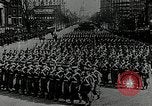
Film opens with view from a building overlooking President Woodrow Wilson's Inauguration Day parade along Pennsylvania Avenue, on March 4, 1913. A large contingent of U.S. Army West Point cadets march in forefront of the parade. Spectators line the sidewalks. Several stand atop buildings. Outgoing President, William Howard Taft is seen in his office signing a bill establishing the U.S. Department of Labor. Closeup of the bill and Taft signing it. Scenes of traffic and pedestrians in New York City. Some of the pedestrians appear to be wealthy class. Crowded early 20th century city streets filled with various horse drawn carriages together with bus traffic and early automobiles in chaotic confusion. A double decker bus with open top and sign "Fifth Avenue" and lower sign "To 22nd Street Only" operates in busy traffic on 5th Avenue beside horse drawn carriages and other motorized vehicles. Glimpses of women working in a factory; Men pouring molten metal into molds; Women punching time clocks as they leave a factory. Newly arrived immigrants at Ellis Island, New York City circa 1910 or during first 10 years of the 1900 decade. View of the Statue of Liberty. Women working in a textile factory. Men tapping a furnace in a steel plant. Pushcarts and peddlers at market lining the curb in a Jewish neighborhood of New York City (possibly lower east side). Brief view of pioneer Labor leader Samuel Gompers, founder of the American Federation of Labor. He hold a walking stick and doffs his hat. Sketches illustrating scenes of labor-related violence. Department of Labor sign being affixed to its location. A horse and wagon, representing the first assets of the new Department. A group of persons illustrative of the employees in the Department's Bureau of Labor Statistics.
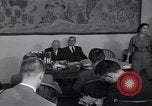
Repository officials and staff brief the press in United States
Two American officials brief the press as a number of original manuscript files are displayed, with "Joulia" and the year 1911 written on them. Others display the year 1913. Journalists take down notes. The officials also display copies of newspaper articles which include a political cartoon above an article entitled "Entre Policiers." Another article is headlined " ENORME." A man breaks the seal of a wooden box labeled "HWL" number 5, as the two officials along with a girl stand next to him. They take out some files from the box and look at them. One of the official looks at some photographs, including one that appears to be of an individual involved with the manuscripts (perhaps the author)..The setting appears to be a university or archive.
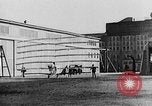
Early experimental failures in airplane development. Lawrence Sperry and his "Messenger" airplane
Film showing early history of flight with many early unsuccessful flying machines. As Igor Sikorsky speaks, in the background, about such earlier failures, the first scene shows a early 1900s seven wing airplane, with its propeller turning, being pushed by several men. Suddenly the the entire thing collapses into a heap, as the men run to safety. They quickly return to check on the occupant. Next, an experimental four-rotor helicopter is seen lifting above the ground, successfully, but not otherwise controllable. Then a contraption (labeled "Sky Car") employs a pulsating umbrella. It jumps up and down but does not accomplish anything else. A tricycle gear contraption, using an array of sails, and displaying the number, 691, moves along under power, but does not ever leave the ground. A helicopter of sorts, with several different size rotors falls sideways, as the pilot is adjusting it. He steps away to safety. Another glimpse of the "Sky Car." A wing-flapping contraption that does nothing else. Aviation pioneer, Lawrence Sperry, moves his early biplane up to a gasoline pump to refuel. He holds the fuel hose to his gas tank while another man pumps the fuel. Next, his airplane taxis along a public road, followed by a motorcyclist. The aircraft takes off. Sperry piloting his small single-place bi-plane "Messenger" aircraft, is seen flying above the U.S. Capitol dome, on March 22, 1922. Next, he lands on the Capitol Plaza and quickly turns the aircraft so it actually ascends several Capitol steps, before rolling back to park. Sperry climbs from the cockpit and is greeted by policemen and officials who surround him and congratulate him. (Sperry perished flying across the English Channel in 1924.) View of the Great Dome on Building 10 at the campus of MIT (Massachusetts Institute of Technology). Dr. Jerome Hunsaker, pioneer aeronautical engineer and educator, is seen in a laboratory. He speaks of beginning the aeronautical engineering education program at MIT in 1913, with Donald Douglas as an assistant.