


 Francais
 Deutsch
 Italiano
Refine Your Search
+"United States USA" +1914 stock footage and images
- Showing 1 to 6 of 31 results more
more Hide
Hide
Debacle at Garment Workers Convention in 1914 leads to formation of Amalgamated Clothing Workers of America
United Garment workers (UGW) Union members discuss plan for 1914 convention in Nashville Tennessee. View from railroad locomotive traveling on a straight train track. A steam locomotive pulling a passenger train. Trainman on rail car waving a lantern. Views of the convention, October 12, 1914, in Nashville, headed by UGW President Thomas A. Rickert of Chicago. Labor union locals from New York, Boston, Rochester, Cincinnati, Philadelphia, and Baltimore, were deemed in arrears on dues (although they had been on strike) and not allowed to participate. They walked out, with the Chicago delegation too. View of Telegram sent from Nashville, by the dissidents, to Sidney Hillman in New York, October, 1914, asking him to head a rival union. Photo of Hillman taking telephone call. A special convention at Webster Hall, in New York City, where dissidents join with Journeyman Tailors union and form the Amalgamated Clothing Workers of America, with Sidney Hillman as President. Key members of the new union are seen standing in front of a car. Sidney Hillman in his office dictating to his secretary. Copies of the new union's House organs in various languages. Amalgamated Clothing Workers holding signs in various languages. Workers pose on a truck by a sign reading:"A Fair Deal, A Chance to Live, Arbitration is all we ask." Workers in cars. Girls on roller skates wearing sashes reading: "Don't Be A Scab." A man in a barrel with sign reading: "Can't afford to wear pants. Pa works in an open shop." Women pose in sandwich boards that spell out: "Closed Shop." Philadelphia garment worker ostensibly writing letter to Sidney Hillman. Shop owners examine sewn item and shop records while man works at sewing machine.

Influx of European immigrants in America in search of jobs and shelter from 1880 to 1914.
European immigration to America from 1880 to 1914. A farmer and team of horses are silhouetted against the sky as they move in a field. They pull what appears to be a field kitchen and a thresher. Scene changes to men working at a drilling site. They appear to be discharging water from a well. Men with horses and rigs, lined up near a passing steam locomotive and railroad train. A dirt road in a town, cluttered with horses and wagons. Telegraph poles and lines are visible. A woman immigrant from Russia, recounts her imagined views of America being a land of milk and honey where fortunes could be easily made. View of an immigrant family. View of shanty houses clustered together around 1900. A family poses outside their rough dwelling in a city. Children pose near a huge cotton bale by a city storefront. A family poses on a rickety 2nd story iron porch on a building. Brief views of new immigrant families inside their slum dwellings. An historian speaking, notes that the East side (of New York City) had population density equivalent to that of Bombay,India.
Immigrants from Europe, arriving from 1880 to 1914, participate in the working life of America.
Two new immigrant man are seen on bunks in a tenement in New York City, where the narrator says nine out of ten immigrants arrived in the period from 1880 to 1914. Two women pose, sitting beside a sleeping child in a tenement. An immigrant speaks about the hardship of arriving in a strange land where he did not speak the language and felt "lost." He says he gradually overcame that by going to night school to learn a little English and to read and write. He says he made a nice living as a peddler, and expressed appreciation for the opportunities America gave to immigrants. In the next scene, children enjoy rides on a traveling merry-go-round visiting their neighborhood. The operator runs it manually, by turning a wheel. View of children riding and others watching on the street. Streams of pedestrians crossing a bridge across a busy city street. Pedestrians on sidewalks and horse-drawn wagons and electrified street cars moving on the street in the commercial center of a city. Workers heading home after their shift in a factory. View of workers producing products in a factory. A line of women punching a time clock at their place of work. Women working in a clothing factory. Men standing atop a shipment of steel rails for the building of a railroad. Views of rails being moved into position for a new segment of the railroad. Glimpse of a steam shovel scooping a bucket full of raw material. Black smoke rising from funnel on a steam locomotive, and also from nearby steam shovel. Iron workers on a the wide open upper floors of the 60-story skyscraper Woolworth Building under construction in Lower Manhattan, New York City, in 1911. Pilings being put in place for a new building. Riveters guiding a section of steel column into place for a new building . Views inside a heavy manufacturing plant of the W. E. & M. company in New York City. Their products appear to be large dynamos and motors. View of the Statue of Liberty on Bedloe's Island in New York harbor, with its arm appearing to hold up a full moon.
American soldiers prepare to test a French M1914 Hotchkiss machine gun at a base in the U.S.A. during World War I
American soldiers in an Army passenger truck, ride into a field at an Army base in the United States, during World War 1. They step from the truck, remove boxes of ammunition, and a French M1914 Hotchkiss machine gun. They set up the machine gun and prepare to fire it. Scene shifts to closeup of a soldier back at the truck, opening its compartments and checking the contents.
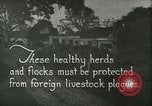
Government prohibits entry into areas marked by high cases of foot and mouth diseases in the United States.
The effects and control of foot and mouth disease in cattle. A herd of cattle graze on a farm. Sheep graze on a farm. Herds of black and white sheep graze. Two men read a notice. The notice reads 'Warning: Entrance forbidden'. A map depicts the states that were affected by the foot and mouth disease in 1914.
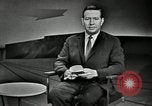
Famous international personalities are shown visiting the U.S. in the 1920s.
A 1959 production featuring footage of personalities visiting the United States circa 1920s. Douglas Edwards, an American television anchor speaks about the people who visited America. The French actress Sarah Bernhardt visits America. She is greeted by the people. In 1914 she is honored by the French government. Madam Ernestine Schumann-Heink, famous contralto, on board ship with friends. Modern interpretive dancer Ruth St. Denis, with a troupe of women dancers. Russian composer, conductor, and pianist Sergei Rachmaninoff, onboard ship. Polish pianist and statesman, Ignacy Jan Paderewski, arriving in America. Famous Irish tenor, John McCormack, arriving in America. Italian tenor, Enrico Caruso, seen with friends, as he visits America. George Bernard Shaw, the Irish playwright visits America. Arthur Ignatius Conan Doyle, creator of the Sherlock Holmes stands with his family. Maurice Maetterlinck, Belgian playwright and Nobel laureate on deck with companion. Michael Arlen, best-selling author, arrives in America. Joseph Conrad, Polish-born English novelist, is seen with ship's officers. British writer, H.G.Wells, tips his hat as he arrives on a ship to America. Douglas Edwards then presents a public interest announcement about civil defense planning, for the U.S. Office of Civil and Defense Mobilization, sponsor of the show (during the Cold War). This is followed by voice-over from unidentified speaker urging citizens to take part in civil defense. Shown is a cutaway view illustrating emergency supplies of canned foods, and other supplies stored in a home basement for emergencies. A sign describes it as part of a "Family Fallout Shelter." Narrator states that civil defense is an American tradition.