


 Francais
 Deutsch
 Italiano
Refine Your Search
+"United States USA" +1918 stock footage and images
- Showing 145 to 150 of 232 results more
more Hide
Hide
Henry Ford watches test drives of Ford 3-ton tanks in the United States.
Testing of Ford 3-ton tanks in the United States. Tanks lined up and military personnel standing next to them. The tanks test drive over rough, hilly fields and over ditches. One of the tanks gets stuck in a trench. Observers look at the military tank. Workers dig next to the tank and pull it out. The tank reverses and drives on a rugged surface. Henry Ford watching the tanks move. (World War I; World War 1; WWI; WW1)

Curtis JN-4 "Jenny" of the U.S. Air Service lands on field in United States, during World War I.
A curtis JN-4 "Jenny" airplane lands on a field in the United States, during World War 1. It taxis in after landing, and parks beside a hangar designated 11B. "The Air Service Needs You" is painted on the airplane fuselage . The pilot climbs out of the cockpit and walks towards the camera, taking off his flight gear.
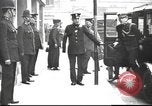
Scenes in London England, following the Armistice ending World War I
U.S. Admiral William Sims, steps from a car and walks toward a building guarded by several British policemen (Bobbies) in London, England. Next, he is seen posing with two of his staff. Scene shifts to London street, where a military officer gives some directions to Winston Churchill who tips his top hat, as he steps into a waiting automobile. In the streets, crowds fill the sidewalks as they watch musicians on the roof of a double-decker bus, celebrate the armistice ending World War 1.
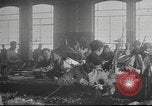
Arms manufacturing in the United States, during World War I
An arms manufacturing plant in the United States during World War 1. War production workers in arms factory woodworking department, manufacture wooden stocks for rifles. Others assemble metal parts of rifles. Still others are seen inserting barrels into wooden rifle stocks. An area staffed almost entirely by women assembling weapon parts. A yard filled with Browning M1917 machine guns.
An armaments factory in the United States during World War I
Men work at fabricating siege mortar shells. A shell blank is heated over a furnace and then transported to a machine where it is formed, while still glowing, into the desired shell shape. A number of finished shells is shown in a yard. Next, men are seen welding the shells. Finally, men are shown filling them with gunpowder. They pound the gunpowder into the shells using wooden rams and wooden mallets (to avoid creating sparks). A worker is seen topping off a shell with gunpowder, from a ladle, pounding it tight, and fastening a cap on the top. (World War I; World War 1; WWI; WW1)
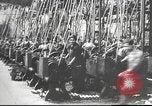
Ammunition manufacturing in the United States during World War I
Men and women work at belt-driven lathes on a crowded machine shop floor in an armaments factory during World War 1. A stack of machined shell cylinders sits on the floor. In another area of the munitions plant, workers are seen with large shells and caps for them. At another machine shop, workers turn large diameter shells in lathes. Camera pans across various work stations where different manufacturing processes are taking place. Closeup of a woman working on a standard size lathe, and of other women working in the machine shop. Men and women sealing hot shells and handling them large tongs. Women working on small caliber ammunition. Women stacking finished shell in trays. Women weighing out gunpowder into sacks, and others loading the sacks into boxes that they dump onto open shells, where women use them to fill shells. A group of women placing objects into shells (fuses?) and sealing them, as a superviser watches. A man taking the shells from a conveyer belt and packing them in boxes. Another area of the plant where items are packed into containers. (World War I; World War 1; WWI; WW1)