


 Francais
 Deutsch
 Italiano
Refine Your Search
+"United States USA" +1919 stock footage and images
- Showing 37 to 42 of 209 results more
more Hide
Hide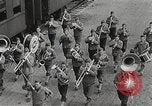
US Army soldiers and heavy equipment transported by railroad trains in the United States, bound for war front in World War 2
Activities of the United States Army in the United States during World War II. A U.S. Army band from the 407th Engineer Battalion playing musical instruments and marching. U.S. Army soldiers board railroad trains at a railroad station for transportation toward the war front. A railway steam locomotive pulling train cars. M4 Sherman tanks are seen on them as well as M2A4 (Mae West) tanks sitting partially turned with their guns out of sight away from the direction of travel.Browning M1919 .30 caliber machine guns are seen in their extra turrets. Army trucks and other military vehicles are also aboard the supply trains. The supply train moves through American countryside. Two women seated under hair dryers converse about the war in a beauty shop or beauty parlor. U.S. troops on troop transport railroad trains at night. Interior of a train car. American soldiers read books, sleep, and some play dice. An African American porter watches the game. A chaplain speaks to the soldiers. Civilians buy newspapers at a news stand. Headline on newspaper reads "London Expects Invasion of Europe at Any Hour" (before the upcoming Normandy Invasion of France in June 1944.)
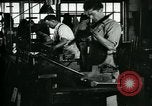
1917 Enfield Rifles in final stages of production during WW I.
1917 Enfield Rifles (U. S. Rifle, Model of 1917) being manufactured in the United States at one of 3 arms plants (Winchester, Remington, or Eddystone) during World War 1 (between the Spring of 1917 and the Spring of 1919). Film shows assemblers hand fitting parts, a worker adjusting the front sight for proper "zero" in a machine vise, and "Proof" firing before final inspection and acceptance. (Note: At the peak of production, the 3 arms plants were turning out 10,000 rifles per day.)
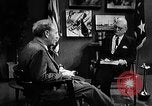
Lieutenant General Ira Eaker talks about his transfer to the Philippines during an interview in the United States.
An interview of United States Air Force Lieutenant General Ira Eaker conducted by Dr. Maurer in the United States. General Eaker talks about his most interesting experience when he was transferred to the Philippines in 1919. He talks about his work at Rockwell Field. The Commander was Colonel Henry Arnold and executive officer was Major Carl Andrew Spaatz. He was among a few regular officers. Colonel Arnold selects one officer to recruit a squadron for the Philippines. Arnold and Spaatz asked his recommendation for the purpose. Then he recruited 60 people and took them to the Philippines. They prepared their aircraft. He says that while flying back from Manila Bay, he was not able to control his airplane because of the clouds and other problems. Then he with other officer started to work out on a system where they could fly in the clouds. They flew with some instruments to prevent any accidents due to the clouds.
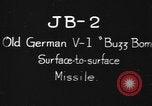
The launching of a JB-2, based on the German V-1 buzz bomb, surface to surface missile at Eglin Field, Florida.
From a review of research and development in guided missiles by the United States Air Force from 1919 to 1948. A JB-2 (Jet Bomb 2) "Loon" based on the German V-1 buzz bomb, surface-to-surface missile. Technicians examine a scale model of the JB-2 missile. Air Force research and development of American type JB-2 missile, the first unmanned guided missile in America's arsenal. A JB-2 is launched from Santa Rosa Island, Florida. A rocket assists in take off. The rocket unit falls away immediately after JB-2 rises into the air. A control aircraft flies overhead showing JB-2 launchings at Eglin Field. JB-2 in flight. The JB-2 was sub-contracted by Republic: Airframe by Willys-Overland; Engine by Ford Motor Company, the IJ-15-1, which copied the German V-1's 900-lb. thrust Argus-Schmidt pulse-jet; Guidance by Jack and Heintz Company; Launch System by Monsanto; Rocket launch sleds by Northrop.. (World War II period).
A JB-10, surface-to-surface missile launched from a launching track at Eglin Field, Florida.
A review of research and development in guided missiles by the United States Air Force from 1919 to 1948. A JB-10, (Jet Bomb 10) surface-to-surface missile. A still photograph of a JB-10 missile in flight. A ground view still photograph of a JB-10. A ground view still photograph of the missile on a launching track. A JB-10 launching shows a rocket unit falling away. The missile starts over water. Flames spurt from the tail of the missile at the Eglin Field. (World War II period).
Ships underway in New York Harbor in New York, United States.
New York Harbor in New York, United States. Film starts showing two women on the deck of a ship using binoculars to view the traffic of ships and tugboats working in New York harbor. A variety of commercial vessels, mostly freighters are seen. One ocean liner, the General W.C. Gorgas is seen, with no visible passengers. (USS General W. C. Gorgas (ID-1365) was a a German ship seized by the US Shipping Board in World War I and used as a Navy troop ship. We see her as she departs New York on 25 April 1919 to embark Army troops and load cargo at Bordeaux, France.) Other scenes of interest include one closeup of a tugboat emitting a plume of black smoke.