


 Francais
 Deutsch
 Italiano
Refine Your Search
+"United States USA" +1921 stock footage and images
- Showing 7 to 12 of 152 results more
more Hide
Hide
A man and a woman talk in the light of a kerosene lamp in the United States. Also shows the 1893 DeWitt Clinton replica locomotive and train in operation.
The world struggle for oil is depicted. Use of components of oil in homes and in railroads in the United States is shown. A dramatization shows the effect of a kerosene lamp on social life. A woman seated in a chair near a table in a room. A kerosene lamp in a corner. A man opens the door of the room and walks in. The woman gets up and welcomes the man. They both walk to a seat and sit down. Another woman enters the room. The man stands to greet her. She increases the light of the lamp and then leaves the room. The man decreases the light of the lamp. The man and the woman talk. The 1893 replica of the 1831 DeWitt Clinton steam locomotive is shown in operation with its three carriage train, in New York City. The DeWitt Clinton was the first railroad locomotive to operate on the Mohawk & Hudson Railroad in New York. The reproduction seen here was built in 1893 by the New York Central Railroad for the Columbian Exposition in Chicago. This footage was shot on July 17, 1921 when the DeWitt Clinton train was preparing for a trip to another exposition in Chicago. On this day it ran several times from 96th to 116th streets in New York City. New York Central employees are seen on the drain, dressed as passengers would have been in 1831. This replica was later displayed at Grand Central Terminal in New York City, and is is now on display at The Henry Ford museum in Dearborn Michigan. It was acquired by Henry Ford in 1934, in an agreement with the New York Central that it would continue to travel to events on occasion.
Aerial bombing experiments on the battleship Ostfriesland and Brig Gen Mitchell with Secretary of war John Weeks.
Experiments on the aerial bombing of water crafts off Virginia Capes in the United States. July 20 and 21, 1921: Latest type First Line battleship, the heavily armored Ostfriesland at sea. Specifications of the ship. Handley Page 0/400 bombers in flight. The Ostfriesland under bombing attack. Explosions on and around the ship. Three 1,100 bombs hit the ship directly. View of the deck and bow. A 2000lb bomb caves in the starboard quarter. The ship tilted to one side and sinking. A final bomb dropped on the ship. Brigadier General William Mitchell congratulates the pilots and bombers. Secretary of War John W Weeks and U.S. Army General John J Pershing inspect Langley Field with other officers. Brigadier General Mitchell explains the NBS-1 bomber to Secretary Weeks. The group of Air Service pilots pose for a photographer in front of hangers.
Special tests on USS Alabama and Brig Gen William Mitchell with a group of Air Service officers.
Special tests on USS Alabama off the United States coast. September 1921: USS Alabama at sea. 50 lb Navy type smoke bombs used to obscure the attack by heavy bombers. Smoke trails all around the ship. Phosphorus bombs explode around the ship. 100lb high explosive bombs dropped on it. The ship under attack of 300lb demolition bombs. Smoke clouds over damaged parts. Three NBS-1 in flight over Langley Field. Bombers drop four 2000lb bombs in the final attack. Ship tilted to one side. Three Martin Bombers drop two 1,100lb bombs to finish the attack. A mushroom cloud rises from the explosions. The ship lies half submerged in water due to anchoring in shallow water. Wrecked hull, damaged deck. Soldiers inspect the damage. Brigadier General William Mitchell stands with a group of Air Service officers.
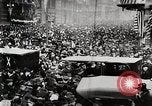
Crowd celebrates Armistice Day in New York City. U.S.State funeral for the unknown soldier of World War I
Crowd celebrating Armistice Day, November 11, 1918, in New York City. Many wave American flags. Dense crowd traps several vehicles. Different sequence shows the U.S. State funeral procession for the American Unknown Soldier of World War I, on November 21, 1921. Teams of white horses pull artillery caissons. Team of dark horses pull caisson bearing the coffin of the Unknown Soldier. It is covered with bunting and dark wreath. General of the Armies, John J. Pershing leads the Military officers who accompany the coffin. Following them is seen a large group of civilian officials, all in top hats.
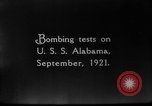
Bombs are dropped by aircraft on USS Alabama during bombing tests in the United States.
Development of air power. Bombing tests on USS Alabama in September 1921 in the United States. USS Alabama anchored in water. A soldier arms and works on fuse mechanism of a large bomb swung underneath a large bomber. A standard-Handley Page 0/400 bomber in flight to the right over water. A United States Army Air Corps Dayton Wright DH-4 aircraft in flight to the left dropping a bomb. The bomb explodes on the ship. A phosphorus bomb explodes on the ship and engulfs the entire ship in smoke. The ship explodes. Part of the superstructure topples off into the water. The ship lists over a side with one of the towers bent over and lying in the water.
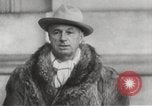
How turbo superchargers facilitate high altitude airplane flight. World War II warplanes equipped with superchargers
General Billy Mitchell wearing fur coat and western style hat. Animated illustration of U.S. Army Martin bomber operating at 15 thousand feet during the famous demonstrations of air power against battleships, in 1921. This was possible because the aircraft engines were supercharged, an outgrowth of Dr. Sanford Moss's developments at General Electric Company.World War 2 scenes of U.S. Army Air Forces aircraft that use supercharged engines: P-51s; P-47s; P-38s; B-24s; B-17s and B-29s. View of atomic bomb explosion.