


 Francais
 Deutsch
 Italiano
Refine Your Search
+"United States USA" +1922 stock footage and images
- Showing 7 to 12 of 104 results more
more Hide
Hide
Animated map-exemplifying the route of disease in U.S.
It exemplifies the spread of disease from New-York to California with the help of an animated map of U.S. 1922.

A primary glider aircraft being flown in the United States
Slate reads: "How the Wrights learned to fly -- the motorless, man-carrying glider."A primary glider is seen, circa 1922. A group of people, at the top of a high hill, overlooking a valley, watch as the glider with skeleton frame,single high wing, and wheels, launches from the hilltop. It is operated by a single pilot who maneuvers it on a long flight toward the valley below.
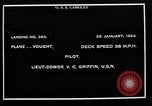
U.S. Vought VE-7 aircraft lands on United States Ship Langley while its is underway in the Pacific Ocean.
United States ship Langley underway in the Pacific Ocean. U.S. Vought VE-7 aircraft piloted by Lieutenant Commander V.C. Griffin comes in for landing aboard the Langley on January 29th, 1922. Aircraft lands and taxis along the flight deck.
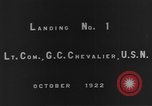
U.S. Pilot attempts to land an Aeromarine 39-B aircraft on the deck of the USS Langley (CV-1)
United States Navy pilot attempts landing on the aircraft carrier Langley (CV-1) off the coast of California, United States. An Aeromarine 39B, piloted by Lieutenant Commander G.C. Chevalier comes in for landing aboard the United States aircraft carrier Langley in October, 1922. He makes a go-around on the first pass. On the second approach, he lands but the arresting gear slowly retracts, pulling his airplane backwards, and causing it to nose over. Sailors rush towards the aircraft. Another view of the same incident from a camera on the opposite side of the flight deck.
Fuel oil is used to run freighters, passenger ships and trains in the United States.
Uses of petroleum products in the United States. Fuel oil ( an oil product ) is used as a fuel in freighters, passenger ships and railroads. Ocean liner SS Majestic in which fuel oil is used as a fuel underway at sea. Smoke comes out of its smokestacks. In 1922 : a train which runs on fuel oil on tracks. Point of view (POV) from behind Engineer in locomotive engine cabin on a moving railroad train.
Water flows over the Niagara Falls and a globe with nine circular parallel lines along the equator rotates in the U.S.
The total consumption of petroleum of the U.S. and the world outside of the United States for the year 1918 is compared. Animation is used for this. Per capita consumption is also compared. Water flows over the Niagara Falls. A globe with nine circular parallel lines along the equator rotates. The 9 circular lines denote that if the per capita consumption of petroleum had increased as rapidly abroad as in the U.S. the world's petroleum requirement in 1922 would have been 10 times the actual requirement and if this volume had been loaded into tank cars of the capacity of 10,000 gallons each it would have made a solid train extending around the world at the equator 9 times.