


 Francais
 Deutsch
 Italiano
Refine Your Search
+"United States USA" +1924 stock footage and images
- Showing 7 to 12 of 135 results more
more Hide
Hide
Animated map of U.S. Army's flight around the world. Expedition Commander, Major Frederick F. Martin congratulates crews.
Animated map shows the course taken by Douglas World Cruiser aircraft of the U.S. Army Air Service in their round-the-world flight in 1924. It also highlights mishaps, such as the location of Major Fredrick F Martin's crash in mountains off Alaska and where Lt. Wade was forced down and wrecked near Iceland. Animation shows route from England to Newfoundland to Greenland to Labrador to east coat of United states and aerial route across states. The expedition was completed by 2 of the 5 original Douglas World Cruiser aircraft, namely: the "Chicago," crewed by Lt. Lowell Smith and Lt. Leslie Arnold; and the "New Orleans," crewed by Lt. Erik Nelson and Lt. Jack Harding. They are seen being congratulated by their Expedition Commander, Major Frederick F. Martin at the completion of the mission, on September 28, 1924, in Seattle, Washington.
U.S. Army Air Service pilot Russell L. Maughan makes a one-stop dawn-to-dusk flight across the United States.
U.S. Army Air Service test pilot 1st Lieutenant Russell L. Maughan's dawn to dusk flight across the United States on June 23rd, 1924. Lt. Maughan in the cockpit of a Curtiiss P-1 Hawk airplane. He takes off from Mitchel Field in New York at dawn. The airplane in flight over Manhattan, New York City showing the East River with Williamsburg, Manhattan, and Brooklyn Bridges. The Curtiiss P-1 Hawk in flight over the Wall Street district, the Battery Park and the Hudson River. The aircraft arrives at McCook Field in Dayton, Ohio. Lt Maughan in the aircraft. A ground-gasoline truck and a fire truck near the airplane as it is refueled with the engine running. He climbs out of the cockpit briefly to allow a boy to look inside. Maughan takes off from McCook field. He is seen by his Curtiss P-1 Hawk, after arriving at Crissy Field in the Presidio, San Francisco, California.
The 1930s Great Depression and the administrations of Presidents Herbert Hoover and Franklin Roosevelt, in the United States
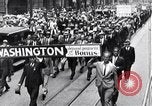
Hard times in the Great Depression led to formation of The Bonus Army. American veterans of World War 1 march on streets of Washington DC, carrying a large poster demanding immediate cash redemption their "bonus" service certificates awarded by Congress in 1924 (but not lawfully payable until 1945). Army Chief of Staff, General Douglas MacArthur, ordered by President Hoover, to clear the Bonus Army encampments, is seen standing in a street surrounded by several U.S. Army troops. People watch from sidewalks as a contingent of U.S. Army cavalry rides down the street. U.S. Army M-1917 tanks roll down Pennsylvania Avenue in July 1932. Bonus marchers and others watch from Lafayette Park in background. Scene shifts to the 1932 Democratic Party Convention in Chicago Stadium, Chicago, where delegates cheer after nominating Franklin D. Roosevelt as their Presidential candidate. Roosevelt seen waving from the podium. Migrant farm workers seen at temporary, dilapidated dwellings in close quarters, and sitting at a campfire, some with sad and desperate faces. Migrant farm workers' cars on the road, piled high with family belongings during westward migration. Migrants riding atop an open railroad freight car. Two men share a copy of the "Epic News" newspaper (published by supporters of Upton Sinclair and the End Poverty Movement in Los Angeles and central California). Narrator describes programs of the Works Progress Administration (WPA) and the Civilian Conservation Corps (CCC). Construction workers ignite demolition charges during construction of Boulder Dam (aka Hoover Dam and officially so-named in 1947). Glimpse of President Roosevelt at the site in an open car, for its dedication on September 30, 1935. Construction workers engaged in building the dam. Another shot of President Roosevelt in his open car. Towers being erected to carry electric power from the dam's hydroelectric generators. President Franklin D. Roosevelt smiling broadly at the formal dedication ceremony, September 30, 1935. Controlled discharges of water through the dam. Views of the Boulder Dam hydroelectric generating station. Oil well rigs or oil derricks at work during construction at night. People at work in fabric mills or textile mills, and in a print shop
Airmen during the first flight around the world land in Boston and New York, United States.
Douglas cruiser aircraft in flight during the first flight around the world in 1924. People gathered in large number in Boston, steamers and boats underway at sea. Aircraft land on the water and a boat brings the crew to the dock. Flight crew meets dignitaries at the dock. Mayor James Michael Curely presents watches to the flight crew. Aircrafts lined up, take off and in flight. People gathered in large numbers to welcome the round the world fliers at Mitchel field in New York. Planes land on the field and people gather around the aircraft. Flight crew along with Prince of Wales Edward VIII.
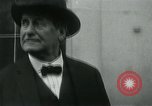
Montage of scenes with William Jennings Bryan
Some restrospective scenes with William Jennings Bryan, assembled after his sudden death in Dayton, Ohio, shortly after the celebtrated "Scopes" trial in 1925. Bryan speaking in front of a residence. (Slate notes he ran for Presidency three times, and was Secretary of State in cabinet of President Woodrow Wilson.) Bryan wearing a cloak and hat, walking on a rainy day, in a city. Automobiles parked at the curb in the background. He smiles, stops and removes his hat to pose for the camera. Next, a closeup of Bryan, bareheaded. Scene shifts to New York City, in 1924, where Bryan stands with his brother, Charles W. Bryan, former Governor of Nebraska, who was nominated as Vice-Presidential candidate during the Democratic Party Convention. William Jennings Bryan conducting one of his weekly Bible classes and Sunday Sermon, to a large outdoor audience, from a stage, in Royal Palm Park, Miami, Florida. Closeup of him gesticulating as he speaks. Bryan and members of his family standing on the bayfront balcony of his residence,“Villa Serena," on the occasion of a visit by former U.S. President Warren G. Harding, who stands behind several Bryan grandchildren
Peacetime activities and contributions by the U.S. Army in the United States.
Scenes from Army Day on April 6, 1934. Secretary of War George Henry Dern, in broadcast to the nation about importance of the Army, in peacetime. Brief glimpses of the Yellowstone River lower falls and Old Faithful and Beehive geysers erupting in Yellowstone Park, Wyoming. View amongst log buildings in Reproduction of Army Fort Dearborn, at the 1933 Century of Progress Exposition in Chicago, Illinois. A pioneer wagon; Native American Indians in ceremonial regalia; antique locomotives and trains at the Exposition. Army General Leonard Wood being sworn in as the Governor General of the Philippines. Closeup of General of the Armies, John J. Pershing, America's highest ranking Military officer. Headquarters of Walter Reed Army hospital, in Washington, DC, named for U.S. Army Major Walter Reed, who confirmed that yellow fever is transmitted by mosquito. Acting on this, the U.S. was able to complete the Panama Canal. View of French dredging equipment sitting idle in the water after Yellow Fever prevented them from completing the Panama Canal. Closeup of U.S. Army General William C. Gorgas, who, in 1904, headed the Sanitary Department that controlled mosquitoes and eradicated Yellow Fever, so the Panama Canal could be finished. View of alligator in swamp near the Panama Canal. Photograph of George Washington Goethals, Chief Engineer credited with making the canal happen. Explosives employed in Panama Canal construction. Earth and rocks being loaded into open rail cars. A steamship transiting the Panama Canal. The Washington Monument; U.S. Library of Congress; and the Lincoln Memorial, cited as examples of accomplishments by U.S. Army engineers. The Wilson Dam, under construction by Army engineers, in Muscle Shoals, Alabama and system of levees being built to control the Mississippi River. The raging Mississippi River during 1927 flood. Flood victims being assisted by U.S. Army soldiers, at a tent camp, receiving food and clothing. An Army airplane flying over a forest fire. Army personnel supervising men in the Civilian Conservation Corps or CCC. Mail being loaded aboard an Army airplane, as airmail service is being opened between Washington DC and New York City. President Woodrow Wilson talking with Army pilot Major Reuben H. Fleet. Mail being loaded into the nose of an airplane. U.S. Army Douglas World Cruiser airplanes in flight, returning from their trip around the world in 1924. A pilot sitting in front seat of a Douglas O-38 airplane, pulls a fabric hood over his cockpit to practice "blind flying". View of the aircraft in flight, with instructor pilot in the open rear cockpit. Army aviators taking a camera and a rifle aboard their airplane as they prepare to leave on an aerial mapping flight. Aerial view of skyscrapers of Manhattan Island, New York City. Army Signal Corps personnel working on communications devices. A cable laying ship operating at sea, in support of the U.S. Army's Alaskan cable and telegraph system. Men loading chemicals into hoppers on Army crop dusting airplane. Several views of Army airplanes crop dusting. Glimpse of boll weevil, the target of their efforts. Closeup of Karl Connell, who as a major in the AEF, in World War I, invented a superior gas mask known as the “Connell” or “Victory” mask. A group of miners wearing gas masks enter a smoky mine entrance. The Army invented tear gas, which is shown being used to thwart a bank robbery, in a staged demonstration. Brigadier General Hugh Johnson, appointed by President Franklin Roosevelt, as head of the Great Depression era National Recovery Administration, or NRA, is seen about to give a speech. Narrator cites him as an example of U.S. Army officers who also serve the country in civilian life. Scene shifts to cadets on parade at the United States Military Academy, West Point, New York.