


 Francais
 Deutsch
 Italiano
Refine Your Search
+"United States USA" +1925 stock footage and images
- Showing 13 to 18 of 156 results more
more Hide
Hide
An aircraft lands aboard United States aircraft carrier Langley off the coast of California, United States.
United States aircraft land aboard the aircraft carrier Langley off the coast of California, United States. An aircraft piloted by Lieutenant H.J. Brow comes in for landing aboard the United States aircraft carrier Langley on March, 25th 1925. A man on the edge of the deck waves signal flags as the aircraft lands. Aircraft taxis along the flight deck.
An aircraft piloted by Lieutenant Commander Mason lands aboard United States aircraft carrier Langley , California.
United States aircraft lands aboard the U.S. aircraft carrier Langley off the coast of California, United States. A man on the edge of the deck waves signal flags as a United States aircraft piloted by Lieutenant Commander C.P. Mason comes in for landing. Aircraft lands aboard on 13th January, 1925. Aircraft taxis along the flight deck.
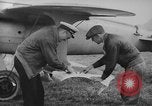
Lt. Williams puts on a parachute and climbs into the cockpit of a R3C1 and two R3C1 fly over Mitchel Field in New York.
Lieutenant Al Williams flying a Curtiss R3C1 racer aircraft for the 1925 Pulitzer Race at Mitchel Field in New York, United States. View of the navy R3C1. Lieutenant Al Williams and a civilian look at a map laid out on a wingtip of the aircraft. Lieutenant Cy Bettis and Lieutenant Williams standing behind the navy R3C1 aircraft. Lieutenant Williams removes his uniform coat and cap, then Lieutenant Bettis helps him put on a parachute and he climbs into the cockpit of the aircraft. Lieutenant Williams seated in the cockpit of the navy R3C1. He smiles at a camera and puts on goggles. A civilian comes up to side of the cockpit and the two men confer over a small notebook. The navy R3C1 with its engine running on a grass field. Several Curtiss mechanics push the tail of the aircraft around. An army officer, a civilian and an army enlisted man are standing nearby and are watching. The navy R3C1 taxis in front of a small hangar. The army R3C1 takes off. Two aircraft flying over Mitchel Field during the course of the 1925 Pulitzer Race. The navy R3C1 lands. Lt. Williams wearing a flight jacket and a navy service cap.
U.S. President Calvin Coolidge, First Lady Grace Coolidge and Senator Charles Curtis in a modern automobile at the White House.
Modern automobile in use by the President at the White House. March 4, 1925: U.S. President Calvin Coolidge, First Lady Grace Goodhue Coolidge and Senator Charles Curtis emerge from inside. Officers around them. The get into a car. The three prepare to leave for the Capitol building on Inauguration day.
City residents and Native American families using early automobiles in the United States.
Growth of suburban and rural areas outside of cities caused by inter-development of the automobile and the public road system (1897-1927). An African American family emerges from a two story apartment building. Men, women and children seated outside. African American woman and children get into a parked automobile (circa 1925 Ford Model T Touring). African American man uses the hand crank in front of the engine to start the car. They drive away. Next scene shows a car parked beside a group of Native American Indian women and children, who are outside a tent; possibly on an Indian Reservation. Next scene is a busy highway packed with cars during a traffic jam. Final scene shows municipal electricians in an electric service truck with a tall, elevated rig on board allowing them access to electricity wiring. Men stand aloft on the rig while the truck moves between light poles, and the men perform some work on an electric pole.
U.S. Army aircraft patrol for forest fires, in 1919, in the United States. Bulldozers and forest plows introduced in 1932
World War I scenes of U.S. Army airplanes in action at the front. A picture of U.S. Army Major Henry A. (Hap) Arnold and California Forester Kurt Dubois, who, together, started the fire patrol practice by United States Army aircraft in1919. Army flyers lined up on a field. Army Curtis JN-4 (Jenny) airplanes in flight as smoke rises from the forests below. Weighted messages with ribbons attached, being dropped by pilots while in flight to inform about a forest fire. Later on after the installation of radios a pilot sends a message on a radio set in case of a forest fire. In 1920s, Crawler tractors used to skid logs out of the forest. In 1925, tractor with a blade was developed and used to build forest roads. In 1932, a Bulldozer being used to create firebreaks during a Southern California fire. A fire plow in operation.