


 Francais
 Deutsch
 Italiano
Refine Your Search
+"United States USA" +1925 stock footage and images
- Showing 43 to 48 of 156 results more
more Hide
Hide
Americans during various dance performances and protests in the United States during the roaring 1920s.
The life of Americans in the 1920s. Women dance the Charleston. A man dances the Charleston with a woman. Musicians play in the background. Patrons of Steeplechase Park, in Coney Island, on a spinning wheel. Clown steer a woman to where her dress gets blown up from a hidden air jet. Women on the boardwalk in batihing suits and being arrested by police. A man lifts up a woman during the dance performance. A sketch shows women applying make up. Several scenes showing the gap between the people who could accept the modern ideas and those who couldn't. Clarence Darrow and William Jennings Bryan. Views of Steelmaking at steel factory plants. A scene with the Ku Klux Klan, or KKK. People protesting the trial of Sacco and Vanzetti, accused anarchists. Various banners during the protests.
The Scopes trial and the Sacco-Vanzetti trial in the U.S.
Court trials in the United States after World War I. Sketches: The Scopes trial. A science teacher John Thomas Scope. Picture of the evolution of man. Defense attorney, Clarence Seward Darrow supports the theory of evolution. Prosecutor, William Jennings Bryan bases his position on the Bible. A person with a poster. People gathered outside the court room for the trial. Sketches: the court room session. People protesting. In separate matter. Accused anarchists, Ferdinando Nicola Sacco and Bartolomeo Vanzetti, two Italian Americans, on trial in Massachusetts for the 1920 armed robbery and murder of two pay-clerks. People protest against the trial. Policemen bring in the accused, to be tried. A huge crowd gathered to protest against the trial.
Famous international personalities are shown visiting the U.S. in the 1920s.
A 1959 production featuring footage of personalities visiting the United States circa 1920s. Douglas Edwards, an American television anchor speaks about the people who visited America. The French actress Sarah Bernhardt visits America. She is greeted by the people. In 1914 she is honored by the French government. Madam Ernestine Schumann-Heink, famous contralto, on board ship with friends. Modern interpretive dancer Ruth St. Denis, with a troupe of women dancers. Russian composer, conductor, and pianist Sergei Rachmaninoff, onboard ship. Polish pianist and statesman, Ignacy Jan Paderewski, arriving in America. Famous Irish tenor, John McCormack, arriving in America. Italian tenor, Enrico Caruso, seen with friends, as he visits America. George Bernard Shaw, the Irish playwright visits America. Arthur Ignatius Conan Doyle, creator of the Sherlock Holmes stands with his family. Maurice Maetterlinck, Belgian playwright and Nobel laureate on deck with companion. Michael Arlen, best-selling author, arrives in America. Joseph Conrad, Polish-born English novelist, is seen with ship's officers. British writer, H.G.Wells, tips his hat as he arrives on a ship to America. Douglas Edwards then presents a public interest announcement about civil defense planning, for the U.S. Office of Civil and Defense Mobilization, sponsor of the show (during the Cold War). This is followed by voice-over from unidentified speaker urging citizens to take part in civil defense. Shown is a cutaway view illustrating emergency supplies of canned foods, and other supplies stored in a home basement for emergencies. A sign describes it as part of a "Family Fallout Shelter." Narrator states that civil defense is an American tradition.
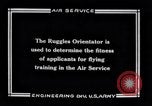
A USAAS engineer sits on a three axes chair and demonstrates the examination for applicants for flying in the Unites States.
U.S. Army Air Service engineers demonstrate the Ruggels Orientation which is used to check the fitness of applicants for flying in the United States. The engineers stand near the machine used for the Ruggels Orientation. An engineer sits on a three axes chair and demonstrate its operation. An engineer sits in the machine and demonstrates the examination.
A PW-8 aircraft performs a barrel roll, a double roll and a tail spin while in flight in the United States.
Activities of the U.S. Army Air Service in the United States. A Curtiss PW-8 in flight. The PW-8 performs a barrel roll, a double roll and a tail spin while in flight. An aerial view of houses and buildings. The PW-8 flies on its back and the pilot controls it perfectly.
Two patients in an XA-1 ambulance plane in the United States.
Activities of the U.S. Army Air Service in the United States. An XA-1 ambulance plane taxis. Two patients in the plane. The XA-1 in flight.