


 Francais
 Deutsch
 Italiano
Refine Your Search
+"United States USA" +1926 stock footage and images
- Showing 13 to 18 of 178 results more
more Hide
Hide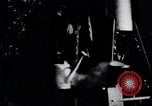
Liquid rocket research and development, led by Robert H. Goddard, in America
Robert H. Goddard with the first flight of a liquid fuel rocket on March 16, 1926, in Auburn, Massachussets. He stands next to the rocket perched high on a launching frame. Goddard uses a long pole and can of benzene to fuel the rocket. Photogaph of his camera and barograph used on July 17, 1929. An 18 meter tower being prepared. A 6 meter high test stand. The barrel could be filled with water and serve as ballast. Picture of a Performance recording device. A man in a protective bunker 15 meters from the launch point for tests in New Mexico. A man using a telescope to observe from a shed 900 meters from the launch point. Another with a telescope and recording device on a tripod. Pictures from the first gyro-controlled rocket flight on April 19, 1932

Crashes showing pilots Lindbergh, Richard B. Byrd, Noel Davis and Stanton Wooster in the United States.
'The Epic American Trans Atlantic Flight' depicts crashes involving various pilots in the United States during early aviation history. Captain Charles A. Lindbergh. On September 21, 1926, Rena Fonck stands in front of his Sikorsky airplane, ready to try a solo flight across the Atlantic to Paris. He takes off and crashes in flames. Navy Commander Richard E. Byrd poses. On April 16, 1927, his Fokker C-2 trimotor airplane ("America"), piloted by Anthony Fokker, with Byrd, Floyd Bennett, and George O. Norville on board, flips over on takeoff at Hasborough, New Jersey. In September, 1927, Clarence Chamberlin in a Bellanca aircraft taxis and takes off. The tail and right main wheel dig into the soft field on landing and the airplane is severely damaged. The wreck of the "American Legion" Keystone Pathfinder airplane that carried Commander Noel Davis and Lieutenant Stanton Wooster to their deaths, in a crash landing, in the Back river, near Langley Field, Virginia, In Paris, on April 26, 1927, French pilot, Captain Charles Nungesser, and Francois Coli pose before taking off on their ill fated flight in a Levasseur PL8 aircraft named " White Bird." Charles Lindbergh standing next to his mother, Evangeline Land Lindbergh. The "Spirit of St. Louis" is towed out and refueled at Mineola, New York. Charles Lindbergh climbs into the plane and makes a bumpy takeoff. Bystanders watch. People gather to greet him upon arrival in Paris. Lindbergh poses with U.S. Ambassador to France Myron Herrick. Lindbergh honored by the French President Gaston Doumergue.
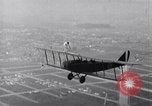
The good times of the 1920's turn into the difficult times of the depression in 1930s America
Documentary depicts the end of the 1920s good times in the U.S. ("Roaring 20s"), leading into the Great Depression. Mildred Unger, age 10, performs a wing walker charleston dance while out on the wing of a JN-4 "Jenny" airplane in flight over Los Angeles in 1926. Four girls dancing on the top of a building higher than those around it, in Boston, Massachusetts. Amusement park patrons riding a roller coaster. People out driving through a park in their automobiles. Patrons enjoying themselves at the Steeplechase amusement park in Coney Island, New York. A crane piling old cars in a heap at a junk yard. But following the Wall Street crash (stock market crash) of 1929, conditions change in America. Group of men, women, and children standing together, looking sad and dejected, poor and desperate, due to conditions of the Great Depression affecting families. Still photo of group of people receiving food assistance or food relief in a bread line in a city. A man, woman, and baby, in a tent (probably migrant workers). The famous 1936 photo, "Migrant Mother" by Dorothea Lange, of migrant worker, Florence Owens Thompson, with two of her children in California. Men receiving food from a city soup kitchen. Dejected unemployed men.

Assortment of unrelated scenes from post-World War 1 period, containing mostly U.S. Navy officers.
A Rear Admiral steps from a doorway, resplendent in special full dress uniform, complete with cocked hat and special embroidered rank insignia on his sleeve. The uniform appears to be European (not American). The scene is repeated in a second take. A French aviator, in leather jacket, walks in front of an early French bi-wing headless pusher airplane parked in an open hangar. (Unlike a Curtiss headless pusher aircraft, this one does not have tricycle landing gear.) He bends to greet a little girl who walks to meet him with a woman, the girl's mother. The three pose for the camera. Next scene shows U.S. Navy Vice Admiral Richard H. Jackson (Commander Battleship Divisions Battle Fleet, 1925-1926). He steps from a building followed by Naval officers. Jackson converses with a young Navy Captain, as others relax behind them. . Closeup of Admiral Jackson and the Captain. The group moves away. Next, a fairly young U.S. Navy Rear Admiral (unidentified) is seen in front of a long, wide, set of granite steps, shaking hands with a Navy Petty officer. They engage in conversation and then the Petty Officer leaves, followed by the Admiral. Next, is seen the entrance to a building numbered 22, that has U.S. Navy signs in its windows. A U.S. Navy Rear Admiral (unidentified) exits the building, accompanied by a Commander and a Lieutenant Commander. The weather is cold enough to show visible moisture from their breath. The three share entertaining conversation, including smiles and laughs.
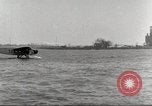
A seaplane being towed by a tugboat in the United States.
A Ford 5-AT Tri-motor Float plane is seen being moving under its own power in a river during tests in 1925. (Its first flight was in 1926.) Later, it is seen being towed close to a tugboat, by a line fastened to its nose. Two men in life jackets stand atop its wing, and several follow in a dory. Several men monitor the tow line from the back of the tugboat.
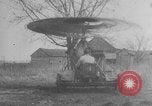
Man attempts to fly the Pitt "Sky Car."
Early attempts at flight during history of aviation. The Pitt Sky Car ornithopter device is seen: A car equipped with an umbrella-like rotor intended for vertical takeoff. 'Sky car' written on a cloth sign on the chassis of the aircraft. A man in aviator's clothing seated at the controls of the machine. The powerful motions of the pulsating rotor cause the machine to rise several inches. But it simply drops to the ground again. This happens with each oscillation of the rotor. (The motor-rotor devise was invented by John W. Pitts, of Detroit, Michigan, and patented in 1926. However, as seen in these images, it was a failure.)