


 Francais
 Deutsch
 Italiano
Refine Your Search
+"United States USA" +1928 stock footage and images
- Showing 97 to 102 of 114 results more
more Hide
Hide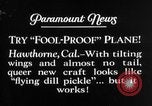
Biplane with tilt wings and no tail changes angle of wings during landing at airfield in the United States.
Flight of biplane in the United States. Biplane with tilt wings and no tail taxis on the airfield. Other aircraft parked in the background. Hangar in the background. The aircraft in flight over grasslands. The biplane changes the angle of wings during landing at the airfield. Men stand on the field.

Slate announcing that a movie is printed on Safety Film
Brief view of a slate at start of a movie film that reads: "In compliance with the law of this state, this is SAFETY (NON-INFLAMMABLE) FILM."
Group of 21 Curtiss Hawk in Selfridge field, Mich.
Group of 21 Curtiss Hawk aircraft in Selfridge Field, Michigan, near Mount Clemens. Men stand in the field. The pursuit planes take off and are seen flying in the sky.

Copper ore mined and copper metal extracted at a copper mine in Montana, United States.
Documentary titled 'The Inside Story of Your Telephone'. Describes raw materials used in telephone manufacturing. Dynamite crew places dynamite at a copper mine in Montana, United States. Miners shovel the blasted ore onto ore cars. Ore is loaded into converters. Slag is poured off. Stacked bars of pure electrolytic copper. Picture of a telephone made of copper.

Loading and transportation of coke for Ford Motor Company.
Coke loaded onto conveyor belt passing through various levels at a Ford Motor Company coal processing facility. Coke being dumped in rail cars and then the rail cars move on railroad tracks. Steam engine attached to the loaded coke cars moving on railroad tracks. "Ford" logo on all of the rail cars.
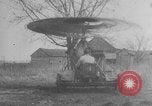
Man attempts to fly the Pitt "Sky Car."
Early attempts at flight during history of aviation. The Pitt Sky Car ornithopter device is seen: A car equipped with an umbrella-like rotor intended for vertical takeoff. 'Sky car' written on a cloth sign on the chassis of the aircraft. A man in aviator's clothing seated at the controls of the machine. The powerful motions of the pulsating rotor cause the machine to rise several inches. But it simply drops to the ground again. This happens with each oscillation of the rotor. (The motor-rotor devise was invented by John W. Pitts, of Detroit, Michigan, and patented in 1926. However, as seen in these images, it was a failure.)