


 Francais
 Deutsch
 Italiano
Refine Your Search
+"United States USA" +1929 stock footage and images
- Showing 19 to 24 of 78 results more
more Hide
Hide
Newsreel restrospective produced following the death of President Franklin D. Roosevelt (WW2)
Opening scene shows the White House in Washington, DC. Scene shifts to President Roosevelt seated, ready to address the Nation by radio. View of the statue of Abraham Lincoln in the Lincoln Memorial in Washington, DC. FDR with his entire family posing, in front of the family home "Springwood" at Hyde Park, New York. Roosevelt, when Governor of New York, seen in a sail boat, in 1929. FDR in his car at his Institute for Rehabilitation in Warm Springs, Georgia. He is speaking with a man associated with the Institute, who then greets several polio victims in wheel chairs there. Crowds celebrating Roosevelt's election, in Times Square, Manhattan, New York City, in 1932. Roosevelt, at the Democratic Headquarters at the Biltmore Hotel on November 8, 1932. He is standing, supported by his son James, as he remarks: "It looks my friends like a real landslide this time." Aerial view of the U.S. Capitol. FDR taking the oath of office on March 4, 1933. Brief view of New York Stock Exchange trading floor. A man looking at stock market ticker tape. A group of people raising a National Recovery Administration member flag. Glimpse of "Springwood" and then view of President Roosevelt sitting next to his mother, Sara Ann Delano Roosevelt. Next, as Franklin and Eleanor Roosevelt sit in the garden, their grandchildren, Anna Eleanor Dall ("Sistie") and Curtis Roosevelt Dall ("Buzzie") come past riding horses, with granddaughter Sara, behind them on a pony. FDR pets the pony and talks with Sara. FDR being nominated for a second term as President, in the 1936 Democratic National Convention in Philadelphia, Pennsylvania. President Roosevelt, riding in an inaugural motorcade as he begins an unprecedented 4th term as President in 1941. Glimpse of President and Mrs. Roosevelt in an open car. West point cadets marching in the inaugural parade. Military trucks towing artillery pieces in the parade. President Roosevelt speaking at the dinner of the White House Correspondents' Association at the Willard hotel in Washington, DC, March 15, 1941. He extols the virtues of Winston Churchill and the British people. And he promises that America will supply them with the war materiel they need in World War II (This is known as the Lend Lease Speech.)
Ruins of United States Army western forts from the late 1800s, and United States Army cemetery near "Battle of Little Big Horn"
Ruins of United States Army (Union) forts established in the Great Plains of the United States from the time of the American Civil War until the late 1800s. View of various paintings by Remington that depict the Union Army regular soldiers in encampments and in battle with Native American Indians in western regions of the United States. Tombstones in a graveyard or cemetery near the Battle of the Little Big Horn. The grave of Corporal of the 2nd U.S. Cavalry James Kelley dated December 21, 1866. The grave of 2nd U.S. Cavalry Blacksmith Dennis Hurley dated July 29, 1878. The grave of Trumpeter 1st U.S. Cavalry Albert Anderson dated 22nd February, 1929. The grave of the an Unknown Soldier.
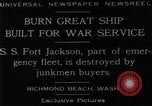
The S.S. Fort Jackson is burned by junk salvagers.
The ship S.S. Fort Jackson, part of the U.S. emergency fleet in 1929, is destroyed by salvage buyers at Richmond Beach in Washington. Flames and smoke rising as the S.S. Fort Jackson falls to pieces.
Dedication ceremony of the U.S. Army Felker Heliport at Fort Eustis, Virginia.
Aerial view of helicopters at Fort Eustis, Virginia, with snow on the ground. Crowd gathered inside a large hangar. The widow of Alfred C. Felker, wearing a corsage, stands with his father, as Army officers salute in tribute at the dedication of the Felker heliport. A young boy who is Felker's young son removes the covering from the dedication plaque, which reads:"U.S. Army Fort Eustis Virginia, Felker Heliport in Memory of WOJG Alfred C. Felker 1929-1953." A Piasecki H-21 Workhorse or Shawnee helicopter takes off from the snow covered airfield. Mrs. Felker is a passenger on one of two smaller helicopters that circle around one another and then land.
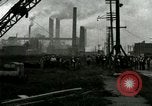
A water tunnel constructed in United States.
In a production plant yard a steam shovel or crane carries load from one side to other. The crane digs hole and dumps dirt to one side. A group of workers and business men in business suits watch. Smoke rises from the industrial stacks in the background.
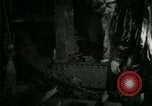
Workers use block and tackle method to lay concrete blocks for construction of a water tunnel in United States.
Block and tackle arrangement used to lay concrete blocks for the construction of a water tunnel in United States. Concrete blocks on a car. Workers use block and tackle to remove pre-cast concrete lining block from a car on rails and attach it to the erector arm of block and tackle system. The erector arm swings around towards the ceiling of the tunnel and lowers the block on the ground. Several blocks are removed in this manner.