


 Francais
 Deutsch
 Italiano
Refine Your Search
+"United States USA" +1935 stock footage and images
- Showing 73 to 78 of 255 results more
more Hide
Hide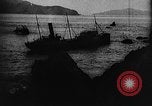
Coast Guardsmen rescue crew of the wecked Union Oil Carrier, "Lyman Stewart" in California and other examples of Coast Guard rescue operations.
Film starts showing the wrecked tanker "Lyman Stewart" off the coast of Land's end outside the Golden Gate, San Francisco. (She was victim of a crash in the fog with the freighter "Walter Luckenbach" and was beached to avoid sinking.) Closeups of the "Lyman stewart." A crew member of the stricken ship is seen being brought ashore by breeches buoy. Spectators gathered on the rocks watching the operation. View from between rocks of the "Lyman Stewart." Another stricken vessel is seen against rocks near San Francisco. It is a large freighter. Half the crew are seen being taken ashore in Coast Guard power life boats. To bring others ashore via breeches buoy, Coastguards men on an overlooking cliff, fire a shot line with a Lyle gun to the ship. Next, a crew member is seen being brought ashore by breeches buoy. A Coast guardsman assists him on the shore. Another crew member is likewise rescued. Several Coast Guard ships and boats are seen underway. A Coast Guard General Aviation PJ search and rescue flying boat seen from above as it flies over a shoreline. Aerial views of several Coast Guard Stations. Coast Guardsmen in lifeboats and patrolling a marine regatta in a power boat. Coast guardsmen firing a warning shot at a vessel being intercepted at sea. Guardsmen from a cutter examine a boat for violations. Persons in distress being helped by Guardsmen. A vessel in rough waters and a burning ship at sea. Coast Guardsmen aboard a cutter with a line to a ship in distress in heavy seas.
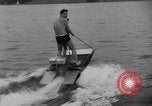
A man and a woman ride a self powered aqua plane during its demonstration in the United States.
Demonstration of a self powered aqua plane in the United States. A man and a woman ride the aqua plane during its demonstration. (The aqua plane was a precursor to the jet ski)
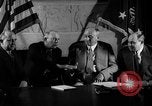
The NRA is declared unconstitutional by the U.S. Supreme Court.
Meeting of National Recovery Act officials. Men put a lock on a Brooklyn poultry farm. Close up of the lock on the door. President of the American Federation of Labor William Green is seen as narrator explains that the shuttering of the poultry farm by the NRA was declared unconstitutional by the Supreme Court.
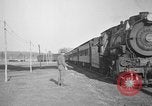
New Civilian Conservation Corps recruits are processed at Army center, receiving personal gear and billet assignments
New Civilian Conservation Corps (CCC) recruits arrive at Army processing center in the Great Depression. CCC recruits arrive by train and bus. A soldier passes out information sheets to the new recruits. Another soldier leads them to an administrative tent where they are interviewed and processed by Army clerks. The recruits are assigned to various tents, and they receive duffel bags and mess gear.
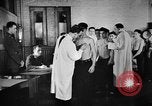
New recruits, for the Civilian Conservation Corps, commence training at Army Camp.
New Civilian Conservation Corps (CCC) recruits from urban areas are examined by doctors at Army processing center during the Great Depression. Men stand on city sidewalk, with their luggage, waiting for bus to take them to the CCC processing center. One man stands in front of a large tent. Several men in civilian clothes, with luggage, line up at a discharge office, after completing their term of service. Army supervisor reads from a list as recruits respond by raising their hands. Recruits run from their tents, carrying their mess gear, as mess call is sounded. Recruits walk through a mess line and receive hot food. They sit and eat at large tables in a mess hall. Recruits are issued blankets, clothing, and personal items from Army quartermasters. Scenes of recruits making beds. A cot with a recruits belongings laid out upon it. Several recruits pose in their civilian clothes, and then in their uniforms. CCC men march, carrying shovels, and commence work on a construction project. Men, with wheelbarrows, work on the project.
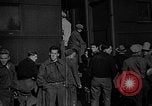
Members of Civilian Conservation Corps work at Camps and Parks in mountainous areas.
Civilian Conservation Corps men leave basic training camp by railroad train. At their destination, they step from the train, unload their supplies and equipment from baggage car into a truck, and board Army trucks that carry them through a town and out to a rustic camp in a pine forest, where tents are set up and buildings are under construction.They commence work on the unfinished structures. Views of completed barracks buildings and smooth dirt roads. View of white tents pitched in neat rows on hillside. Trucks loaded with CCC workers leaves a camp. View of a CCC camp out west, with large cactus ,and rugged mountain landscape. CCC men setting up picnic tables and benches at a park, by a lake surrounded by mountains. an encampment with row of tents and several utility buildings, in a canyon surrounded by beautiful mountains. (Great Depression period)