


 Francais
 Deutsch
 Italiano
Refine Your Search
+"United States USA" +1936 stock footage and images
- Showing 73 to 78 of 286 results more
more Hide
Hide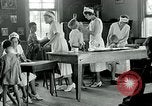
WPA nurses conduct health check ups in nurseries while men construct roads and build dams in drought areas of the Great Plains.
Drought affected areas of the Great Plains during the Dust Bowl and the Great Depression in the United States. A Nursery school in the drought area. Works Progress Administration (WPA) nurses conduct a health checkup physical examination of children. Children seated on benches in the school. A nurse questions a little girl. They administer typhoid serum. A nurse takes a little boy’s temperature while another examines a boy's eyes and throat for signs of problems caused by dust. Farmers with horses and horse carts. They construct roads under the Works Administration Program (WPA). They employ horses and plows for road building to carry crops to market. They cut wide fire lanes in drought damaged farms to prevent the spread of Prairie fire. Construction of assorted small dams to capture rainwater. Men transport dirt and rocks in wheelbarrows, dig in the ground, and work with machinery and equipment. Larger dams are also built. Men at cleared land. They twist strengthening wires into place using pliers. Men wearing gloves and smoking pipes work at the dam site.
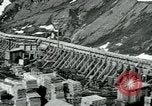
Construction of the Fort Peck Dam in Montana and ponds and lakes built by WPA relief workers in the Great Plains.
Drought affected areas of the Great Plains during the Dust Bowl and Great Depression in the United States. U.S. Army engineers and WPA (Works Progress Administration) relief workers construct the Fort Peck Dam in Montana. Workers digging. Tunnels and spillways at the construction site. Heavy machinery and equipment. A worker on the tracks leading into a tunnel. The gigantic structure at the headwaters of the Missouri River. Ranchers with their cattle near ponds and lakes built by WPA labor. An old rancher on his horse with a dog alongside. Ranchers with horses as they drink from a pond. A rancher with his son and their dogs look on as cattle graze and bathe.
A documentary titled "The Dust Bowl"
A documentary film, titled "The Dust Bowl", showing the drought ridden areas of Southern plains in United States. Cattle grazing. A map of United States showing Southern plains, then the states of Colorado, Kansas, New Mexico, Texas, Oklahoma and the city of Dalhart is also seen highlighted. Cattle grazing, a man standing outside a house. Views of Southern plain terrain. Tractors, wind mills and other farm equipment can be seen. Parched and barren land, desolated roads and houses can be seen.
American Farmers heading to California with their families, to escape the dust bowl and start life anew.
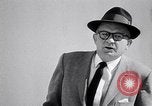
Narrator, Lewis Nordyke, recalls seeing farm families passing through Dalhart, Texas, on their way West, to escape the dust bowl and start anew in California. Farmers and their families traveling in trucks. They stop and make camp for the night. Two farmers in conversation. Woman feeding a baby. Woman drying clothes. Girl sleeping. Journey starts again, with trucks piled high with belongings driving on roads. A sign marked with 'Arizona Welcomes You' can be seen as they pass through the Inspection office. Entering California, a board marked 'Needles welcome You to California'. Farmers go through inspection process in California.
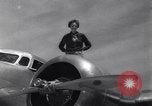
Amelia Earhart gets into her Lockheed L-10E Electra and takes off.
Amelia Earhart stands on the wing of her Lockheed Electra. Earhart enters the cockpit of the Lockheed L-10E Electra. Wide shot as the Lockheed Electra takes off.
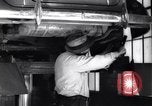
Automobile anti skid device invented in America.
A man installs an anti-skid device he invented for the brake system of an automobile. The man tries the brakes on the car. Demonstration of the device in action. Comparison between a car with the device and another without. The one without the device skids on a curve.