


 Francais
 Deutsch
 Italiano
Refine Your Search
+"United States USA" +1939 stock footage and images
- Showing 19 to 24 of 172 results more
more Hide
Hide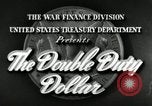
World War 2 film promoting public investment in War Bonds and stamps to aid the war effort and temper inflation
World War 2 era film that also includes some World War 1 scenes. Show girls or chorus girls in follies-like show, costumed as U.S. silver dollars and marching to tune and lyrics alluding to dramatic increase of currency in circulation, over the years. Animation with stacks of coins shows increase in national income from $46 billion,in 1933, to $71 billion, in 1939, and $142 billion in 1943. Back to the "follies dollars," a boy asks why, and then scenes of the Japanese attack on Pearl Harbor,are shown, with U.S. battleships being sunk. Wartime arms plants are shown. An M2A3 Light Tank rolls off a production line. Ships being constructed in a shipyard. B-24 Liberator bombers being built in a factory. Artillery shells being produced. Defense workers receiving their pay. The "follies dollars" group themselves to illustrate the fractions of income devoted to taxes and savings. But other spending is curtailed by wartime shortages. A woman talking with clerk in a drug store. U.S. Army troops crossing a pontoon bridge in open trucks, towing 75mm M1A1 howitzers. Infantry on the march. Animation showing industrial production devoted to war materiel and lots of dollars chasing few civilian goods. A grocery clerk offers to sell a woman customer butter for more than the established price, and she agrees. The "follies" performers then introduce the idea of an "inflationary dollar," and some history of past U.S. inflations. Animated examples of price inflation are shown. Glimpses of World War I scenes are seen, circa 1917 -1918, including: a 12-inch railway gun firing; a huge explosion from shell bursting near the camera; various scenes of United States infantry soldiers and French soldiers in battle action, running to bomb craters for cover and emerging from trenches to go up "over the top" into no-mans land during combat. Meanwhile, singing narration refers to the home front inflation due to competition for limited civilian goods. Map shows Europe and singing narration cites rising prices for food in occupied France and other countries suffering ravages of World War II. Montage of scenes showing needy civilians obtaining food in those countries. Animation shows increases, by 1944, in cost of U.S. civilian goods since the Pearl Harbor attack. "Follies" character called "Double-duty dollar," appears explaining he serves the war and curtails inflation on the home front by being saved through investments in War Bonds and stamps.
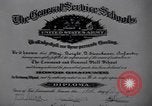
The military career of General Dwight D Eisenhower from 1926 to World War II
Film starts showing Dwight D. Eisenhower's diploma as honor graduate of the Army Command and Staff School, in 1926. Image of Major Eisenhower (in civilian clothes) Narrator says he was assigned to France, to prepare a guide book on American battlefields in Europe. Image of Eisenhower as a member of General Douglas MacArthur's staff in the Philippines, where MacArthur was Commander-in-Chief of the Philippine army. Glimpse of headquarters building there. MacArthur in his office helping the Commonwealth of Philippines work out a plan for its military defense. Image of Lieutenant Colonel Eisenhower in 1939, serving as Executive Officer of the 15th Regiment, at Fort Lewis, Washington, View of the Regiment's Headquarters building. Scene shifts to 1940, showing German forces invading Holland and Belgium. German tanks are seen in action. German Junkers 87 Stuka dive bombers and Heinkel 111 bombers drop bombs. After passing of the Selective Service draft act, President Franklin D. Roosevelt is seen at a public ceremony on October 29, 1940, where Secretary of War Henry L. Stimson drew from a bowl the capsule containing the first draft number of World War 2. Views of Lt. Col. Eisenhower as Chief of Staff of the Army 3rd Division and later as Chief of Staff of the Ninth Corps. Next, he is seen as Chief of Staff to General Walter Kreuger, who in 1941 led the Third Army in the most realistic maneuvers held by American troops (The Louisiana maneuvers). Views of American troops engaged in those maneuvers. Image of Eisenhower as a Brigadier General. Views of the Pearl Harbor bombing during Japanese attack on December 7, 1941.
Igor Sikorsky speaks about helicopters.
Igor Sikorsky speaks about helicopters. A rack full of books in the background. VS-300 Sikorsky helicopter flies first time in September 1939. A pilot sits at VS-300 helicopter. Vought Sikorsky VS-300 helicopter lands at water. Helicopter takes off.
America plunged into World War 2. Montage of various World War II scenes over the span of the war years
American Jitterbug dancers seen at a contest in 1938. View of feet in shoes, as wearers tap their feet and beat time to music. View of drummer using wire brush on drum. Stadium of people cheer for a dancing cinematographer who is using a motion picture camera to film the event. In contrast, Nazi troops seen parading by torchlight. Nazi flags everywhere and Nazi party ceremonies, overseen by Adolf Hitler, in Germany. Nazis burning books. "Attention Jews" with skull and crossbones painted on stores and business establishments. Nazi Storm Troopers intimidating Jewish businesses and advocating boycott. Glimpse of Heinrich Himmler, in foreground, and Hermann Goering, in center of group of Nazi officials. Junkers Ju-87 Stuka dive bombers attacking Poland in 1939. German artillerymen firing heavy guns. A German railroad gun firing. German paratroopers jumping from Ju-52 trimotor transport aircraft. In contrast, patrons are seen descending in parachutes on the Parachute Jump ride at Coney Island Steeplechase Park, in Brooklyn, New York. Life Savers company sponsorship sign seen atop the parachute jump tower. People eating hot dogs, and firing guns at the shooting gallery on Coney Island's boardwalk. Germans march Polish prisoners of war. German troops invading Denmark and Norway. German troops passing a road sign for Chemin des Dames in Picardy, Northern France. Bomb exploding at Pearl Harbor, Hawaii, on December 7, 1941. American forces engaged in war against japan in the Pacific and against the Axis powers in Europe. U.S. soldiers throwing hand grenades. American wounded being carried on litters. People cheering liberating Allied forces in a European town. British soldiers on a vehicle displaying cartoon of Prime Minister Winston Churchill. Soviet forces advancing in snow. U.S. steel and war plants in operation. Men and women war production workers in American defense plants and war materiel factories, using drills, lathes, and power tools in the spirit of "Rosie the riveter." C.I.O. Poster to promote voting, during the war. Closeup of Sidney Hillman, President of Amalgamated Clothing Workers of America. Spectators line sidewalks to get glimpse of President Franklin D.Roosevelt (FDR) in a motorcade. Silhouette of two soldiers helping wounded comrade. FDR's funeral cortege. U.S. troops taking a break, in a war zone. American school children run into a field. An atomic bomb explosion.
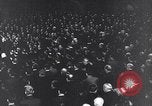
Isolationist versus interventionist sentiments of people in the United States regarding America entering World War 2
Americans express their views about United States entering into World War II after the Pearl Harbor attack. Anti-war isolationist and interventionist views are presented. Senator Gerald P. Nye advocates in favor of an arms embargo. Urging against American involvement in war, Senator Burton K. Wheeler cautions that war mongers and interventioners or intervention advocates control most of the avenues of propaganda. Wendell Willkie speaks advocating unity of purpose in America and importance of assisting the threatened democracies of Europe with war materiel and supplies. Next, Senator Joshua B. Lee of Oklahoma strongly urges support for lend-lease and "setting in motion an industrial blitzkrieg (of war materiel) that will make it possible for England to blast Hitlarism from the face of the earth." View of Congress meeting in the U.S. Capitol chamber. Anti-war college aged students protests against involvement in war and picket at the White House in Washington D.C.,United States. Adjacent to them are other protestors picketing against the peace advocates, with signs like "Americans are against subversive organizations picketing the White House" and "We Americans protest Communists picketing the White House. A women's organization advocating peace or protectionism or isolationism is seen wearing all black. They pull down black veils over their faces in a show of unity against war and the possible loss of American boys to war. An outdoor rally of a fascist organization meeting in America. Also scenes from a German American Bund meeting in 1939 at Madison Square Garden in New York City. Speaker at the meeting is Fritz Julius Kuhn who watches as a protestor leaps on the stage and is subdued by guards. Scenes shown from various other protests in the United States during the same era, including labor strikes and lockouts, and a group holding a rally in favor of equal rights or civil rights, with a woman holding a sign "Did Lincoln Free the Slaves?"
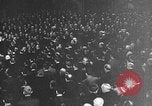
Varying sentiments about war and labor in lead up to World War 2. Roosevelt delivers his war message in the United States.
Disturbances and conflicting views about war versus isolationist approach in the United States prior to World War II. Officials speak about lend lease and officials with anti-war involvement stance advocate protectionism. Speakers include Senator Gerald P. Nye. and Senator Burton K. Wheeler. Wendell Willkie speak advocating a unified approach. Senator Joshua B. Lee of Oklahoma speaks. United States President Franklin D. Roosevelt addresses the Congress and delivers his war message. Pacifist student protestors on street in front of the White House with anti-war banners that read 'Peace Mobilization'. Counter demonstrators also picket, including a man with a sign, "We Americans Protest Communists Picketing the White House." Vehicles drive past in front of the White House. A group of women anti-war protestors are seen seated at an event, and together they pull down black veils in front of their faces. German Bund officials (German-American Bund) are seen meeting at an outdoor rally, and then again at Madison Square Garden in New York City in 1939. A band plays and the leader Fritz Julius Kuhn gives a brief speech during which a protestor leaps the stage and is beaten down by Bund members. Workers on streets protesting for various labor rights. They march and picket on a street. Demonstrators for other causes in American society in the early 1940s, including a woman demonstrator who carries a sign advocating civil rights or equal rights that says "Did Lincoln Free the Slaves?" Clip ends with scenes of violence at various labor strikes, including scabs (strike-breakers) being attacked, beaten, and hit by strikers, and authorities directing water hoses on strikers to repel them away from a building gate.