


 Francais
 Deutsch
 Italiano
Refine Your Search
+"United States USA" +1941 stock footage and images
- Showing 127 to 132 of 303 results more
more Hide
Hide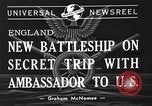
Lord Halifax travels aboard HMS King George V on a secret trip to United States during World War 2.
Lord Halifax arrives in United States aboard a new British warship. British Ambassador to United States, Lord Halifax travels aboard HMS King George V on a secret trip. Lord Halifax and his wife aboard the ship. Sailors stand on deck of the ship. United States President Franklin Roosevelt meets Lord Halifax before the warship reaches the port. Lord Halifax and his wife give a speech. Lord Halifax states that it was a great honor as President Roosevelt came to meet them.
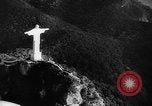
FBI agent William Sebold (posing as Harry Sawyer), and successful filming of members of Duquesne spy ring in the United States.
Aerial view of Christ Redeemer Statue on Mount Corcovado, Brazil. The director of the Federal Bureau of Investigation (FBI), John Edgar Hoover, narrates this 1944 clip and talks about enemy agents in the United States during World War II, before America's entrance into the war. German and Japanese suspects seen in South America. A German fleet carries German agents aboard merchant and cargo ships. German agents in formation on deck of ship, shown debarking the ship after receiving instructions. Japanese and Nazi German colonies being established in South America in large cities and in remote areas of Patagonia. Automobile industries, hotels, shops, and other industries established by Nazi German agents. German signs and Nazi Swastikas and Nazi flags shown on some buildings in South American countries including Brazil. A Nazi flag. A view of German factories in South America. Photographs of Adolf Hitler in a school building where young boys and girls are being instructed by their teacher. German pilot shown operating a passenger airliner; aerial view of from aircraft of Rio de Janeiro Brazil, including port and city areas. A dramatization depicts well planned accidents in the factories and sabotage attempts to slow production of goods bound for the United States. The Federal Bureau of Investigation (FBI) receives reports about planning of German attack on the Panama Canal. A woman watching a teletype machine as a report arrives. A man in a radio room of the Federal Bureau of Investigation receives information and turns to type out a report on his typewriter. Men and women convicted as spies are seen together in a room with U.S. federal agents. The spies are taken in a police van. Man serving as projectionist seen running a film projector. A film of Fritz Duquesne case in the FBI office shows FBI Agents' successful secret filming of members of the Duquesne spy ring. The film is shown being loaded onto a projector and then played. FBI agent William Sebold (posing as spy Harry Sawyer) is seen with Fritz Duquesne and other spy ring members: Pedestrians and vehicular traffic on a New York street corner as Sawyer and Duquesne prepare to meet. German spies sit together in a hotel room in New York City, recorded by hidden camera. Heinrich Clausing, a spy ring member and former cook on the cruise ship SS Argentine is seen. Also seen is Hartwig Richard Kleiss putting on his hat and smoking a cigar. He's shown giving money to Sawyer for purchase of a spy camera, according to narration. J Edgar Hoover notes that German agents communicated through a Long Island radio station that was secretly controlled by the FBI. Hartwig Kleiss is seen showing the blueprint plans of the steamship SS America, including plans for its secret gun emplacements. Fritz Duquesne is shown in the film, removing diagrams of various American arms that he had concealed in his sock Japanese agent Takeo Ezima, of the Imperial Japanese Navy, is also seen meeting in the hotel with Harry Sawyer.
An officer from "March of Dimes" addresses the nation and asks people to join in the parade of dimes in the United States.
An officer of health charity "March of Dimes" addresses the citizens of the United States. The officer seated at a desk. He addresses the nation and asks the Americans to join in the parade of dimes and aid for infantile paralysis (polio) victims. A nurse examines a crippled child. Children suffering from polio are seen in a hospital. View of a special swimming area and harness apparatus for patients with polio In a theatre, a kiosk is seen with a banner that reads: "drop a coin here" and is raising money to fight polio and other childhood ailments. Theatre patrons are seen dropping coins in the slot to help with the fundraising effort. (World War II period).
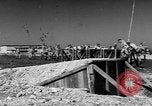
Basic training of Aviation Cadets in the U.S. Army Air Forces
Entire film is devoted to challenging obstacles that U.S. Army Air Forces aviation cadets are required to run through as part of their basic training. They are seen climbing walls. running up platforms, jumping and catching hold of ropes, and facing similar kinds of physical challenges on an extensive obstacle course. (World War II; WW II; World War 2; World War Two)
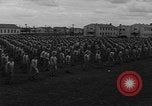
U.S. Army Air Forces Aviation Cadets in basic training..
In opening scene, hundreds of Army Aviation Cadet candidates are seen running in formations.This consumes most of the film. Next, they are seen lined up outside their quarters and practicing Judo throws, in pairs. Later, some run on a track around the field as others gather in the center of the field and play football.
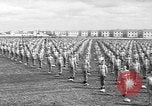
U.S. Army Air Forces Aviation Cadets in basic training physical exercises.
In opening scene, hundreds of Army Aviation Cadet candidates in formation are seen engaged in calisthenics. They perform several different types of exercises, starting at attention and moving their arms forward, then to their sides and down. After doing a number of repetitions, they begin doing numerous "Jumping jacks" combined with deep bends to the ground. They conclude their exercises with a number of squat pushups. (World War II; WW II; World War 2; World War Two)