


 Francais
 Deutsch
 Italiano
Refine Your Search
+"United States USA" +1941 stock footage and images
- Showing 175 to 180 of 303 results more
more Hide
Hide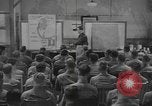
An instructor prepares before giving a lecture to students in a class in the United States.
Training methodology for U.S. soldiers in the United States. Soldiers seated in chairs in a class room. An instructor speaking to them. He talks about types of gases and their identification. A diagram on a chart. The instructor has not prepared for the lecture. He arrives near a table to get a gas identification set. The set is not there. Another officer talking to the soldiers and speaking about the well preparedness for any action before it is being undertaken. The instructor preparing for the next lecture. He reads a book and makes notes. He assembles equipment and rehearses lesson. The instructor speaking to the students in a class. He speaks about a rifle and its working. He gives step by step demonstration of each phase. The students holding rifles. The instructor asks them questions. They discuss at the end of the lecture to sum up the important points and to clarify the doubts. (World War II period).
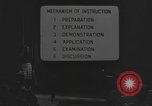
Correct mechanism and methods of instruction are explained to soldiers in the United States.
Training methodology for U.S. soldiers in the United States. An instructor instructs soldiers seated in a class room. He speaks about the correct methodology of teaching. A chart on a board reads 'Mechanism of instruction'. There are six steps in the mechanism of instruction. They are 'Preparation, Explanation, Demonstration, Application, Examination and Discussion'. The methods of instructions are also explained. These things should be considered while instructing 'The Lecture, the Conference, the Demonstration, the Group Performance Method and the Coach and Pupil method'. The lecture should be brief and interesting. Training films, slides, maps, models and other devices should be used. An instructor instructing a class. He takes a long lecture. The soldiers sleep in the class. (World War II period).
Actors portray small Native American Indian family leaving the funeral of the grandfather
Actors portray Native American father, mother, and their boy, riding on a buckboard wagon pulled by two horses. White clouds low on horizon behind them. The parents speak to the boy about his grandfather's death, and talk about beginning anew. Brief view of of a burning funeral pyre, in the desert, with dramatic outcroppings of rock in background. Slate appears telling about the family in ensuing years.
Native American Indians reenact a tribal ceremony around campfire and discuss problem of combating tuberculosis.
Large group of Native Americans chant and dance as they reenact old tribal ceremonial activities. Several discuss deaths of their parents from disease (tuberculosis) and ponder competing views for combating it. One thinks old ways are better but another thinks more modern methods might be called for. A young Native American man sitting alone with with a young Native American woman, speaks about his decision to attend a White man's boarding school.
Enactment showing Native American Indian youth leaving a reservation and attending a boarding school
Native American actors portraying story of youth who leaves a reservation in the United States to attend a boarding school. A man saddles his horse and brings another with him as he crosses a fenced area, past a man chopping wood. He stops near a young woman, named Nema, standing in front of a low log shelter. A young man, named Robert, says goodbye to her and to an older man named, Slow Talker, standing near a buckboard wagon. Robert climbs on the empty horse and canters away with the other rider. As they watch the riders depart, Slow Talker tells Nema, that Robert is forsaking the ways of his people. The riders continue across the desert landscape and then are seen walking up to a substantial building housing the boarding school. Robert enters as his companion bids him good luck. Robert is seen inside the school with text book open as he writes. Another scene shows him practicing in a forge, as part of his training. He cleans up in a lavatory.
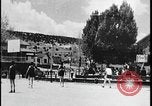
Physician giving physical examination to Native American Indian youth at a boarding school
Native American actors portraying boys at a boarding school. They play volley ball on a school field. A school supervisor calls them together and introduces a physician, who tells them they look strong but could harbor germs. Doctor examines one of the boys, by tapping on parts of his upper body, as he explains what he is doing. He uses a stethoscope. He takes a chest Xray of the boy. The doctor removes the film and tells the boy he'll show it to him after it is developed.