


 Francais
 Deutsch
 Italiano
Refine Your Search
+"United States USA" +1943 stock footage and images
- Showing 31 to 36 of 523 results more
more Hide
Hide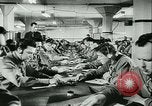
U.S. Army Signal Corps officers train at Fort Monmouth and production of signal communication items in the United States.
The role and contribution of the U.S. Army Signal Corps in combat and war. U.S. Army Signal Corps officers train at the Signal Corps Officer Candidate School (OCS) Fort Monmouth, New Jersey. Officers train at telegraph machines under the supervision of an instructor. Officers seated at desks in a classroom. Instructors take classes with the help of charts, diagrams and black boards. Officers seated atop electric poles for training. Two officers train in hand-to-hand combat at the OCS. Officers learn to use Radio Relay. Students listen to an instructor as he demonstrates the process. A U.S. soldier lays field wire across a hilly terrain to establish wire communications in the European Theater during World War II. Soldiers on the hill. Soldiers set up a sending station at the point where the wire can't go forward. A receiver is set up at the point from where the wire can go forward again. A soldier receives a photograph of a map through facsimile. Items of signal communication including radio relays, receivers, walkie-talkies, radio boxes and fuses to be produced and distributed by the USA Signal Corps to all other ground forces, navy and the Allies. New, modern, improved efficient signal communication equipment. A soldier displays two old type fuses and their counterparts.
V-mail procedures including cutting, microfilming, transport, photographic enlargement, and processing during WWII.
The use of V-mail (Victory Mail) by the United States during World War II. V-mail procedures including cutting, microfilming, transport, photographic enlargement, and processing of V-mail letters and post. A poster promoting the use of V-mail. Women in a line at a post office. The post office staff at counter windows serves the customers. A woman collects a V-mail letter, writes her message and then addresses the letter. The preferred use of a softer pencil in V-mails. Cutting: Specially trained soldiers unpack the V-mails and use a cutting machine to open each mail. Processing: The experienced staff sorts mails into the respective destination groups at sorting tables. Soldiers open mails to photograph them. A soldier sorts mail that can't be photographed and are to be sent back. These mails include stamps, enclosures, snapshots and bad writing. The correct mails are then sorted into given numbers in bundles. Microfilming: Women use Airgraph machines to photograph each mail on 16mm films. 1600 mails on 100 feet of film. The complete reels are sent for developing. Women put in new reels of negatives into the cameras. Developers dry the film reels. Stacks of reels on a table containing images of thousands of letters. Soldiers packing and stacking many hundreds of sacks filled with V-mail letter microfilm images. A Boeing 314 Pan American Clipper flying boat sea plane (military designation C-98) is seen taking off to transport V-mail to major destination points. A bag of microfilm reels is delivered to an officer. He unpacks the reels and sends them to the printing room. Enlargement: Enlargement machines are used to enlarge the snapshots. Men and women operate the printing machines. Soldiers with the printed facsimiles on tables. Processing: Women slice the prints into separate letters. Machines used to insert facsimiles into V-mail envelopes and seal them. The mails are then sent to the exact destinations by ordinary post. Soldiers gather around as a comrade distributes mail at a U.S. military base in the combat area.
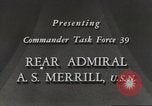
Rear Admiral A S Merrill states his observations on the Commander Task Force 39 at battle of Empress Augusta Bay
Rear Admiral A S Merrill states his observations on the Commander Task Force 39 during the Battle of Empress Augusta Bay. United States B-24 Bomber in flight. The Task Force should develop a tactical doctrine to attack the Japanese enemy. Radar shows the Northern Southern and center Japanese enemy groups in range. Division 45 pass an enemy target thinking it to be friendly. Cartoon animation of a sailor with NBC emblem on sleeve. (World War II period).
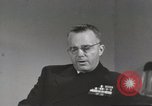
Admiral A S Merrill talks about target recognition of the Commander Task Force 39 during Battle of Empress Augusta Bay.
Rear Admiral A S Merrill talks about target illumination and recognition of Commander Task Force 39 during the Battle of Empress Augusta Bay. Enemy drop star shells. He talks about the speed ships should maintain, the accessibility of CIC to the Captain and planning a tactical plot. (World War II period).
U.S. Army Air forces pilots learn about the Republic P-47 Thunderbolt airplane
From a U.S. Army Air Force Training film, "How to Fly the P-47. Pilot Familiarization." United States pilot seated on table writes a postcard to his mother, "Mrs D.Q. Hopkins. 1024 Clay Avenue, Pelham, New York" Board in the background with 'Daily Assignment of today' written on it. Scene shifts to forward view from cockpit of a Republic P-47 aircraft flying low over the flight line at an Air Base. Momentary glimpse of the pilot and his post card in the office. Back again, to forward view from cockpit of a P-47, but this time it is on final approach to the runway. Scene shifts to ground view of a P-47 landing. It taxis to the ramp and parks. The crew chief stands on the wing as the pilot completes and signs the aircraft's Form 1 (record of any problems). Five pilots walk past the flight line. The pilot, wearing a seat pack parachute, climbs down from the cockpit. The five pilots, seen earlier, approach, and one introduces them to the P-47 pilot (Captain Hopkins). They are Lieutenants assigned to his training flight. He greets them and shakes hands with all. The group ask questions about the P-47. Then they all go to the pilots room. As Captain Hopkins takes off his flight gear he tells them the P-47 is designed to operate at high altitude. He describes the P-47, referencing a large illustration of it on the wall. (World War II; WW II; World War 2; World War Two)
United States Army Air Forces pilots undergo training on characteristics of the P-47 Thunderbolt aircraft
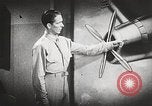
A U.S. Army Air Forces Captain is explaining characteristics of the Republic P-47 thunderbolt airplane, as he points to a large illustration of one on the wall. Among other things, he emphasizes aspects of its engine and propeller. Closeup of instructor pointing to switch, on panel inside the cockpit, that allows pilot to select automatic or manual control of the Curtis Electric constant speed propeller. Instructor points to diagram as he discusses the plane's fuel tanks. The instructor continues describing the aircraft, removing covers to expose parts of the illustration as goes along. The Captain (instructor) and students (Lieutenant pilots) look at a cutaway of the aircraft turbo supercharger. Together, they look at the throttle controls they'll find in the airplane. Instructor demonstrates actions to invoke military power, moving throttle past the sea level stop and invoking supercharger as well as water-injection. He also mentions gear and flap controls as well as armor, and the plane's eight 50-caliber machine guns. Next, the Captain takes one of the Lieutenants with him and leaves to look at an actual airplane on the flight line. (World War II; WW II; World War 2; World War Two)