


 Francais
 Deutsch
 Italiano
Refine Your Search
+"United States USA" +1943 stock footage and images
- Showing 409 to 414 of 523 results more
more Hide
Hide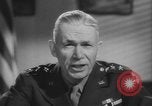
ASF Commanding General Brehon Somervell speaking about the problem of substitution and conversion of needed World War 2 supplies
Production of supplies for American soldiers during World War II. Commanding General of Army Service Forces( ASF ) Brehon B. Somervell seated at a desk in his office in the United States. He explains the serious problem of substitution and conversion and what is being done by American science to meet these needs. Somervell states that he is issuing an order: A command to think along new lines regarding every product essential to the war. He asks: 1) Can it be made as well of some less critical material; 2) Can it be made better, faster, or in greater quantity by some other method of production? He calls on viewers to draw on the brains and ingenuity. View of ordnance insignia. Interior of an office. An officer and a draftsman examine a machine gun. Exhibit of mannequins wearing uniforms with supplies for soldiers and nurses. Miniature tents and kitchen equipment. An officer and executives from two rubber production companies check synthetic rubber and collaborate on improvements. Radio engineers at work in front of equipment checking new type equipment. Workers weighing equipment and finding ways to make needed supplies lighter in weight. Chemical warfare officers at work. A soldier with a new plastic gas mask comes out of a room. Medical and other industry leaders around a conference table. Men gathered around tables planning improvements. Workers entering a large aircraft production factory. A man places a paper in a suggestion box labeled "ideas for increasing production."
U.S. paratroopers exercise and are trained on parachute towers in the United States.
A film titled: 'Paratroops' on general and special training of U.S. paratroopers. Paratroopers descending with the help of parachutes in the United States. The paratroopers march in formation. They exercise during their training. They are being trained on a tower mock up. An instructor trains them. They practice with parachutes and a wind machine. A man jumps from the tower mock up. He is being hoisted by a cable. Men packing a parachute. Paratroopers climbing out from a dummy airplane. They jump from the tower mock up with an already inflated parachute.
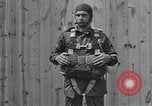
U.S. paratroopers board an airplane and execute a jump in the United States.
A film on general and special training of U.S. paratroopers. Paratroopers equipped with parachute packs and wearing boots, stand at attention in the United States. An officer inspects them. The paratroopers board an airplane. The airplane takes off and is in flight. Interior of the airplane. Paratroopers seated inside the airplane. Aerial view of land. The paratroopers get up and get ready to execute a jump. They jump out of the airplane and descend with the help of parachutes. A building in the foreground. A paratrooper holding a rifle is lying in prone position.
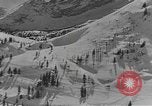
U.S. paratroopers learn skiing techniques and cooking during a training in the United States.
A film on general and special training of U.S. paratroopers. A snow covered area in the United States. The paratroopers learn how to ski and camp in the snow. They hold and prepare the skis during the training. They learn how to walk with the skis. They learn various skiing techniques. An instructor demonstrates skiing techniques to them. They practice jump on snowy mountains. Some of the paratroopers seated on the snow. Other paratroopers learn to cook food. Some of the paratroopers sleep.
U.S. paratroopers jump out of an airplane and ski on snowy mountains in the United States.
A film on general and special training of U.S. paratroopers during World War 2. U.S. army soldiers prepare parachute packs in the United States. An airplane in flight overhead. The paratroopers jumping out of the airplane. They descend towards a snowy mountainous area. They carry arms and ammunition. The paratroopers skiing on the snow in warm, all white winter uniform clothing. A paratrooper holding a rifle is lying in a prone position.
U.S. Navy Fleet Admiral William Frederick Halsey awards the Distinguished Flying Cross to navy fliers in the U.S.
Navy fliers being decorated in the United States during World War II. A submarine crew returns to a e harbor after a victory. They cheer and wave towards people. They repair the submarine. Japanese flags on the conning tower of the submarine. Sailors, navy fliers and officers aboard an aircraft carrier. U.S. Navy Fleet Admiral William Frederick Halsey arrives at the aircraft carrier. He awards the Distinguished Flying Cross to the fliers.