


 Francais
 Deutsch
 Italiano

Refine Your Search
+"United States USA" +1944 stock footage and images
- Showing 85 to 90 of 490 results more
 Hide
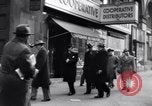
British and American working men on exchange visit meet with labor representatives in the United States (WW2)
Four British working men and their four American counterparts on an exchange visit to the United States enter a building in World War II. They are seen inside, seated at a table opposite representatives of American labor organizations including the American federation of Labor (AFL), the Congress of industrial Organizations (CIO) and the Railroad Brotherhood. During the meeting, one of the American workers states that they had just returned from England. One of the American labor representatives asks the English workers what they think about these exchange visits. They respond in support of them, and note they had an similar exchange with Russians as well. They also discuss international labor unity and its importance in winning the war. The British contingent note that they need more time to meet rank and file American workers to make any assessments. The subject of women filling jobs in war industry was viewed as affecting the lives of all women during the war and afterwards.
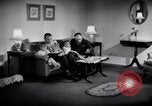
Four British labor exchange visitors return home after several weeks visiting war plants and labor organizations in America (WW2)
A British guest on labor exchange program visit spends his last day as a house guest of his counterpart American's family, in Los Angeles, California. He is seen with the father in their living room with two children, while the mother prepares dinner in the kitchen. The children are sent to bed and the men and the wife, named Ellen sits down to dinner with the two men. The British guest waves goodbye to the family at their doorstep. Scene shifts to another of the British labor exchange visitors leaving the family where he had been hosted in a different city. Next, the four British labor exchange visitors are seen seated opposite representatives of American labor organizations including the American federation of Labor (AFL), the Congress of industrial Organizations (CIO) and the Railroad Brotherhood. They had met them a few weeks ago when they first arrived in the U.S. One of the labor representatives asks them about their impressions of America. They uniformly praise the effectiveness of the U.S war effort, extolling the efficiency and productivity of her war plants. One of the commenters calls for more international unity in the labor union movement. A spokesman for the American labor representatives expresses need to support the United Nations movement. Film closes showing the four British exchange visitors boarding a U.S. Army Air Corps C-54 transport plane to fly them home to England. They are checked in by an airman who wears a leather jacket with the Air Transport Command logo on it. The aircraft is seen taking off and climbing out over hangars at the airfield. (World War II period)

Ford Jeep, with tire chains, driven over rough terrain, up and down the steep hills.
Ford Jeep, carrying Edsel Ford and an army officer, is driven over rough terrain, up and down the steep hills, on a test course. Jeep has tire chains fitted to move on the rough terrain. Large number of jeeps and trucks driven over rough field and up the hill.

Ford M-10 tank destroyer is driven on several terrains in United States.
Ford M-10 tank destroyer is driven on field, road, rough terrain and through a wooded area in United States.

Hollywood actors Robert Montgomery, Clark Gable and Irene Dunne at launch of the victory ship "Carol Lombard" in the U.S.
Launch of the victory ship 'Carol Lombard' to honor the movie star Carol Lombard. Lombard died in the line of duty. A flashback shows the actress Carol Lombard signing autographs for the people. The launching ceremony-US Lieutenant Commander Robert Montgomery and U.S. Captain Clark Gable, husband of Carole Lombard, look as Irene Dunne smashes a bottle against the hull of the ship. Flashback shows Carole Lombard at a show.

Operators and engineers watch and operate controls as airplane propellers are tested in a wind tunnel in United States.
Airplane propellers are tested in a wind tunnel in U.S. In a wind tunnel men work at the propellers of a plane. The propeller rotates. Operators look from the windows in the tunnel. A man walks into the wind tunnel and looks at the controls. Operators and engineers watch and operate controls. Operators study the motion of the propeller in the dark. A lady walks in the front of the tunnel. Her hair blows towards the tunnel.