


 Francais
 Deutsch
 Italiano
Refine Your Search
+"United States USA" +1944 stock footage and images
- Showing 145 to 150 of 489 results more
more Hide
Hide
Views of Japan and its militarism from 1937 through 1943 . Construction of B-29 bombers in the United States
Volcanic eruption and creation of island of Japan. Glimpse of map of Japan. Gardens and rivers. Two men demonstrate samurai sword techniques. Japanese soldiers advance through smoke carrying rising sun flag. Chinese suffering under Japanese military occupation. Two executed with rifles. Japanese soldiers waving weapons and red ball flags. A DC-3 aircraft flying over a Japanese Pagoda. Vies of Old Japan. Farmers at work. One manually turning a water pump with his feet. A man using a pole to propel a boat. Modern methods adopted in Japan for terraced farming. Japanese building railroads. Japanese modern locomotive on South Manchurian Railway. in 1934. A Japanese twin engine bomber taking off. The Japanese ocean liner, Asama Maru, in the 1930s. Glimpse of numerous ships in Tokyo harbor. Western style architecture in modern Tokyo buildings. Neon lights on the Grand Palace Hotel and other establishments in Tokyo. Industrial smoke stacks. Women at work in a silk factory. Finished product stamped "Made in Japan."Steel ingots being made in a Japanese steel mill using scrap iron imported from the U.S.A. Chinese victims of 2nd Sino-Japanese War. Japanese troops on parade. Dead American Marines on shore of Tarawa Atoll in the Pacific in World War 2, killed in battle. Japanese high ranking officers reviewing troops on parade. Japanese warships underway. Troops parading beneath the Imperial Palace in Tokyo. American B-25 bombers on flight deck of the USS Hornet, headed to bomb Tokyo.A crew of Doolittle's Raiders standing by their plane. B-25 taking off from the Hornet. Formation of B-25s in flight. View from bomber of smoke rising from bombing of Tokyo below. Brigadier General Jimmie Doolittle pledging to repeat bombing of Tokyo. Supply train entering a Boeing Company defense plant. United States war production workers being scrutinized as they enter the facility and punching in at a time clock. Poster in the plant picturing a B-29 bomber aircraft on a message in German describing it as an instrument for a "Destruction Battle against the Luftwaffe." Bold letters, above, in English read: "They're Promised-Let's Deliver 'em!" And, below, the words: "B-29, Super Bombers." Slabs of aluminum sheets fill a factory room. Overhead traveling cranes move them. Workers in airplane manufacturing and assembly plant use heat and brakes to shape the aluminum sheets. Multiple views of the aluminum being machined and stamped to specifications. Wings being fabricated. Relatively unskilled labor using jigs to perform the work. Woman war worker operating an overhead crane moving a wing in the plant. Views of plane parts moving across the ceiling via cranes. Women workers driving rivets into wings. Men and women employees working inside fuel fuel compartments of wings. A floor full of engine nacelles. A floor full of 2200 HP radial engines. A skeleton nose section being fabricated. Midsections and bomb bays being assembled. Workers crawling through the airframe during aircraft assembly. A woman working on a connecting tunnel. Sub-assemblies made by contractors arriving at the plant. More views of Boeing employees including young, old, men, and women, at work in the plant.
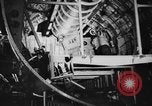
Workers in B-29 plane construction plant give finishing touches to the planes in the United States.
U.S. Army Air Forces film about B-29 aircraft construction in the United States during World War 2. Workers in B-29 aircraft cabin. War production worker stands on stairs and works on the wing of a new B-29 at the factory. Technicians assemble parts of plane. B-29 plane under construction. Completed B-29 planes lined up in plant. Workers give finishing touches to the planes.
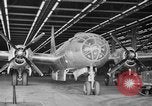
New B-29 plane towed out of a plant and takes off in the United States during World War II.
U.S. Army Air Forces film about B-29 aircraft construction. A completed B-29 bomber towed out of the construction factory during World War 2. Wheels of the bomber. Workers in plant weld, bolt and do other work to complete another B-29 plane. Women and men war production workers seen working in the plant look up and smile on hearing one of the new B-29 aircraft in flight overhead. Aerial views of B-29 in flight. Wing area and tactical gear of the plane. Close-up view of revolutionary flap design that constitutes one fifth of the wing area. Flaps shown moving on the aircraft. Close-up view of landing gear descending. B-29 aircraft lands. View of guns mounted on plane. Pilots shake hands with crew member. B-29 flight crew in briefing to receive information about bombing objective over Japan. Laborers assisting with loading and unloading the aircraft. B-29 taking off and again seen in flight.
The demonstration of guns like M-1 rifle and Sherman tank that can help in the war (WW2)
A documentary titled 'How Good Is A Gun' depicts the importance of good guns in World War II. A valley in North America. Damaged buildings. The rubble and dead bodies in the town. U.S. soldiers carrying guns walk on the rubbles. They are seated and talk about the good guns and weapons. The soldiers smoke and drink. The soldiers enter a building and are seated in a hall. Demonstration of various guns that can help the soldiers in different situations. A soldier firing the light carbines. A soldier fires a M-1 rifle. Fire by the machine guns that makes a hole in the 4 inches concrete wall. Troops in prone position and in the same line as they fire from a BAR (Browning Automatic Rifles) five times faster than a rifle. Two troops fire with a 30 caliber machine gun that cuts a tree. Air- cooled light machine gun that can fire within three miles and cuts the hill stone. Soldiers stand around a 60-mm mortar and fire. They put shell in the 80-mm mortar and fire. Smoke arises due to fire. A bazooka rocket powered and a killer tank. Troops pulls a 37-mm anti tank gun, they fire and look through binoculars. The troops around a 105-mm howitzer. The wooden logs arranged in a heap and are put three miles away. Howitzer fires and the heap being shelled. 155 rifle that lifts the roof of a German plant 15 miles away. Soldiers seated around the rifle. The rifle and the damaged German plant. A view of a war at the Italian Front. Troops pull away into positions along with artillery on the Italian front. They move forward along with the Howitzer,rifles and a Sherman tank.
U.S. troops show their ingenuity by designing new improvised gadgets (WW2)
A World War II documentary titled ' Yankee Noodle' depicts improvised devices and techniques used by U.S. troops to save time. Aircraft parked in a line at an aircraft industry. A man operates washing machine. Men at work on a granite launcher. A man operates a grappling wire used to trip mine. A man holds a cable binder used to put a line. Men on an elephant and put a wire. A man uses oxygen tank and a copper tube being coiled inside an oil drum for making a still for distill water. The water comes out from the tank and used for the battery. Men put the water in the battery. A U.S. aircraft lands. A man works on a gadget that takes only 20 minutes to change the tire of an aircraft. A tire loaded in a trolley and being pulled by a jeep. Three men load tire. Men hold a winch designed to tighten nuts and bolts. Mobile service and repair unit mounted on a truck. Instrument panel mounted behind the driver seat. Men at work on 110 volt generator. A work light, electric grill. A parachute used as an emergency brake for an airplane.
Charles de Gaulle visits Arlington National Cemetery and addresses people of New York City in the United States.
Charles de Gaulle visits the United States. An aircraft lands at Washington National Airport in Washington DC. People at the airport. The leader of the Free French Forces General Charles de Gaulle disembarks from the aircraft. He is greeted by dignitaries. U.S. Army General George Marshall, U.S. Army Air Forces General Henry Arnold and U.S. Navy Admiral Ernest King salute as the French National Anthem is sung. De Gulle also salutes and shakes hands with these and other dignitaries. He gets in a car and leaves for the White House. At the White House he is greeted by U.S. President Franklin Roosevelt, his daughter, U.S. Secretary of State Cordell Hull, U.S. Secretary of the Interior Harold Ickes and U.S. Secretary of Navy James Forrestal. He visits Arlington National Cemetery to pay tribute at the Grave of Unknown Soldier. In Manhattan people line the streets and cheer as De Gaulle's car moves towards the New York City Hall. He addresses the people of the New York City from the top of the RCA Building. (World War II period).