


 Francais
 Deutsch
 Italiano
Refine Your Search
+"United States USA" +1944 stock footage and images
- Showing 217 to 222 of 489 results more
more Hide
Hide
Promotion of war bonds in the United States during World War II.
A film titled 'What If They Quit' dramatizes promotion of war bonds in the United States during World War II. A man carries a box walks out of a building. He tries to convince a man named Joe who thinks that he cannot afford to buy war bonds anymore. Workers work in factories and on an assembly line contributing to war effort. A U.S. Task Force underway at sea. U.S. Marines hitting Pacific island beaches. Naval bombardment on sea waters. U.S. WACs (Women's Army Corps) parade in formation. U.S. troops advance on a beach under heavy fire. The man on the street convinces Joe to buy war bonds and says that if American troops can afford to fight then American citizens can also afford to buy bonds.
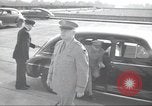
Chief of Staff of the U.S. Army General George Marshall enters Pentagon building in the United States during World War II.
U.S. Army Air Forces Chief, General Henry H. (Hap) Arnold, steps from his car and walks up the steps of the Pentagon, in Washington, DC, the United States during World War II. Chief of Staff of the U.S. Army, General George Marshall arrives separately and enters, carrying a briefcase. Cameramen photograph them entering the Pentagon Building.
Old men voluntarily guard docks and ships for the United States Coast Guard in the United States.
'So's Your Old Man' depicts activities of older American men in the United States Coast Guard during World War II. Recruitment of older men in coast guard service. A doctor examines an old man. The man seated with his wife in his house listening to a radio. He arrives at a building. 'US Coast Guard Volunteer Security Force' written on the top of a cabin. The man talks to other man seated in the cabin. Training being given to the older men. They march. Buildings along a side. The men seated in a class room. An officer explains a model to them. They practice drilling. They hit target boards with pistols. The men in coast guard uniforms stand in formation. An officer reviews them. Auxiliary Coast Guard patrol vessels. Men guard Liberty ships and warehouses. Women give them coffee and doughnuts.
A man instructs a group of army photographers about correct use and functions of a camera in the United States.
A film titled: 'Joe learns the hard way' depicts a training of army photographers in the United States during World War II. A group of U.S. Army photographers carry photographic gear on backs. Joe, an army photographer, walks along with them. They walk inside the building of Signal Corps Photographic Center. Army men put down their gear. They take out their still photograph cameras from the gear and walk over to an instructor. The instructor explains various uses of the still camera equipment. Joe watches the camera. A B-24 Liberator aircraft in flight. Joe takes picture of the aircraft. Interior of a classroom. An instructor gives lessons. Students take notes in the classroom. Students load film in the still cameras both in classroom and in the field. Joe does not pay attention and sleeps in the class. The instructor gives a demonstration with a camera. A blackboard in the background. Interior of the classroom during a test. Joe cheats in the test. He stands near the door of a dark room for developing photographs. A sign near the door reads: 'School Darkroom'. He enters the room. He comes out of the room with pictures in hand. He enters his room and sits on a bed. Joe looks at pictures he took which are not very good.
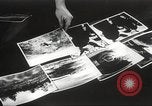
Joe, an army photographer, makes mistakes while taking photographs in the United States.
Activities of army photographers in the United States during World War II. Joe, an army photographer, seated on a bed in his room. He looks at photographs taken by him. He recalls various mistakes that he made while taking the photographs. Men look at a notice board. Joe tries to take their picture. He uses a wrong grip over the camera and stands in a wrong position and takes a picture. Another photograph of a wheel of a car taken by Joe. The photograph was damaged due to bad lighting effect. Joe takes a photograph in a field. A truck arrives in the field. Joe takes the picture but because of wrong camera angle the photograph gets spoiled. Groups of soldiers get into a troop carrier. The troops wave towards people on a shore. A large ship pulls away from a pier. Joe places a slide in a camera. He takes a photograph. He again fails to take the correct photograph. Joe in barracks. He places his photographic gear on his back and walks out of the barracks.
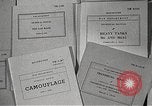
Officials of the ASF train soldiers and discuss strategies in the United States.
A training of the Army Service Forces (ASF) in the United States during World War II. War Department technical manuals. Training of the soldiers. The soldiers in fox holes. They fire rifles in a battlefield. Officials gather around miniatures of railroad yards and warehouses. An officer lectures on supply routes. Entrance to the school of military government as officers file in and out of the building. The officers study in a library and hold brief discussions on the military government. Officials seated at a desk discussing. A wall map in the background.