


 Francais
 Deutsch
 Italiano
Refine Your Search
+"United States USA" +1944 stock footage and images
- Showing 241 to 246 of 489 results more
more Hide
Hide
A German Karabiner 98K rifle is being disassembled and fired by a soldier in the United States.
A film titled 'Enemy weapons : German infantry small arms' demonstrates weapons used by the German Army during World War II. A soldier with a German Karabiner 98K rifle in the United States. Different parts of the rifle including a blade foresight. A soldier sets the safety device and turns the safety lock. The weapon being disassembled. The firing pin being removed. The main spring being separated from the firing pin. The soldier loads the rifle and fires it.
A German MP40 submachine gun being disassembled and fired by a soldier in the United States.
A film demonstrates weapons used by the German Army during World War II. A soldier holds a 9 mm caliber MP40 Submachine gun in the United States. He unfolds the stock. The blade sight of the gun. The soldier pulls the cutting handle. The gun being disassembled as he separates the receiver from the frame lock. The soldier removes bolts and the firing pin. He takes out the magazine. He attaches the bolt in a forward position and fires the gun.
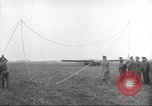
Scenes involving U.S. World War II CG-4A gliders
U.S. Army Glider operations in World War 2. Men set up two poles 20 feet apart on a field, for a so-called "Snatch" operation. (This involves a flying pickup, by an airborne tow plane, snatching the towline of a glider that is still on the ground. It is intended for glider retrieval. The actual operation is not shown in this sequence.) A C-47 aircraft takes off towards the camera, towing two CG-4A gliders. Close view from nearby airplane, of a glider being towed (its tow line visible).

Postage stamps printed commemorating the 50th Anniversary of Motion Picture Industry in the United States (WW2)
Motion Picture postage stamps printed in the United States during World War II. Chairman of the War Activities Committee George J. Schaefer and Assistant Postmaster General Ramsey Black looking at postage stamps rolling off presses. The postage stamps printed at the Bureau of Engraving in Washington to commemorate the 50th Anniversary of the Motion Picture Industry. The men looking at the stamps. Close view of a stamp which depicts a group of U.S. Soldiers in the South Pacific watching a movie. Men standing in a line outside a counter at the New York Post Office collect the stamps. A stamp with 'United States of America' written across the top and '3c, postage' and '50th Anniversary of Motion Pictures' written across the base of the stamp. The first letters bearing New York cachet are stamped. Men stamping the letters. An envelope with a stamp. A signboard behind men at a counter reads 'New York, N.Y., Cachet Applied Here'. Schaefer holding a framed sheet of stamps is flanked by New York Post Master General Goldman and Post Master General Frank Walker. The Chairman expresses his thanks to the Post Master General during his speech at a function in New York. Hollywood stars gathered at a post office to express their thanks. Maria Montez, a motion picture actress, autographs on a giant envelope addressed to the Postmaster General Frank Walker expressing their thanks for his appreciation. A group of stars holding the envelope. Maria Montez with the envelope.
USAAF cargo aircraft C-82 Packet, loaded with troops and tanks, takes off from an airfield in the United States (WW2)
A cargo aircraft in the United States during World War II. United States Army Air Force cargo aircraft C-82 Packet on an airfield. Troops and tanks moving into the aircraft on a ramp. An officer standing beside the ramp. An army tank moving on the ramp entering the aircraft. Several army personnel beside the aircraft on the airfield. The fuselage and the wings of the aircraft in view. The aircraft takes off from the airfield.
A USAAF B-17 Flying Fortress in flight releases a life boat for men in trouble at sea during an experiment in the U.S.
An airborne life boat experiment in the United States. Airmen wheeling a life boat to the under side of a United States Army Air Force B-17 Flying Fortress bomber on an airfield. Fumes rising from a boat at sea during an experiment. The B-17 Flying Fortress bomber, with the life boat underside the fuselage, in flight over the sea. The bomber releases the life boat after spotting the boat in trouble. The life boat equipped with medicines and other emergency supplies is lowered by means of three parachutes attached to it. The life boat reaches the men waiting for rescue.