


 Francais
 Deutsch
 Italiano
Refine Your Search
+"United States USA" +1945 stock footage and images
- Showing 79 to 84 of 405 results more
more Hide
Hide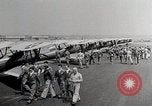
Trainees receive instructions by an officer and a map shows the connecting routes in the United States.
Boeing-Steerman PT-13, Kaydet airplanes in a row at training station.Flight instructors accompanying student pilots to the aircraft. Pt-13s start up, taxi, and one is seen taking off. Pilot trainees are shown a radial engine, by an officer.A student inserts a cylinder into engine block. Pilots from North and South American countries line up in front of At-6 (Texan) training aircraft. they run to their respective aircraft and start them up. Fuselage of one airplane shows crossed flags of United States and Chile. Formation of AT-6s in flight. A map shows airways in America. Another shows them in Central and South America. A map of the world shows the military Air Transport Commands routes.
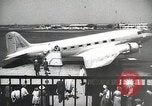
A United Airlines passenger plane equipped with modern, luxurious facilities takes flight in the United States.
Passengers board DC-2 airliner parked at airport. View inside cabin. Baggage being loaded in door under cockpit. Engine starts. Fire extinguisher near wheels in foreground. Aircraft taxis out. "U.S.Mail" painted on tail. "United Airlines" logo on fuselage. View of takeoff from underneath aircraft. Stewardess (flight attendant) passes out newspapers to passengers. DC-2 in flight near clouds. A child watches the plane in flight. Old man watches airplane overhead. First class luxury in flight: A steward in uniform serves passengers as they dine on fine food inside the plane. A steward arranges sleeping berths for the passengers. They climb into the berths. A globe shows the development of aviation.
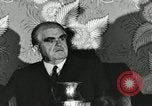
U.S. Labor leader, John L. Lewis, President of United Mine Workers of America, at official function
John L. Lewis, President of the United Mine Workers of America, at an official function. Mr. Lewis listens as he is being introduced by an unseen person.
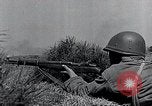
Role of American women in the military; WACS, nurses, and other military roles for women in World War 1 and World War 2
The role of women in the armed forces in the United States. A U.S. Army sniper fires a 1903 Springfield rifle on the Korean front during the Korean War. A woman in the Women's Army Corps (WAC) inspecting such a rifle in the U.S. Several Patton Tanks moving up a hilly road in Korean War. A WAC testing the turret of a Patton tank. U.S. Army women at desks as they work with Army men in an office. Picture depicts Molly Pitcher, wife of a fallen U.S. Revolutionary War artilleryman. Depiction of George Washington at desk. Depiction of Clara Barton, an American nurse with a wounded soldier. Reenactment of Clara Barton working with another women. A man holds the flag of the American red cross. Actual footage of a Wright Brothers aircraft in flight. Women in long dresses pushing an early model of car. A group of American soldiers in World War I running on a battlefield.. U.S. Army troops wearing gas masks and firing rifles from trench in World War I. American women war production workers assembling belts of machine gun bullets during World War I in a munitions factory in the United States. A nurse tending a wounded soldier. A woman nurse helping place a wounded soldiers into an ambulance in Europe, in World War I. Nurses in an operating theater in a hospital during World War I. Women march in victory parade at end of World War I. Women's suffrage demonstration by suffragists (sometimes called suffragettes) in front of the White House and then women and men entering a polling place to vote around time of of 19th amendment giving women the right to vote in 1920. Aviatrix Amelia Earhart climbing down from an airplane. Swimmer Gertrude Ederle on an award stand. U.S. Navy Vought SB2U-2 planes in flight as they drop bombs. Scene of Pearl Harbor attack by Japanese during World War 2. Army nurses look out from deck of ship in World War II. Soldiers fire artillery. View of mountains and scenes of combat on islands in the Pacific during WWII. General Mark Clark awards nurse Silver Star medal. Repatriated Army nurses, who were prisoners, are loaded onto an aircraft by means of a fork lift. In 1942, President Franklin D. Roosevelt signs legislation establishing the Women's Army Auxiliary Corps (WAAC). Secretary of State George Marshall and others witness the signing. Depiction of Godess Athena. Women volunteering for WAAC move in a line carrying bags. American women in military uniform marching. WAAC volunteers being processed. Women receive physical exams and receive inoculations. WAAC personnel being trained: working on X rays, in medical pharmacy laboratories, food service, and radio work. Women on board warships in World War 2.

President Harry S. Truman announces the surrender of Germany, ending World War II hostilities in Europe.
President Harry S. Truman broadcasts to the nation from a desk in the White House, Washington, DC. on V-E (Victory in Europe) Day, announcing that Germany has surrendered to end World War 2, in Europe. He expresses his regret that the late President Franklin Roosevelt had not lived to see the day. Truman calls it a "solemn but glorious hour" and offers thanks to the "providence that has guided and sustained us through the dark days of adversity and into light."
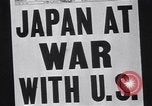
Various newspaper headlines announce war with Japan, guns mounted, airplanes parked in line during World War II.
Newspaper headlines announce U.S. declaration of war on Japan in World War 2, such as 'Japan at war with US'. Supplies moved along a conveyor belt to waiting ships. Arms buildup in the United States as the U.S. enters World War II. Stockpiles of new tanks, Army trucks, and fighter airplanes lined up as U.S. war production increases.