


 Francais
 Deutsch
 Italiano
Refine Your Search
+"United States USA" +1945 stock footage and images
- Showing 163 to 168 of 405 results more
more Hide
Hide
Radio reporter John Charles Daly reports on U.S. Navy in Pacific Front War under command of Admiral Nimitz (WW2)
(Audio only). Radio reporter John Charles Daly reports on U.S. Navy operations in Pacific Front War under command of Admiral Chester W Nimitz in World War II. News about bombardment of Okinawa and attack on Japan by U.S. troops. New York weather report and news about Easter celebrations. News about war in Italy.

Radio news reporter Robert Bob Trout reports on battle of Rhine and General Patton's forces advance in Europe.
(Audio only). Radio news reporter Robert Bob Trout reports on the battle of Rhine and General Patton's forces advancing in Europe. Field Marshal Bernard Montgomery's 21st Army Group overcomes German resistance. Advance of the American 1st Army in Ruhr Valley. He also reports on General Eisenhower's message to German soldiers asking them to surrender. (World War II period).
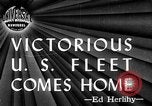
Pacific Battle fleet comes back to United States after victory in World War 2.
The units of Pacific Battle fleet comes back home after victory and end of World War 2. Views in Diamond Head, Hawaii. U.S. Navy sailors aboard ships, returning home from war in the Pacific. Admiral William 'Bull' Halsey speaking to the press. People crowd pedestrian walkway of Golden Gate Bridge in San Francisco to wave welcome to ships in the fleet arriving in San Francisco. Fog partially covers the area. Admiral Halsey on deck of aircraft carrier waving to crowds on bridge. Ships of the 3rd fleet arriving in San Francisco. U.S. Navy Fleet units passing through Panama Canal and stopping to indulge in recreational activities on land in Panama Canal Zone. Sailors on streets of Panama Canal Zone visiting souvenir shops, trying on hats, clowning around, and getting photographs taken. USS Enterprise (CV-6) aircraft carrier leading the fleet and arriving in New York harbor. A view of Statue of Liberty. USS Enterprise at dock. Sailors disembark and walk down walkways to dock. Relatives and families smile and welcome the sailors. People hug each other.

Animated film shows Private Snafu battling a dragon and explains facts about fear to soldiers in World War II.
Animated film targeted at American soldiers during World War 2 talks about fear and the body's response to fear. shows the cartoon character Private Snafu as a knight. He rides on a horseback. He experiences fear as he battles a dragon. The effect of fear on body functions is explained. In danger the nerve messages from the brain stimulate the body for action. Narrator describes effects of nervous system and adrenaline on the body, including more glucose reaching the muscles from blood, improvements in vision and hearing, enhanced ability to run or fight.
Sneak craft used by Germans and Italians in maritime sabotage operations.
Methods and machines used by Germans and Italians in maritime sabotage operations. Some methods used as sneak craft are human torpedoes, midget submarines, explosive boats and torpedo boats, aka Schnellboots or S-boats. Allied ships destroyed by sneak craft. Meditaranean naval sites seen include the harbors at Alexandria and Algiers. Rock of Gibraltar. Dramatization: a swimmer used for sneaking. A man wears tight suit and breathing apparatus. The swimmer in water. The swimmer can remain underwater for half an hour. (World War II period).
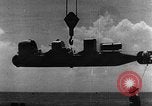
Italian human torpedo used in maritime sabotage operations against Allied ships.
Methods and machines used by Germans and Italians in maritime sabotage operations. One method in sneak craft is the use of human torpedoes. Dramatization: an Italian human torpedo. The torpedo is lowered. The crewmen equip themselves with scuba diving suits and breathing apparatus. They ride on the torpedoes. Detachable warhead attached to the torpedo. The controls and switches of the torpedo. Animation shows the action of the human torpedoes for destruction of ships. Germans use human torpedoes. One man seated on the torpedo. The torpedo dives deep in water. (World War II period).